Showing posts with label Theme Month. Show all posts

Thursday, November 1, 2018

The Final Fantasy of Theme Month (Chocobo's Crystal Hunt)

Welcome back to the final week of Theme Month: Classics with a twist.  This one will actually be posted on the 1st of November, as the last day is Halloween.  
So for the finale, I thought what better way than to review a version on what is probably the simplest and, really, most boring game I could think of.  The game in question: Old Maid, to be rivaled with War.  The game, Chocobo's Crystal Hunt.  Let's see where the hunt takes us.


BACKGROUND: Chocobo's Crystal Hunt is a card game for 3-5 players, and was designed by Yoshihiro and published by Square Enix.  Chocobo's come from the game franchise, Final Fantasy, and are a staple in the game.  Players use these creatures to find crystals, but must look out for monsters.

GAMEPLAY:  Each player starts with a Fat (white) Chocobo, 1 elemental Crystal of their type, and one random card from the deck.  Each turn, a player draws a card, and reveals either a Fat Chocobo or Yellow Chocobo to look at a card in the opponents hand.  If it's a Crystal, the player takes it.  If the Yellow Chocobo was played, the player may continue attempting to find Crystals in any players hand.  If a Chocobo is revealed, the turn ends, and the Chocobo is discarded if it was Yellow, or returns to the hand if it was Fat.


MONSTERS:  There are 2 Monster cards to trigger if revealed.  The fiery Bomb forced the turn player to place a Crystal on the bottom of the deck.  The two one-eyed Ahriman forces the player to reveal their hand to the player that was attacked.

WINNING:  A round ends once any player gathers either all 4 different Crystal Elements, or 6 Crystals.  The player is granted a Victory Token, marked with a crown.  The first player to get to two Victory Tokens wins.

CONCLUSION:  Despite its colorful box, gorgeous artwork, and attempt at something different, this is Old Maid.  That being said, it does try to do something unique and original with its good, bad, and win scenario.  As with any Final Fantasy work, the strongest point is the art.  Square Enix has always pushed the visual aspect of every Final Fantasy piece, and this is no different.  Chocobo's Crystal Hunt is a game that I can enjoy in small bursts with young people, or those who love Final Fantasy, but don't expect this game to blow your mind.  But every once in a while, it's fine to just put on some To Zanarkand, pour a glass of cider, and play something nice and chill.

Wednesday, October 24, 2018

Who Ordered Dominoes? (Pip)

Welcome to the next week of Theme Month.  This time we look into a variation of one of the most well-known games, Dominoes.  Now, there are more variations of Dominoes then there are of almost any game, such as Spinners, Forth-Two, and Threes and Fives, so I had to really narrow it down to the one I thought had the most impact on me, or the one I played more recently, Pip!


BACKGROUND:  Pip is a tile game published in 1991 by Puremco.  It is a variation on the game of dominoes, with a few new twists thrown in.

GAMEPLAY:  Just like in Dominoes, players start with a hand of 9 tiles (15 for 2 players), while the rest remain face-down. The turn plays along the chain of dominoes by matching the same number of dots, or pips, on both sides.  If a player cannot play, they draw from the stock pile, and then must either play a tile or pass to the next player clockwise.

SPECIAL:  Unlike most Dominoes, there are 5 special tiles, which have effects when played, but which still must be matched:

  • Pip: Represented by a P with 3 arrows on the bottom, is a wild and can represent any tile.
  • S: Skip the next player
  • R: Reverses play order
  • A: Gives that player an additional turn.
  • D:  The next player draws a tile from the stock pile. If there's none in the stock pile, the player using the D tile passes a tile from their hand to the next player.


STARTING:  The game starts by any player first playing either the double 1 tile, or the double "Pip" tile, which turns into double ones.  If neither is drawn, one player draws from the stock, and the next player draws until a tile can be placed.  The next player then starts with either a 1 or a pip horizontal to the tile.  The next players then play on either the un-played side of the original domino, or on the previously played domino.  Players are free to play on either side of any domino, or on the top and bottom of the starting tile once both sides of the starting tile have had play.

DOUBLES:  When a Double is played, it is placed vertical to the tile.  Then, unless it is the starting tile, the next three plays must be played on the double using either a corresponding number tile or a wild-pip tile, until it makes a three tile path, which any player may play on.


WINNING:  The round is over when any player runs out of tiles in their hand, or when no player can place a tile from his hand, and the stock pile has been depleted, called blocked.  Players then score the tiles in their hand, with Pips being their number, Specials (besides Pip) worth 25, single Pips worth 20, and double Pips worth 50.  If a player ended with 0 tiles in hand, they score -10 points, to a minimum score of 0. The next round starts with either a double Pip or double 2, with the starting tile being the round number.  The player with the lowest score at the end of the 9th round wins.

CONCLUSION:  Pip is a Dominoes game.  Shocking, I know, but let me explain what I mean.  At the end of the day, even with it's special center piece holder, or its weird tiles, or even its ability to play more tiles, it is Dominoes.  Sure, it may look flashier, but unlike the other games I've reviewed this month, there's not a lot that changes it from just playing Dominoes.  Now, does that mean that you shouldn't play it, that it's just the same game with another skin, like most 'versions' of Monopoly?  Not necessarily.  While it is true that Pip is just Dominoes, it does have enough to be surprising, to stand out that it really is worth a look.  Just, if you want to try it, expect it to be Dominoes, and nothing else.

Wednesday, October 17, 2018

Sorry, Not Sorry (Jokers and Marbles)

Welcome back to Flipping the Table: classics with a twist.  Tonight we'll be looking at the board/card combination game Jokers and Marbles, and then at 5, I will put on a purple thing and dance around.  At 6 o'clock with the news, then at 9, 4 hours of utter black paired with Gregorian chanting.  Ladies and Gentlemen, the game.


BACKGROUND: Jokers and Marbles is a board and card game for 3-8 players.  Originally published sometime in the 1970's, it shares features with Aggrevation and Sorry.  Players move their characters from their start around the board.

GAMEPLAY:  Each player starts with 5 marbles in their home and a hand of 5 cards.  Each turn, the player draws and plays a card.  Players must play a card if they are able, and discard one if they cannot.  Players may never have their pawns pass another pawn they control, but other players pawns are fine.


MOVEMENT:  Aces and face cards (J,Q,K) allows the player to move out of their start.  Ace through 6 moves 1 through 6 spaces, respectively.  7 can move one pawn forward, or split the movement between two pawns to total 7 spaces moved.  8 moves backwards, 9 splits movement like 7, but moves one pawn backwards, and one forwards.  10 and face cards also allow you to move forward 10, and Jokers swap spaces between the turn players pawn and another players.  If a pawn is swapped from Start, however, that other players pawn is sent back to their Start.

TEAMS:  There is also a team mode.  Play normally, with players only worrying about their pawns.  The catch is once a player gets all their pawns to their Home, they now start moving their teammates pawns with their cards.


WINNING:  Just like Sorry, players win by getting their pieces into the Home first, but make sure to be accurate, you can't pass your own pieces in Home either.

CONCLUSION:  Jokers and Marbles has a lot of really strong points going for it, especially when compared to its counterpart, Sorry.  By having a hand, customizable boards to fit up to 8 players, and the ability to play with teammates, their are a lot of options and ways to strategize here.  I do have two points of contention, however.  The first is that if you truly dislike Sorry, I wouldn't hold much hope here, but you should still give it a chance to see just how different it is.  The second is the inability to pass pawns.  Now, while I know the other games do that too, I still think it reduces your ability to play cards, and therefore your options decrease.  Even with that said, I think it's a solid game, and a great replacement to the same game nights.

Thursday, October 11, 2018

Own the Mushroom Kingdom (Monopoly Gamer)

Oh, hello!  This week we look at both this month's theme, and a previous theme.  By coming both Video Games and Oldies with a Twist, we get the all-powerful Gamer Monopoly!  


BACKGROUND:  Gamer Monopoly is a board game for 2-4 players, and was produced in 2017 by Hasbro and Nintendo.  Players take control of Mario and his friends to run around the board a la Monopoly, and fight the bosses, including King Koopa AKA Bowser.

GAMEPLAY:  Like traditional Monopoly, you roll and move your character from the start to buy property with Gold Coins, or other effects based on the board space.  However, players now roll both the regular movement six sided die, and the ability die, which gives them an effect according to the character card.


PROPERTIES:  Landing on a property still requires the player to pay the owner the amount indicated on the card.  Another unique feature is the lack of hotels and mortgage.  Instead of hotels, if a player lands on another players property, they are merely paid double. If a player runs out of coins, they either sell property back to the bank or to other players for a price.  If a player has neither coins nor property, they lose, and are removed from the game.

BOSSES:  Once a player lands on or passes GO, that player flips a Boss card and may fight the Boss by paying its roll cost.  If the player does not meet or beat the number, they lose and pass the opportunity to fight the boss to the next player.  If any player does manage to beat or hit the number, they collect the Boss card.  However, if all players pass and no one manages to beat the Boss, the Boss is removed from the game.

WINNING:  Each property and Boss card has a point value at the end.  When Bowser is either defeated or flees, the game is over.  Players total up their point values on the cards, with every 5 coins worth 10 points.  The winner is the player with the most points at the end, with ties going to the player with more property.

CONCLUSION:  I hate Monopoly.  That might seem like rather harsh thing to say, but if there is a game I dislike over all games, it's Monopoly.  It's long, dull, and uninteresting.  So, when Monopoly Gamer came out, I was...skeptical.  After all, almost all other versions of Mario are the same with a new skin, so why should this one be different.  There's even a previous Monopoly Super Mario Bros.  After playing it, I can say that this version of Mario is enjoyable.  There's a set gameplay end, so I never felt like my time was wasted waiting for 1 player to just finally win with their massive lead.  The elimination rule is also helpful, as is the lack of punishing players with mortgages and hotels.  If there's one problem I have, it's that, in the end, it's still Monopoly.  Sure, it's been vastly improved, but Monopoly is Monopoly, warts and all.  It's still unbalanced, unfair, with uninspired gameplay.  Still, if you are a video gamer turned board gamer, just recognize the theme, or you don't and this sounds good, give it a play.  This is one game that surpasses its brothers by a large degree.

Wednesday, October 3, 2018

Not One, But Two (DOS)

Welcome back to theme month!  This months going to be a little different, so hang on to your butts!  The theme this October is Classics with a Twist.  We'll look at variations of games I normally wouldn't review.  The point of this blog is to get people into games that aren't seen in everyone's closet.  This month, I hope that people can find fun alternatives to those games, and the first one is Dos, the sequel to Uno.


BACKGROUND:  Dos is a card game published in 2018 as a variation on the classic Uno, designed by Nick Hayes for 2-4 players.

GAMEPLAY:  Dos starts with 2 cards in the "center row", rather than just 1 pile.  On their turn, players match either one or both cards in their hand to the cards in the center.  Cards can be matched by Number, with any color, or by Addition, which requires two cards that add up to the top card.  Wild Dos cards count as any colored 2, and # cards count as any number of that color

BONUS:  If a player manages to match both number and color, they play an additional card into the center row.  If a players plays two cards that add up to a number and both match the color, they play a card in the center and all other players draw an additional card.


WINNING:  The first player to get rid of all the cards in their hand wins the round and all point values in each players hand.  Similar to Uno, a player must call Dos when they have exactly 2 cards in their hand, or draw 2 cards as a penalty if another player calls it out on them.

CONCLUSION:  Dos is obviously an attempt to capitalize on Uno's success, like SkipBo or It Came To Pass.  However, the complexity in the rules has changed.  Complex rules, however, do not a good board game make.  The rules feel unnecessarily complicated, especially if they wanted to evoke a game like Uno.  I applaud Mattel for trying something different, and expanding what they're known for, but really, Dos just feels like a flop.  Uno has stayed a staple of card games for a reason, it's simple to learn even at a young age, but Dos isn't, and I don't expect many to enjoy this once-off game.

Wednesday, November 1, 2017

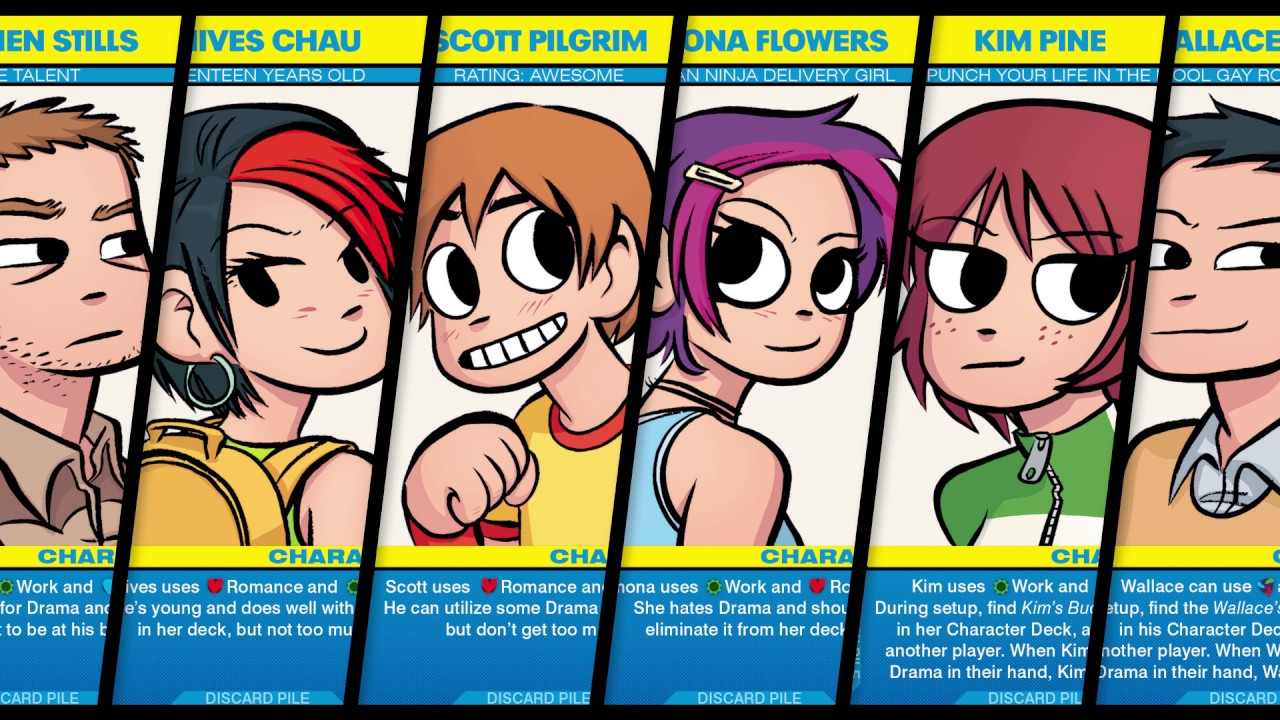
It's the Sex Bob-ombs! (Scott Pilgrim's Precious Little Card Game)

Welcome to the final week of VG Month, a look into Video Games as Tabletop games.  This week, we close off by traveling to the rich, drama filled world of Scott Pilgrim.  But with a successful comic, a well received movie, and a solid actual video game, is there a place in the Pilgrim verse for a physical game?  This is Scott Pilgrim's Precious Little Card Game. 


GAME DESCRIPTION:  Scott Pilgrim's Precious Little Card Game is a deckbuilder published by Renegade Game Studios for 1-4 players.  Players take on the role of Scott and his friends to defeat the Evil Exes.

SET-UP:  Scott Pilgrim is odd in that all the cards are double sided, and players are able to look at both sides of the card in their hand.  In order to set up, each player places their character card and all cards with the characters face in the top right in front of them, shuffling and keeping it face-down to prevent peeking.  Shuffle the remaining cards and place them in two separate piles.  Take 1 Evil Ex and place it between the two decks, applying any effects to all cards.

PLOTLINE:  Now, place the top card from both decks and place them in a column, making 2 rows called the Plotline.  The first player then adds 1 card from the top of either deck to the right of any card, and may also Eliminate, or remove from the game completely, 1 card from the top of the deck.  The next player then does the same, until there are 2 rows of cards equal to the number of players.  Players may not look at the opposite side of any card in the Plotline.  The first player draws 4 cards to begin, while other players draw 5.


ACQUISITION:  Before the first phase, the current player may Eliminate the top of either or both Plotline decks.  Then, the player may play any cards from their hand.  Each blue Story card generates 1 of 3 resources, indicated the top left of all blue Story cards, on the opposite side of Combat.  Cards with the 3 arrows generate any type of resources.  Any card that generates multiple resources can only be used for 1 resource.  These resources are used to buy cards in the Plotline, with their buying price in the top right.  Any card except Challenges can be bought, with Power Up! cards going in front, and any other being discarded.  Once the player chooses not to buy anymore, they discard their hand and may either continue to the fight phase, or skip it and draw 6 cards.

FIGHT:  Players choosing to fight first declare which Challenge card they are fighting and draw 5 cards, using the Combat side.  If the card has a VS Draw, the player to the right draws the number indicated, and places them next to the Challenge, with any Drama cards drawn giving the challenge the indicated bonus.  The player may then exchange any 1 card from their hand with any drawn card. 

COMBO:  On the back of each card is a list of "Combo's", which is given when you play a particular set of cards in a certain order, with the "Button" hit indicated on the top left.  These will give you a specific amount of points against the Challenge when played in the right order.  Then, when a Combo is shown, players may play another Combo below it.  If no Combo's can be played, the player "Button Mashes" by just playing cards, each one with 1 point against the Challenge.  Any cards requiring a specific card must be played before the required card, not after.  If a player Succeeds in matching or beating the number, or Fails by not matching the number, the player follows the effect on the card.


DRAMA:  Each deck starts with a set amount of Drama.  Drama is used only in VS Draw and cards that require Matching Drama, which is when you play that card, you play a Drama with it.

WINNING:  Players win by gathering Victory Points, indicated by the Black Star of certain cards. the player who gathers the Victory Points indicated on the Evil Ex card in the small star wins, or if another victory condition is indicated by an Evil Ex.

CONCLUSION:  Scott Pilgrim's Card Game is a deck builder, complete with deck construction and thinning, Victory Points for winning, battles, and manipulating luck and RNG for your benefit.  If you'd like my opinion on most deckbuilders, go check out my review on DC Deckbuilder.  As for this one, does it stack up against most deck builders, and does it differentiate itself enough?  There are definitely some interesting ideas, such as the combo's, the elimination phase, and the double-sided cards.  The elimination and double-sided provide speed to a genre that, frankly, could use it.  In addition, the ability to solo or play co-operative, while not original to this game, is still a nice variance to this game.  I will say it's kind of a slog to only have 1 boss per game, and getting unlucky still happens in games like these.  But I think it's a simple game with the right theme, and plays pretty smooth, a nice way to round out Video Game Month.

Wednesday, October 25, 2017

Quake: The Board Game? (Adrenaline)

Ladies and Gentlemen, welcome to the future of sports!  Take your very life into your hands of this show, with bullets flying everywhere and no one is safe, not even the audience!  Find the weapons and show the world who's boss!  It's time, Ladies and Gentlemen, to feel the Adrenaline!


GAME DESCRIPTION:  Adrenaline is a board game for 3-5 players for Cranio Creations.  Players take the role of 1 of 5 characters and attack the other characters with various forms of weaponry and rack up kills.

BOARD SET-UP:  Each player takes the 2 board pieces and lay them out on any side combination.  Place 5 to 8 red plastic skulls on the Kill Fshot track located at the top of the board, depending on the length of the game.  Shuffle the small Power-up (indicated by a lightning bolt on the back) and large Weapon (indicated by a gun) decks.  Draw 9 Weapons into each matching gun space on the board.  Shuffle the Ammo tiles and place 1 onto each space marked with a circle inside a square.

PLAYER SET-UP:  Each player takes a double sided colored board and matching Action Tile, with the side with the 8 and the Action Tile with only a "x2" face-up.  Each player also takes their character and matching blood shaped Wound tokens, and 3 of each different colored Ammo cubes into their personal supply, placing 1 of those 3 onto their portrait, or Ammo Box.  Finally, give the first player the Starting Player marker.


SPAWNING:  Players begin their first turn by drawing 2 Power-up cards, and discarding one.  The colored cube at the bottom of the discarded one indicates in which color the player is spawning.  Players spawn in the spaces with a large circle and smaller square next to it, where no Ammo tiles should be placed.

ACTION: Once a player has Spawned, or during a normal turn, they may take up to 2 of the following actions, in any order, or even taking the same action twice.  At the end of the turn:
  • Movement:  Move up to three spaces.  A player cannot move through walls or diagonally.
  • Grab stuff:  A player may move up to one space and grab something.  Players cannot grab and then move with this action.
  • Shoot:  A player must have a loaded Weapon, indicate by being in the hand.
  • Reload:  This action only takes place at the end of the turn, before reserving any kills.
ITEMS:  If an Ammo token is "grabbed", the grabbing player moves up to that many from their personal supply to their Ammo Box.  If there is less Ammo then indicated in the supply, the player moves all that colored Ammo into their box.  If a Power-Up card is shown, that player draws 1 Power-up card, and puts in their hand to a max of 3 cards.  At the end of the turn, replace any Ammo tokens that were taken.  If there are no more tokens, shuffle the discarded ones.

WEAPONS:  If a grab action is used in a Spawn room, then the player may take 1 of the Weapons next to that spawn room by paying its cost, ignoring the top colored cube, and then move any other required cubes from the Ammo Box back to the personal supply.  Add the paid for weapon to your hand.  If a player has more than 3 Weapons, they must discard 1 into the slot from where it was just purchased.  At the end of the turn, replace any Weapon cards that were taken from the deck.  If the Weapon deck runs out, do not replace it.


SHOOTING:  If a player is using a Weapon to attack, it is placed in front of them, following the rules on the card and in the Weapons manual.  If the Weapon has any special abilities or alternate moves, the player may choose to use the ability by paying the Ammo Cubes indicated next to that ability from their Ammo Box.  Then the Weapon is placed face-up in front of the player, and must be re-loaded using the whole cost indicated at the top from their Ammo box at the end of the turn.  Any re-loaded gun is added to the players hand.

POWER-UPS:  A player may discard a Power-up to add its colored cube at the bottom to any cost required.  Power-ups also have special effects to add more damage, Mark a player, or move a player's figure.

DAMAGE:  When a player is dealt damage, that player is given Wound tokens from the attacking player equal to the damage given.  It is added to the damage track from left to right.  Once a player has taken 3 Wounds, that player may now move up to 2 spaces and pick up an item as part of their actions, as shown on the board.  If a player has taken 6 Wounds, they may now move 1 and attack as part of their action, again according to the Wound token.  If a player takes 11 Wounds, they take a Kill shot.  Once a player has taken a 12th Wound, they take Overkill, and any other Wounds or Marks are ignored.

MARKS:  Marks are indicated on certain weapons with a double red circle.  For each Mark, add a Wound token to the top of that players board, for a max of 3 from each player at any one time.  The next time that player does damage, add the Mark to the damage track.

DEATH:  Once a player has taken a Kill shot, they are dead.  If a player gets 2 or more Kill shots, they score 1 more point.  Tip the figure over, and the "dead" player may still be able to take Overkill.  At the end of turn, after Reloading, the players score on any players board who received a Kill shot or Overkill.  The first player who shot gains 1 point.  The player who put the most total damage gains 8 points, as shown on the bottom of the damage tracks.  The 2nd most gains 6, etc.  Any tie is broken by giving the highest points to the player closest to the left.  The other tied player(s) get the number next indicated.  Any players not on the Damage Track or have only Marks do not score any points.


SKULLS:  Once a dead player has been scored on, return all Marks and Wounds on the player, and the killed player takes the Wound token from the Killshot space, and puts it in place of the left most Skull on the Killshot track.  Any Overkill is placed on top, and the dead player Marks the player who caused the Overkill.  Take the skull and place it on top of the highest point of the dead player.  Players cannot gain points from any indicator covered by the skull.  The dead player will now only generate 6 points and lower for their highest score on their next death.  The dead player draws a new power-up card, discards a card and respawns there.  Any previous Weapons or Power-ups stay with the player in the position they were previously.

WINNING:  Players are given Point tokens to represent their points, which are placed face-down on the side of the board.  Score the Killshot track from using the points to the left of the track as you would a dead player.  Once all Point tokens are given and counted, the player with the most points wins.

CONCLUSION:  Adrenaline seems like a rather complex and ambitious game, but that isn't exactly true.  While scoring and setting-up seems complicated, it's not hard once you start seeing the patterns.  There's also more modes with Domination, Final Frenzy, and Bot mode.  Each adds more rules to the game that I haven't even touched yet.  However, there is a lot of replay value to this game just with the amount and combination of Weapons it has to offer.  Adrenaline very much feels like if Quake or a multiplayer Doom were made into a board game.  There's plenty of hectic, wild energy that this game provides.  Again, the amount of weapons is great, but most of the weapons feel different, from melee based scythes and chainsaws to chain lightning guns and shotguns.  The abilities add something unique to guns that might feel the same, as do the power-ups.  A solid game that could easily have come from the First Person Shooter video game genre.
Also, the rules have some real character.  Go read them, even if you aren't planning on playing it.

Wednesday, October 18, 2017

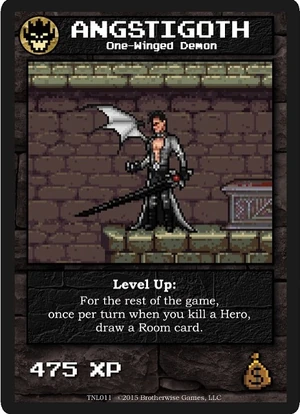
Big bad boss! (Boss Monster: The Dungeon Building Card Game)

Week 2 of Theme Month: Video Games.  This week we're delving down deep into the dungeons.  We're taking the role of the villain, struggling to survive against the onslaught of heroes meant to kill us all, but we'll show them, with tricks and traps and treasure to tempt even the most Nihilistic of adventures.  We are the one and only Boss Monster!


GAME DESCRIPTION:  Boss Monster is a card game published by Brotherwise Games for 2-4 players.  Players take the role of the Boss Monster of a dungeon, inspired by RPG's from 16 bit games.

SET-UP:  The number of Heroes and Epic Heroes you begin with is changes according to the number of players, indicated on the bottom of the Hero cards, i.e. 3 figures represent a 3 & 4 player game. Shuffle and deal each player 1 Boss card, 5 Room cards, and 2 Spell cards.  Each player reveals their Boss card, discards 2 of the remaining 7 face-down. and keeps the rest hidden in their hand.  The Boss with the highest XP goes first, indicated in the bottom left.  Before a players first turn starts, they may play or build a room by placing it face-down to the left of the Boss

BEGINNING:  Draw 1 Hero for each player and place it next to the deck.  Then, each player draws 1 Room card.  No effect can be activated during this phase.  Once all players have drawn, the Build phase begins.


BUILD:  Players take turns placing Rooms face-down in their dungeon, left of the most recent room built, or of the Boss. Players may also build over any room, as long as the bottom right Treasure icon matches in both rooms.  Room cards with a gold icon in the top right are upgrades, and can only be played on another room.  Any ability or Spell with a Hammer may be used in this phase only.  If you choose at any point not to build a room, you cannot build any longer.  Once every player passes, flip every Room card and activate any appropriate effects.  Now, the Bait phase begins.

BAIT:  During this phase, players has a chance to bring Heroes into their dungeon.  Compare the Treasure icon of each hero in the top right with the icon in the bottom right.  The player with the most of that icon brings any and all Heroes into their first Room, according to the order revealed, with any ties and 0's causing those Heroes to stay.  Epic Heroes with gold backing come into play after all ordinary heroes are claimed.

ADVENTURE:  During the Adventure Phase, the first player has their first hero go through the Rooms in order.  Rooms first activate any effects, then deal damage according to the bottom left number to the Hero.  Once damage is dealt, players may activate any ability or Spell card with an Axe.  If the Hero takes at least as much damage as they have health, they die, and the player gains the Hero in their score zone face-down, adding it's Soul value to their point value, indicated at the bottom of the back of the card.  If the Hero survives to the Boss room, the player takes the Hero and puts in the score zone face-up, adding its Wound to their count indicated in the bottom right.  Once all Heroes for 1 player have gone, the next player goes.  Once all Heroes have gone, go back to the Beginning phase.


WINNING:  Any player is eliminated if they end their turn with 5 Wounds.  The first player who ends their turn with 10 Souls wins.  In the case of a tie, or if the Hero deck runs out, subtract each player’s Wounds from their Souls collected. The player with the highest number wins.  If this still results in a tie, the player with the lowest XP value wins.

CONCLUSION:  Boss Monster is a cut-throat, dirty, vicious game that successfully manages to capture the difficulty presented in old Super Nintendo games.  It feels long, but that is mainly due to the fact that it is slow and deliberate.  Once players become familiar with the cards, it starts to pick up.  That being said, especially in 4 player games, there is still a fair amount of down time to be expected.  It's a very methodical, competitive game that captures the nostalgia of old video games.

Wednesday, October 11, 2017

Jump Up, Super Star (Super Mario Bros Power Up)

Welcome back to Flipping the Table: Theme Month.  This month's theme is Video Games.  Over the course of October and the first week of November, I'll look at various games dealing with Video Game themes.  This week we're looking at one of gaming's iconic characters, Mario.  This is Super Mario Bros: Power Up.


GAME DESCRIPTION:  Super Mario Bros Power Up is a card game published by USAopoly for 3-8 players.  Each player has a set of lives that they must avoid losing by using Power-ups and the Levels themselves

SET-UP:  Each player starts with 4 Life tokens, 1 Power-up card in their hand, and everyone is dealt 1 Level card face-down.  The player to the left of the dealer begins.

LEVELS:  Each player may look only at their Level card.  Each Level card has either a number from 1 to 12, or a Castle card, which is flipped immediately.  During their turn, each player may either keep their card, or trade it with the next players card.  Castle cards cannot be traded, so if the next player has a Castle, that player may not trade.  The last player is the dealer, and instead of trading, they may discard the card and draw a new card.

LIVES:  Once every player has kept or traded their card, then flip all cards.  Any players with matching numbers draw a Power-Up card, and the player(s) with the lowest number lose 1 Life token.


POWER-UP:  Power-Up cards are represented by the "?" cards.  Each Power-up has a variety of effects, from raising or lowering Levels to trading with any player, to stealing or eliminating a life from any player.  Each card states on the bottom when it can be used.  Players may not stack, or play multiple Power-ups from their hand onto a card.

WINNING:  If a players loses all 4 Life tokens, they are eliminated from the game.  Once all but 1 player has lost all 4 Life tokens, the remaining player wins

CONCLUSION:  Supposedly, this is based on a standard deck card game.  The Mario theme does strike a resonance with the game, especially the coins representing the numbers on the Levels. and the Power-Up cards.  The mechanics, however, are heavily reliant on luck.  If it were just the Level cards, I'd probably say just skip this one.  However, with the Power-ups, there's a tiny bit more bluffing and chicanery involved to consider playing this.  It's a fairly quick game, which can be made quicker or longer by adjusting the life count.  Not a lot of depth, but something to play with kids or family, and has a bit of strategy enough to come back occasionally.

Wednesday, October 26, 2016

Tick Tick Boom (Exploding Kittens)

Can you hear that hissing?  Can you smell the sulfer and litter mix?  It's getting closer.  Closer and closer until your loss, closer and closer until your dead.  The hissing, it sounds like a bomb, but it's more.  Oh, my dear friend, it is much more.  But that won't matter soon.  The last thing you'll worry about is that kitten, blowing up and ending your life. Watch out for the EXPLODING KITTENS!!!

Image result for exploding kittens

GAME DESCRIPTION:  Exploding Kittens is a card game for 2-5 players.  Each turn players must draw cards and avoid getting an Exploding Kitten.

SET-UP:  Before the game begins, remove all Exploding Kitten and Defuse cards, then shuffle the rest of the deck.  Each player begins with 1 Defuse card and 4 randomly dealt cards.  Shuffle all Defuse cards into the deck, as well as Exploding Kitten cards equal to 1 less than the total number of players.  If there are only 2 players, shuffle 2 Defuse cards into the deck.  Any cards left are removed for this game.

Image result for exploding kittens

CARDS:  Each turn, a player may play any cards during their turn, or end the turn.  Once a card's effect is resolved, you may continue to play cards, or end the turn.  Each player ends their turn by drawing a card.
  • Exploding Kitten:  These black border cards, when drawn, mean an immediate loss unless a Defuse card is played, and discard all cards as well as this card.
  • Defuse:  If a player draws an Exploding Kitten card, they may play a Defuse card.  The player discards the defuse and places the Exploding Kitten card anywhere in the deck they wish.
  • Nope:  If a player plays a card, any other player may cancel it by playing a Nope card, and discard both cards.
  • Attack:  The player who plays an Attack card does not draw, and the next player takes 2 turns in a row.
  • Skip:  The player ends their turn immediately without drawing a card.
  • Favor:  Forces another player to give up a card of their choosing to the player of the Favor card.
  • Shuffle;  Shuffle the deck.
  • See the Future:  Look at the top 3 cards of the deck, and place them back in the same order.
  • Kitten Cards:  These cards have only images on them, and must be played as a matching combo of 2 or 3 of a kind.

Image result for exploding kittens

COMBOS:  Combo's are advanced rules which, when played correctly, ignore the text on the card and are instead applied accordingly.
  • 2 of a Kind:  If 2 matching icons (located at the top left) are played, randomly take 1 card from any opponent.
  • 3 of a Kind:  If 3 matching icons are played, name a card from a specific opponent.  If they have it, it's now yours.  If not, nothing happens.
  • 5 Different:  If 5 different icons of any card are played, you may take any 1 card from the discard pile and add it to your hand.
WINNING:  When an Exploding Kitten is drawn, and the player does not or cannot play a Diffuse card, they are eliminated for that game.  The game ends when there is only one player left.  They are now the winner.

CONCLUSION:  Exploding Kittens is a card version of Russian roulette, plain and simple.  The randomness nature of the game will definitely put off more than a few people, but the simplicity of the rules combined with the fact that the game is random gives most players a chance to win, even if they play 'badly'.  It makes for a great intermission game for longer gaming sessions and wind downs on game nights.  It's a fun, enjoyable little game that both younger and newer players can pick up.

Wednesday, October 19, 2016

That Rabbit's Dynamite (Killer Bunnies and the Quest for the Magic Carrot)

Round and Round the Bunnies go,
Shot at and Burned and Turned into dough,
magical carrots are sought from afar
while Bunnies are Drowned in pits of tar,
all while we Watch
and Laugh.

Image result for killer bunnies

GAME DESCRIPTION:  Killer Bunnies is a card game developed by Playroom Entertainment for up to 8 players.  Each player attempts to find the Magic Carrot card that determines the winner.  Each player also attempts to gather Bunnies and keep them alive, while eliminating and killing other players Bunnies.

SET-UP:  The main deck and Carrot cards are placed in the center, next to the Starter Card: "Kaballa's Market".  Each player starts with 7 cards in their hand, and will always have 7 cards in their hand, minimum.  Place the small green Cabbage and blue Water cards in the middle, and place the small orange Carrot cards off to the side.  Then, each player places two cards horizontally in front of them, in a single column.  This is your run, and you should always have 2 cards in the run at the end of your turn.

RUN:  At the start of the turn, each player flips the top Run card over, and moves the bottom Run card to the top.  If it is a Bunny, it is played in front of that player, to the side of any other Bunnies (think of playing the Bunnies in one big circle).  Some cards cannot be played without Bunnies.

Image result for killer bunnies

IMMEDIATE:  If you get a Play Immediately card, it is played and resolved right away, regardless of turn order.  If you get a Kaballa Dolla, it is placed in face-up front of you.  Kabala Dolla's are spent before you reveal your top Run card at the Market.  Then, draw back up to 7 cards.

DEATH:  Most Play Immediately, as well as any successful Weapon cards and other various cards will Kill or Eliminate a Bunny.  Killed Bunnies go to the discard pile, and all other Eliminated Bunnies (such as Abduction) are placed where the card's effect states.  All cards have a small pink or white rectangle on their left side.  If a player has no Bunnies when any card with a pink rectangle is revealed from the Run, that card cannot be used, and is discarded as play continues.

SPECIAL:  Some cards have Special or Very Special at the top instead of Run.  Special cards may be played before you play your top Run card as well as in your Run.  Very Special cards can be played at any time from your hand, or in your Run.  Any Special or Very Special card in your run may be played off to the side to be played at any time.

Image result for killer bunnies

DICE:  There are various colored dice used in Killer Bunnies.  On the right side is a column of boxes, sometimes no colors, one color, or a bunch of colors.  The colors indicate which colored die or dice you roll.

TRIPLETS:  If a player has 3 Bunnies of the same color or name, they then play the 2nd card in their run at the time of the reveal.  Then, both cards in their Run are revealed during their turn, and place both cards in their Run instead of just 1.

WINNING:  Once the last player has bought or chosen the last Carrot card, the game is over.  If any player does not have a Bunny in play, they must give all their Carrot cards to the player with any Bunny and the most Kaballa Dolla left. A player then takes the small Carrot cards and reveals them one at a time.  Each time a small Carrot is revealed, the large corresponding Carrot card  is eliminated and turned face-down.  The last Carrot revealed determines the winner.

CONCLUSION:  The best way to describe this game is Rabbit Russian Roulette: The Card Game.  It is incredibly easy to lose your Bunny right before the game ends, or not get a Bunny for most of the game.  Still, the luck factor makes it so that even if you only get 1 Carrot the whole game, you can still end up winning, making it possible for even beginners and first timers to come out winning.  There are very few games where newer players have a chance to come out ahead, making this a rather strong recommendation.  Plus, the wacky build-up and planning ahead don't feel gimmicky, and the cultural references are all over the place, from puns like the Holy Angle, to the more obscure Red Dwarf reference in the Holographic Bunny.  This game is silly, luck-driven, and a whole lot of fun for the whole family.

AFTERTHOUGHTS:  One of the difficulties reviewing this game is the Expansions.  With the edition I played having one built in, and a dozen expansions, the gameplay has altered from one version to the next.  Still, with the extra cards and rules I've played with, the game changes a fair amount, allowing the game to have more life just from including or excluding a version of it.

Wednesday, October 12, 2016

Flying Through Udder Space (Cosmic Cows)

Log entry 5978:  The Earth creatures known to the locals as "cow" simply fascinates us.  They seem so unaware and accepting of their fate when we abduct them.  So, while waiting for our Commander, we have decided to play a game, seeing who can capture the most.  Sub-Commander Draub wants to call it Space Cow Chess, but that's stupid.  We've agreed on "Cosmic Cows" until a better name can be chosen.  So for, I'm winning.

Image result for cosmic cows

GAME DESCRIPTION:  Cosmic Cows is a 2 player dice game published by Playroom Entertainment, and created by designed by Maureen Hiron.  The object is to move Cows from the center of the board to your "Win Zone".

SET-UP:  Set the board between both players.  Place the 9 Cows in the middle of the board, on the green "grassy" area. Each player is given a set of 5 matching dice.


MOVEMENT:  Each turn, players roll their set of dice up to three times.  Between rolls, they may set aside/re-roll any amount of their dice, and roll again, or stay with their current roll.  Cows move closer to the player who rolled according to a specific roll (similar to Yahtzee):

  • Pair:  Move the cow on the board in the column that matches the number you rolled 2 spaces towards you.
  • 3 of a Kind: Like the Pair, but move 3 spaces instead of 2.
  • 4 of a Kind: Like the Pair, but move 4 spaces instead of 2.
  • Two Pairs:  Move the two cows in the columns that match the number you rolled 2 spaces each.
  • Full House:  Move the cow in the column that matches the number of the pair you rolled 2 spaces, and the other cow that matches the number of the other dice you rolled 3 spaces.
  • 5 of a Kind:  Move the cow in the Super Beam Column closest to you.
  • Small Straight:  Move the cow in the Straight Column 3 spaces
  • Large Straight:  Move the cow in the Straight Column 4 spaces
  • Chance:  If no other conditions can be fufilled, or the player wishes to move this cow, add up the total number rolled.  If the total equals 10-12 or 23-25, move the cow in the Chance Column 3 spaces.  If the total equals 5-9 or 26-30, move 4 spaces.
WIN ZONE:  Each player has a Win Zone, indicated by the red spaces on the board.  When any player gets 3 cows in their Win Zone, they win the game.


CONCLUSION:  Cosmic Cows is like Space Yahtzee, in a way.  It can be fun to play through once, but due to it's reliance on luck and basic rules, it's hard to recommend after a couple playthroughs.  The fact that this game is for only 2 players makes it limited in where and with whom you can play this. This game would work great for kids who want something with a little more visual feedback than something Yahtzee or Farkle can provide.  It's a good choice to play a round if you're looking for something a little more intimate with someone close to you.

Wednesday, October 5, 2016

Anyone for Furry Smoothies? (Kittens in a Blender)

October marks the start of Theme Month, where each review will revolve around a single theme or concept.  This year, the theme is "animals".  The month will begin with a nice glass of blood, fur, and cat spirits, as we blend up our first game: Kittens in a Blender.  Just, watch out for any dogs wandering in.

Image result for kittens in a blender

GAME DESCRIPTION:  Kittens is a Card Game designed by the Brothers Knudson for 2 to 4 players.  The object is to amass a furry pile of cats in the Box, while killing off your opponents with the Blender.

SET-UP:  The over-sized Blender card is placed face-up in the box top, and set in the middle of the table.   The base of the box is placed next to it.  These will be the Blender and the Box, respectively.  The space in between is the Counter. Each player then selects of a color, designated by the background of the Cat cards.  Then, each player is dealt 6 cards.

Image result

PLAYING:  Turns consist of playing 2 cards, applying their effects, and drawing back up to 6 cards. If the deck ever runs out, play continues without drawing:

  • Kittens:  A kitten may be played in the Box, the Blender, or on the Counter.
  • Blend!:  When this is played, all Kittens in the Blender are removed for the game, all Kittens in the Box are saved, and all Kittens on the Counter are moved to the Blender.  Saved Kittens count towards your total point value at the end.
  • Blend Pulse:  Similar to Blend, with the addition of cancelling a Blend card.  Blend and Blend Pulse cards stay in front of you.
  • Kittens on the Move:  Move a specified amount of Kittens the specified amount of spaces (if it says 1 space, you can move the Kittens from the Box or the Blender to the Counter, or vice versa, but you cannot move the Kittens from the Box to the Blender, as that is considered 2 spaces.)
  • Dogs in the Kitchen:  Every players hand is rotated to the appropriate player.
  • Kittens in the Blender/Box/Counter:  All Kittens move to the place the card specifies.
  • These Cats in the Blender:  Move all Kittens of a specified color to the Blender.

Image result

SCORING:  The game ends when all 16 Blend and Blend Pulse cards have been played.  All saved Kittens are worth 2 points, and Blended Kittens are worth -1.  In the case of a tie, a winner is decided by whomever has the most Blend and Blend Pulse cards in front of them.

CONCLUSION:  Kittens in a Blender sounds like one of those twisted games that can't help but get a laugh from how messed up the concept is.  Yet, the game plays simply, fairly quickly, and gets a laugh in a good way.  The art is so cute and appealing, and really gets what it was going for.  This game does require you to be okay with having vast amounts of luck and RNG be against and with you.  The games time requirements makes it easy to play multiple rounds if you just keep losing.  Kittens in a Blender can make for a great, silly time with some close friends.