Showing posts with label Board. Show all posts

Wednesday, August 14, 2019

A Bone Chilling Experience (Dead of Winter: A Crossroads Game)

The blizzard blinds you, freezing you to your bones.  Your feet crunch the snow, each step slower and slower as you put your arm up to block the incoming flurry so you can see.  The faint groan makes you stop.  You have a choice, do you continue and hope to find food so your colony can survive this nightmare, or do you retreat to avoid whatever that was?  You pray that it wasn't a zombie as you press on, the need for survival strong.  The groans get louder, and you move faster.  You hope you can outrun them, but you fear the worst.  This is the zombie apocalypse everyone was warned about, horror made real in the Dead of Winter.


BACKGROUND: Dead of Winter is a co-operative board game created Jonathan Gilmour, Isaac Vega in 2014, and published by Plaid Hat Games.  Take the role of the last survivors of a zombie outbreak, with starvation, traitors, and frostbite as a few of the many threats throughout the game.

GAMEPLAY:  Starting with the first player, each player takes their turns in order.  The player to the right of the starting player draws and reads a Crossroad card, reading the italicized to themselves to check if it applies.  If at any point the italicized is true during the players' turn, they read the card out loud.  If its a numbered option, the player chooses, but if it's thumbs up/down, all players vote to determine the outcome.  If the italicized text is never true during that players turn, it goes back to the bottom of the deck.


ACTIONS:  During their turn, players may play any amount of cards from their hand, or put them in the crisis deck, move once per turn to an available location by rolling an exposure die to determine if they get a wound, request a specific item type to use immediately and not into the Crisis deck, give equipped items to a survivor in the same location, spend food to raise the value of a die, or use any of the players survivors that do not have a number.  A player may also choose to vote a player to exile, preventing that player from returning to the Colony.

ACTION DIE:  These actions require moving a die from the pool to the unused pool.  A player can remove the top 3 waste cards, barricade a location to prevent zombies from coming, move 2 zombies from a location to that survivors location.  By spending specific numbers, players can use certain survivors abilities.  By spending a die equal to or higher that the Search rating or Attack rating on the survivors card, the player may respectively search a location they are at by taking the top card or placing a noise token to keep searching, or attack a zombie or survivor at their location. 

COLONY:  At the end of all players turn, the colony turns happens.  First, the colony, if possible, spends the food in the supply equal to the number of Survivors and Helpless Survivors in the colony divided by 2 (rounded up).  If not possible, the colony instead adds a Starvation token into the food supply and morale decreases by the amount of Starvation tokens.  Every 10 cards in the waste pile decreases morale.  Shuffle and reveal all the cards in the crisis deck.  Every card meeting the crisis requirement adds 1 to the success, every card not meeting it subtracts 1.  If the number is matching, the crisis is averted, but if not, the effect on the crisis triggers, and in both cases all cards contributing are discarded. 

ZOMBIES:  Zombies are added to the colony for every 2 Survivors and Helpless Survivors there, and are added to each location for every Zombie and Noise Token there.  If there are more Zombies than locations, it's discarded, and the survivor with the lowest number in the top left rolls the d6 for each additional Zombie being added.  If the roll is 3 or less, that survivor is killed.  Then the round tracker goes down by 1.


DEATH:  Death is real here, and punishing.  Survivors die after 3 wounds or 1 bite, with equipment shuffled into the deck of the location they're at, or just dropped in the colony.  That player loses a die, until they are down to 2.  If a player loses all their survivors, they discard their hand, draw a new survivor and place the character on the board in the colony.  If a survivor is bitten, they lose that survivor, the Morale tracker goes down by 1, and the player with the lowest influence on the board rolls to either survive or die and keep the spread going in that location, or die to end it. 

EXILE:  If a player is exiled, they draw the top card of the Exile deck and reveal their secret objective if they weren't the Traitor, and are given a new secret objective.  If they were, they don't reveal, and their secret objective is slightly altered.  All of the exiles survivors are moved immediately to any available location, rolling the exposure die.  They cannot add cards to the crisis or Helpless Survivors to the colony, move to the colony, or use food tokens to adjust their die, only using food cards in their hand in the same manner.  Any cards added to waste by the exile are removed instead, exiles cannot vote, and the morale doesn't go down if their survivors die.  Morale drops to 0 if 2 non-traitors are exiled.

WINNING:  After the zombies are added, the game ends if the Main Objective is cleared, or the Morale or Round tracker hits 0.  In addition, each player is dealt a secret objective to complete before the game ends to win, some of which are traitors to act against the party.  If the player completes their secret objective, they win.  If not, they lose.

CONCLUSION:  Ho boy, that's a lot of explanation.  I usually try to summarize the rules for background, but this time was harder to do without losing the idea of how things worked.  I feel like this game kept saying "but what about this situation".  This is an interesting game about team-work, unity, and sacrificing for the betterment of the group.  However, while I find the game fun for its strategy and cooperation, it's also nerve-wracking and mentally exhausting.  Not only are the rules deep and complex, in game they are just as difficult to master.  I like this game as I like This War of Mine, it's interesting, and there's some choices that make it 'fun', but this is easily a game that can split opinions, and a game that leads you to a crossroads makes it difficult to recommend to all players.  This is for a specific group that can make it fun and be focused on it, but due to length and difficulty, it's really only for that group. 

Wednesday, July 31, 2019

And It Burns, Burns, Burns (Flash Point: Fire Rescue)

*WOOOOSH*
The blaze of the fire intensifies, surrounding you.  A faint cry is barely heard over the flames.  You rush through the fire and the flames to find the victim, putting out the fire as you go.  The walls grow weaker, leaving the house even worse for wear.  There, in the smoke, you get closer.  As you step through, you see...nothing.  It was all a trick of the smoke, there was nobody here.  You walk past, putting out more fires.  That's the role of the firefighter, putting out fires and rescuing people.  That's Flash Point: Fire Rescue.


BACKGROUND:  Flash Point is a co-operative board game for 2-6 players, created by Kevin Lanzing in 2011, and published by Indie Boards & Cards.  By working together, players attempt to put out fires, save victims, and keep the building from collapsing.

GAMEPLAY:  Each turn consists of a player taking 4 AP (Action Points).  Action Points can be used to move through spaces, open and close doors, put out fires, and chop through walls.  Depending on the action, each takes 1 or 2 AP.  If a player doesn't use all their AP on their turn, they can save it, up to 4 at most.  Scattered throughout the house are face-down POI markers, with "?" on them.  Whenever a player lands on these tokens, they are flipped face-up.  If there is nothing on them, they are discarded.  If there's a person or animal on them, they are now Victims, and must be taken out of the house.


FIRES:  At the end of each players turn, the player rolls the red and black dice, and puts a smoke token based on the roll.  If there's one there, it flips and becomes a fire token, instead.  If that's already a fire, an explosion occurs, spreading fire in each direction.  Explosions can cause players to get knocked down, kill Victims, and destroy doors and walls.  Finally, if there are less than 3 POI and Victim tokens in the house, roll to replenish the house to up to 3 POI tokens.

ADVANCED:  Now that the base rules are set up, there are more things to introduce.  Each player is given a character card, which can change how many AP they get each turn, and how much certain actions cost.  There are also vehicles, an Engine and an Ambulance, which can be used, and driven to certain points on the board for AP.  Players now have to get the Victims to the Ambulance.  The engine can be used to put out fires easier, but only within a single quadrant.


DANGERS:  There are also more bad things that happen in the advanced rules.  Hazmat tokens immediately cause explosions, and can be carried out of the house.  Hot spots are used to not only simulate where fires would be hottest, but when a fire lands on a hot spot, the player keeps rolling for more fire.  They cannot be removed from the game, but do not change the tokens if a hot spot is added to a space with a smoke/fire token.

WINNING:  To win, the players must get 7 Victim tokens out of the house before all 24 damage markers are placed on the house's walls, or 4 or more Victims are killed or lost.

CONCLUSION:  Ho, boy, this game is a doozy, in a good way.  This is exactly how a co-operative game should be, difficult enough that the victories, even the small ones, mean something.  Everything is high stakes, working together means coming up with a plan you all follow and can execute without one player suffering for not communicating with the team, and that smidge of luck that can make or break a plan that you can't quite account for.  Now, this is based on the advanced version, and that can put a lot of pressure on people.  The basic version is a bit more friendly and open, and makes the game a little easier to win, but not less stressful.  Kids, never run into a burning building unless you're a professional, but do run to your local game store and buy this hot game.

Wednesday, July 24, 2019

Floating down the Nile (Imhotep: Builder of Egypt)

The sharp crack of the whip echoed throughout the dry Egyptian desert.  The stone, massive in size, was being pushed, pulled, and carried by hundreds of slave-workers.  You look down at the carving you made, and back towards the pyramids.  Soon, the pharaoh would choose who would create and design their masterpieces.  You put everything you had into these designs, so that you would be remembered like Imhotep, the Builder of Egypt!


BACKGROUND:  Imhotep is a puzzle board game for 2-4 players.  It was created in 2016 by Phil Walker-Harding, and published by KOSMOS.  Each player ships stones by boats to build various monuments.

GAMEPLAY:  Each turn,, a player can take 1 of 4 actions.  They can take 3 Stone cubes from their 'Quarry' off to the side, and place them on their Sled board.  Each sled can only hold 5 stones, so if there are more stones then there is room, players return the excess back into their Quarry. Another action players can take is to take a stone from their Sled, and place it on one of the boats set out at the beginning of the game.  Players may also sail a boat as their action if the number of stones is equal to or greater than the number indicated on the front of the boat to one of the 5 site boards.  Finally, a player may play a blue Market card as their action that turn.


WINNING:  Once a boat has sailed to a site, other ships cannot sail there.  Each site has a different requirement, such as players getting points for their position, or being the tallest at the end of the game.  At the end of the round, players score points, kept track of on the scoreboard, and draw a new boat card to show what boats are available this round.  Once the game is over, players total up any remaning points to determine the winner.

VARIANTS;  Each board has 2 sides.  While this review only mentions the A side, the B side has its own rules and twists on the game.  In addition, there is also the rule that players are docked points if they fail to deliver at least one stone to each place.

CONCLUSION:  I really enjoy Imhotep.  It's a purely strategic game, plain and simple.  There's so much thought and fore planning that goes into it that makes the game fun and thought-provoking.  True, the market cards are dealt randomly, so there is that element of chance, but even that is a matter of strategy and risk-reward decision making.  This game can get overwhelming, so it's easy to see why it would be difficult for some players to enjoy this game.  Because of its lack of luck elements, it does lead to players who aren't as strategically minded to be defeated more often due to lack of skill or "lucky" balancing maneuvers.  If that's the case, try to play this with people at your skill level.  It's hard, true, but if you can, it's one trip to the Pyramids you should take.

Wednesday, July 10, 2019

2,000,000 Years in the Making (CroMagnon)

Ugga, Ugga tooga nah.  Ugga tooga chaka sha.  CROMAGNON!


BACKGROUND:  Cro-Magnon is a party game for 3-12 players.  It was created by Fanny Cherpe and Olivier Mercier in 2007, and published by KOSMOS.  Players adopt the persona and tribes of the Cro-Magnon to give information to their fellow people.

GAMEPLAY:  Each turn, the player(s) will act out their "YooDoo" on their tribal, and then draw a Word List card from the pile and try to get the other players to guess the word on the card according to their Age/space.  However, communication is limited based on the Age the player(s) is at.  Anytime a player makes a guess, the acting player(s) can say "Naga" for off/no, "Yaga" for close/yes, and "Binga" for correct.  That player(s) can then draw a new card for the rest of the players to guess.  Every correct guess before the timer runs out grants that player(s) 1 space, for a maximum of 5.

AGES:  The space the player(s) start in on their turn determine how they convey the information on the cards.  The red space is only miming and grunting.  The yellow space uses modelling clay, and while creations are allowed to be moved, miming or noises not allowed.  The
Orange spaces uses the "Primitive Language" sheet, requiring the player to try and describe the card using only these words.  Finally, the Green spaces has the player(s) drawing with a charcoal stick, and no miming, talking, or writing.


WINNING:  The winner is the player who makes it to the end of the board.

CONCLUSION: This is a party game like Cranium, or Whirled Peas, but with a twist.  It restricts the player in a way to come up with something kinda clever, but at the end of the day, it still has the same audience and restrictions that the others have.  The only thing really going for it is the theme.  If that's enough for you, great.  However, this is one caveman who is going to evolve into more interesting games.

Wednesday, June 19, 2019

Ruler of the Islands (Kahuna)

HELLO!  I was the previous ruler of this island, and yes, it does look like a hand, deal.  But I have grown tired of the crown, what with the remaining on the island, the treasure, the neighboring war, and the tribute.  So, I have decide to leave, to adventure and explore beyond the horizon, and will name you the next ruler of the island.  And don't worry too much about that war I mentioned, they only want control over all the islands.  Have fun being the next Kahuna!


BACKGROUND:  Kahuna is a strategy board game for 2 players, and was created in 1998 by Günter Cornett, and published by KOSMOS.  2 players attempt to take control of the most islands in a game of strategy and timing.

GAMEPLAY:  Each turn, the turn player may play up to 5 cards from their hand, or secretly discards 1 or more cards under the discard pile.  A player may choose not to play or discard any cards.  When a card is played, the player puts a Magic Bridge token from the island printed on the card onto a dotted line connected to any neighboring island.  The player may then draw 1 card or pass, discarding 1 or more cards if they have 5 cards in their hand.  If a player chooses to pass, the opponent must draw on their turn.


ISLANDS:  Once a player has more than half of their Bridges on an Island, they take control of that island, marked with a players Kahuna Stones, and remove all of the opponents Bridges connected to that island.  A player may also remove an opponents Bridge by playing two cards that only name 1 of the 2 islands the Bridge is connecting.

ROUNDS:  The game is played in 3 rounds.  When all the cards have been taken, the player with control of the most islands scores 1 point in the first round, or 2 points in the second round, with no points scored on ties.  All cards in a players hand, as well as all Bridge and Kahuna tokens, remain.


WINNING:  On the third round, the players count how many islands they control, and the player with the most scores the difference between both players' scores.  Scores from all 3 rounds are added up, with the player with the most points winning.  Ties are broken by \whoever scored the third round, with a tie there broken by who had the most bridges at the end.

CONCLUSION:  Every time I play Kahuna, I start out liking it.  There's a huge strategy element here about when to take cards, when to make your opponent do so, where to play and what to discard.  The game is incredibly promising, then the 2nd round starts.  The scoring isn't too bad, but it's the games utter lack of care about who's in the lead that's the problem.  Once a player is far enough ahead, they enter what I like to call Psuedo-Star Mode.  Like the Power Star in Mario, once a player is far enough ahead, it really doesn't matter what you do, and that's the problem.  Rather than start fresh, or give the player falling behind any advantage, the board state remains the same.  This means that a player who is winning will likely continue to win, because they already have a lead on the opponent.  Even if the other player somehow manages to take the lead the next round, they now have that huge lead on the opponent.  I like this game, but I only want to be the Kahuna in one shot, not three.

Wednesday, April 3, 2019

The Case of the Mysterious Mr. X (Scotland Yard)


FOR YOUR EYES ONLY:
Eyewitnesses have recently informed us that the criminal, only known as Mr. X, has been spotted in Central London.  As you know, this vagabond is wanted for such crimes as Grand Larceny, creating selling Forgeries, and disrupting the police force (seriously, none of us could stop laughing when Constable Harpers put his helmet on and out fell a dozen glazed doughnuts).
It is up to you to find and catch this hoodlum and place him behind bars.  We have seen to pre pay for your local transport tickets, as Mr. X's latest crime was sabotaging all our vehicles.
Scotland Yard's honor and reputation rest entirely in your hands, detectives.


BACKGROUND:  Scotland Yard is an asymmetric board game for 3-6 players.  It was first released in 1983, by Manfred Burggraf, and has since been published by Ravensburger Spieleverlag GmbH, Milton Bradley, and others.  One player takes the role of Mr. X, and sneaks around avoiding the rest of the players.

GAMEPLAY:  Each player has a set of tickets, with Mr. X having a different set than the other players.  On their turn, starting with Mr. X, the player uses one of their tickets to move along a path that they are connected to (e,g,, using a taxi ticket moves them on the road, but a bus ticket moves them along the bus line).  The detectives are seen, and move accordingly, but Mr. X is different.


X:  Mr. X does not use a pawn right away.  Instead, the player controlling him writes the path he follows on the Travel Log, and covers it with their ticket instead of returning it to the box like the players.  Mr. X can also double move (taking his turn twice) or throw off the players with black tickets, which count as any type of ticket. On the 3rd, 8th, 13th, and 18th position, the player puts the clear pawn on the space Mr. X ended up on to indicate where he is at that moment.  The piece is removed the next turn.  Mr X also cannot run out of tickets, and if that player ever needs tickets, they are allowed to use tickets in the box.

WINNING:  Mr X wins if he has successfully evaded the detectives long enough that they cannot move anymore, or reaches the last space in the Travel Log.  The Detectives win whenever they land on a space that Mr. X is already on.

CONCLUSION:  This game is a lot of fun, but it can be tricky and frustrating.  I think the biggest problem is when you are playing as Mr. X.  Because most players can't see where Mr. X would be, it can become tempting to cheat.  Mr X needs to be an honest player, who can lose gracefully, and more importantly, will remember where they are.  That's the biggest struggle; not players who cheat, but players who get lost as Mr. X.  There were a few times I just lost where I was.  Sure, you can look at the last place you were on the map, but at least in the version we were using, it was a pain to get it out, and it slows the game down when doing so.  That being said, it can be frustrating and mind-racking trying to find where Mr. X is, but it's also an enjoyable puzzle and rewarding if you do.

Wednesday, March 20, 2019

Disease {Name} is Spreading! (Pandemic)

We attempt to treat spreading viruses all the time, but a new plague has entered the scene, leaving the public baffled at what to expect.  At first, it seemed harmless enough, merely taking away a couple hours out of a few groups lives, but it was infectious.  It grew quickly, spreading and affecting thousands of people.  Medical professionals are uncertain of how it will grow next, but as it has spread over land, sea, air, and Steam, there is one name everybody recognizes it by: Pandemic.


BACKGROUND:  Pandemic is a co-operative board game for 2-4 players.  It was created in 2008 by Matt Leacock and published by Z-Man Games, Inc., among others.  Known as one the most successful board co-operative games, players take the roles of various research heads to fight against brand new diseases while they spread quickly across the world.

GAMEPLAY:  Each player has 4 actions during their turn. Players take their turns by moving across the world via train, or discarding a card to move by plane.  They can trade if either player has the city they're in by trading said city, treat the disease by removing cubes located on their city, or discover a cure by discarding 5 city cards of matching color.  Some Role cards, which are dealt at the beginning, also have or change certain actions.  Player end their turn by drawing 2 new cards, and discarding down to 7.


INFECT:  Each players turn ends with drawing cards from the Infect deck according to the Infection Level.  When an Epidemic card is drawn, raise the Infection Level, draw from the bottom of the Infect deck, and shuffle the Infect discard and place it on the top of the deck.  Whenever 3 or more disease cubes are placed on any city, an Outbreak occurs, spreading that disease to each connecting city.

LOSING:  If the players manage to cure all diseases, they win.  However, as is far more likely, the players lose if:

  • DEATH: More Disease cubes need to be added, but are all out.
  • OVERWHELM: The 8th Outbreak occurs.
  • SHORTAGE: The player deck runs out when a player needs to draw.

CONCLUSION:  As with a lot of co-operative games, Pandemic is hard, plain and simple.  Games will generally cause you to lose, but that's part of the fun.  It's a little tricky to watch every timer this game has, and can be annoying if you know you couldn't do anything because of the luck of the draw.  That being said, there's a reason that almost everybody, casual or hard-core board gamer knows this game; because it's just that good.  Don't be afraid to catch this disease.

Wednesday, February 13, 2019

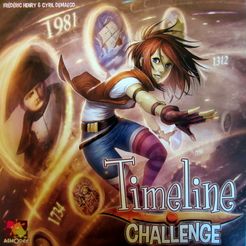
Better Late Than Never (Timeline Challenge)

They say that real life can direct the plot of a story.  Well, that's a matter of fact with this game.  Now, before you click off, let me sell you on this.  Imagine a game of figuring out dates, don't close yet, but actually has gameplay elements.  This is Timeline Challenge.


BACKGROUND: Timeline Challenge is a board/card game for 2-10 players by Cyril Demaegd and Frédéric Henry, art by Xavier Collette and Jérémie Fleury, and published by Asmodee in 2015.  It is an expanded sequel to Timelines.

GAMEPLAY: Each turn, all players are engaged in a Trial, depending on the space the leading player is on.  Generally, the Historical board (with the dials) is used to guess the the cards dates or orders. Players move spaces according to the Trial.  There are also 2 Challenge lines, which are played immediately once any player crosses that line, but are only played once.  The player in last starts, and continues clockwise. The winner of the Challenge moves ahead 3 spaces, and play continues as normal.


WINNING: The game ends once a player reached the center Finish space.  In the case of a tie, the tied players play one final Sudden Death Challenge.

CONCLUSION:  I want to summarize this game with 'this is Timelines', and to an extent, it is.  It uses the same premise and idea that the original uses.  But, because Timelines was so simple an idea, it became easy to be able to flesh it out and make it more tangible of a game.  Once you understand the Trials, the game becomes just as easy to understand, but with more mechanical depth (but not much) of the first game.  So, if you like the idea of Timelines, but want something that will last a little bit longer, this is the Challenge for you.

Wednesday, November 21, 2018

To Boldly Go (Star Trek Panic)

Captain's Log: Stardate -304110.774.  We have become stranded in the past, during the time that humans used to call Thanksgiving.  We have been invited to stay for the holiday, and until we can find a way back, I don't see that we have much a choice to blend in. I personally have talked with the youngest of the family, who seems fascinated with board games, especially one titled Star Trek Panic, a game that somehow dictates Captain James Kirk's adventures in the future.


BACKGROUND:  Star Trek Panic is a board game for 1-6 players, designed by Justin De Witt and published by Fireside Games and USAopoly in 2016.  Players take the role of a member of the NCC-1701 Enterprise from The Original Series, and do the same missions that Kirk and his crew did in the series.

GAMEPLAY:  This game is based on Castle Panic, and uses the same turn order.  Players start their turn by first drawing Enterprise cards, then trade cards with each other.  The turn player plays cards to deal with any threats on the board, then when they are done, the 'monsters' or ships move, damaging the 'walls' or shields, and the ship itself.  Finally, the player draws 2 new threats before passing the turn, rolling and placing them on the board, with some threats having special effects.

DIFFERENCES:  There are a few major differences, however.  Before you trade, you draw a Mission card.  The Mission cards determine what your goal is and how many turns you have to finish. The Enterprise can also Maneuver during Play Cards phase.  Unlike Castle Panic, which is divided into color rings, the Enterprise cards are based on position.  You can move one section left or right, or "Move Forward", i.e., move all ships in front of Enterprise towards the ship.


WINNING:  To beat Castle Panic, you had to slay all the monsters.  To beat Star Trek Panic, you must complete a predetermined number of missions, but failing is easy.  Failing a mission just requires you to go to the next mission.  If the Enterprise loses 3 sections of its hull, it can't Maneuver, and losing all 6 sections destroys the ship and ends the game.

CONCLUSION:  Star Trek Panic feels like a natural evolution to Castle Panic.  The ability to move and adapt to the board makes a strong mechanic to an already great game, and help suppliment the randomness of the cards.  Obviously, there's still a chance of random element, but it doesn't punish as bad as it could.  The missions can range from easy to impossible, depending on the ship's condition.  The ability to adjust the length and the ability to use character abilities during your card play phase adds another strong element.  Really, what can I say but I suggest you go where no one has gone before, and pick up Star Trek Panic if you're a fan of the original game or the original series.

Wednesday, October 17, 2018

Sorry, Not Sorry (Jokers and Marbles)

Welcome back to Flipping the Table: classics with a twist.  Tonight we'll be looking at the board/card combination game Jokers and Marbles, and then at 5, I will put on a purple thing and dance around.  At 6 o'clock with the news, then at 9, 4 hours of utter black paired with Gregorian chanting.  Ladies and Gentlemen, the game.


BACKGROUND: Jokers and Marbles is a board and card game for 3-8 players.  Originally published sometime in the 1970's, it shares features with Aggrevation and Sorry.  Players move their characters from their start around the board.

GAMEPLAY:  Each player starts with 5 marbles in their home and a hand of 5 cards.  Each turn, the player draws and plays a card.  Players must play a card if they are able, and discard one if they cannot.  Players may never have their pawns pass another pawn they control, but other players pawns are fine.


MOVEMENT:  Aces and face cards (J,Q,K) allows the player to move out of their start.  Ace through 6 moves 1 through 6 spaces, respectively.  7 can move one pawn forward, or split the movement between two pawns to total 7 spaces moved.  8 moves backwards, 9 splits movement like 7, but moves one pawn backwards, and one forwards.  10 and face cards also allow you to move forward 10, and Jokers swap spaces between the turn players pawn and another players.  If a pawn is swapped from Start, however, that other players pawn is sent back to their Start.

TEAMS:  There is also a team mode.  Play normally, with players only worrying about their pawns.  The catch is once a player gets all their pawns to their Home, they now start moving their teammates pawns with their cards.


WINNING:  Just like Sorry, players win by getting their pieces into the Home first, but make sure to be accurate, you can't pass your own pieces in Home either.

CONCLUSION:  Jokers and Marbles has a lot of really strong points going for it, especially when compared to its counterpart, Sorry.  By having a hand, customizable boards to fit up to 8 players, and the ability to play with teammates, their are a lot of options and ways to strategize here.  I do have two points of contention, however.  The first is that if you truly dislike Sorry, I wouldn't hold much hope here, but you should still give it a chance to see just how different it is.  The second is the inability to pass pawns.  Now, while I know the other games do that too, I still think it reduces your ability to play cards, and therefore your options decrease.  Even with that said, I think it's a solid game, and a great replacement to the same game nights.

Thursday, October 11, 2018

Own the Mushroom Kingdom (Monopoly Gamer)

Oh, hello!  This week we look at both this month's theme, and a previous theme.  By coming both Video Games and Oldies with a Twist, we get the all-powerful Gamer Monopoly!  


BACKGROUND:  Gamer Monopoly is a board game for 2-4 players, and was produced in 2017 by Hasbro and Nintendo.  Players take control of Mario and his friends to run around the board a la Monopoly, and fight the bosses, including King Koopa AKA Bowser.

GAMEPLAY:  Like traditional Monopoly, you roll and move your character from the start to buy property with Gold Coins, or other effects based on the board space.  However, players now roll both the regular movement six sided die, and the ability die, which gives them an effect according to the character card.


PROPERTIES:  Landing on a property still requires the player to pay the owner the amount indicated on the card.  Another unique feature is the lack of hotels and mortgage.  Instead of hotels, if a player lands on another players property, they are merely paid double. If a player runs out of coins, they either sell property back to the bank or to other players for a price.  If a player has neither coins nor property, they lose, and are removed from the game.

BOSSES:  Once a player lands on or passes GO, that player flips a Boss card and may fight the Boss by paying its roll cost.  If the player does not meet or beat the number, they lose and pass the opportunity to fight the boss to the next player.  If any player does manage to beat or hit the number, they collect the Boss card.  However, if all players pass and no one manages to beat the Boss, the Boss is removed from the game.

WINNING:  Each property and Boss card has a point value at the end.  When Bowser is either defeated or flees, the game is over.  Players total up their point values on the cards, with every 5 coins worth 10 points.  The winner is the player with the most points at the end, with ties going to the player with more property.

CONCLUSION:  I hate Monopoly.  That might seem like rather harsh thing to say, but if there is a game I dislike over all games, it's Monopoly.  It's long, dull, and uninteresting.  So, when Monopoly Gamer came out, I was...skeptical.  After all, almost all other versions of Mario are the same with a new skin, so why should this one be different.  There's even a previous Monopoly Super Mario Bros.  After playing it, I can say that this version of Mario is enjoyable.  There's a set gameplay end, so I never felt like my time was wasted waiting for 1 player to just finally win with their massive lead.  The elimination rule is also helpful, as is the lack of punishing players with mortgages and hotels.  If there's one problem I have, it's that, in the end, it's still Monopoly.  Sure, it's been vastly improved, but Monopoly is Monopoly, warts and all.  It's still unbalanced, unfair, with uninspired gameplay.  Still, if you are a video gamer turned board gamer, just recognize the theme, or you don't and this sounds good, give it a play.  This is one game that surpasses its brothers by a large degree.

Wednesday, September 5, 2018

Best of the Worst (Disney's Villainous)

Aladdin, Ariel, Hercules.  At one time or another, we've imagined being a hero like these in a story, to emuate their strength, or their courage.  But how often have we imagined taking the role of the villains? How we love to hate them, with their flair for the dramatic, and their utter presence in every scene.  A hero is good, but a villain is grand!  To take their roles and prove we could succeed where they failed would be truly Villainous. 


BACKGROUND:  Villainous is a card game for 2-6 players, designed by Prospero Hall and published by Wonder Forge, where you take the role of a famous Disney villain to thwart both fate and canon and become the ruler of your realm.

GAMEPLAY:  During their turn, a player moves into any unlocked space on their board.  Some locations, like the Cave of Wonder, are locked until a card is played, but others, like Prince Eric's Palace in Ursula's Realm, must be moved to simulate transforming from land dweller to sea dweller.  Each Location in the Realm determines what actions you can take on your turn, with any others unavailable to use that turn.  Some actions grant you Power, which is used to play certain cards and abilties, discard cards, or even to play a card or move cards to an adjacent Location.  Turns end by drawing up to 4 cards.  If either the colored Villain deck or the white Fate deck runs out, shuffle the discard into a new deck.


FATE:  Whenever a person uses a Fate action, they reveal 2 cards from another players Fate deck.  The player doing the action chooses one and applies its effects, and the other is discarded.  If it is a Hero, it is placed in the targeted players Realm, usually covering certain Actions so that players may not use those being covered.  In 5-6 player games, the Fate token is given to a player so that they may not be targeted by the Fate action twice in a row.  Multiple Heroes may be in the same location, but multiple Heroes may not be Vanquished with a single Vanquish action.  Only one may be Vanquished with one action.


VANQUISH:  Vanquish is a action applying to Heroes and Allies.  Allies are generally used to Vanquish a Hero in their Realm.  Certain Items can be equipped to Allies to raise the power of the Allies.  The Power of both Heroes and Allies are located in the bottom left.  To Vanquish a hero, the Ally or Allies must be in the same location as the Hero, and Heroes are discarded from the Realm until their Strength matches or exceeds the Hero, then the Hero is discarded.

WINNING:  A player wins when certain conditions are met on their board.  Some must start their turn with their objectives, while others merely need to meet those objectives.

CONCLUSION:  This game has some really unique, interesting things going for it that make it both worthy of praise and a detriment.  The theme is both original and exciting, which is also how I would describe the game.  The fact that affecting a player and slowing them down only occurs indirectly is fascinating, and leads to some really interesting maneuvers, without sacrificing the theme of the game.  However, that also means that you once a player starts to get the pieces they need for victory, it can snowball, i.e., it can make it really hard to stop them from winning.  Some of the Villains win conditions seem a little unbalanced, like Prince John's, but after playing it a few times, it is possible for any player to win.  The biggest drawback is the turn length's, which takes longer for newer players as it's mechanically so different, and the card system.  Like every other card game, it is really easy to just have no cards that work for you, and because discarding is an action you have to land on to use, it makes a dead hand that much worse.  Still, if you want an interesting, quirky, and uniquely solid game, make a wish and become Villainous.

Wednesday, August 29, 2018

But She Don't Care (Ticket to Ride)

All aboard!  All aboard!  
Tickets, please!  Thank you, sir or madame, and welcome to the Moon, one of the most luxurious and prestigious inter-continental trains to exist.  It may not be the fastest, but it's one of the best, if I do say so myself.  Well, on to the next car, must check everyone has their Ticket to Ride.  Tickets, please!


BACKGROUND:  Ticket to Ride is a board game for 2-5 players, published by Days of Wonder and designed by Alan R. Moon.  Connect the cities of North America with the most modern and convenient way of traveling, the steam powered engine.

GAMEPLAY:  Each player starts with being dealt 3 Destination Tickets secretly, which determine what routes a player must take over the course of the game.  A player may keep either 2 or 3 tickets, with any not kept placed at the bottom of the Destination deck.  A player may take only one of three actions on their turn, Draw Train Car cards, Claim a Route, or Draw Destination Tickets.


DRAW TRAIN CAR:  Each player gets a hand of various colored Train Car cards.  Each turn, a player may either claim a combination of 2 solid colored cards from the 5 cards in the stockpile and/or draw blindly from the deck, or 1 rainbow colored Locomotive.  Players may not take a Locomotive if they claimed a Train Car card.  If 3 or more Locomotives are ever in the stockpile, shuffle the stockpile into the deck, and reveal 5 new cards, repeat as necessary

CLAIM A ROUTE:  Instead of drawing cards, players may instead claim a route on the board.  To do so, players must discard a number of matching colored train cards equal to the number of spaces between two connecting cities that hasn't been claimed, then place their trains onto that route.  Some are grey, and can be claimed with any trains, but some routes are colored, and can only be claimed with matching colors.  If there are any two wide, the player only claims one of those sides, so a 2 by 4 would only require 2 cards, and connect a straight line to the next city.  Locomotives count as any color.


DESTINATIONS:  Each Destination card has a set of two cities that players must make an unbroken line of trains from.  Any pathway may be used, but a set of trains must go from one city to the other in a continuous path with no breaks.  Each Destination has a number of points to score in the bottom right if a player makes that destination, or deduct if they fail that destination at the end of the game.  If a player chooses to Draw Destination Tickets, that player draws 3 Destination cards.  They must keep at least 1 card, but can keep 2 or all 3.  Any not kept go to the bottom of the Destination deck.

WINNING:  Each time a route is claimed, the player scores based on the length of the route, kept track of on the sides of the board.  Once a player is down to 2 or fewer trains, every player gets 1 more turn.  Then, points for the longest unbroken route and all successful and unsuccessful Destinations are scored after the last players turn. The player with the most points wins.

CONCLUSION:  Ticket to Ride is surprisingly easy to learn, and I've always had fun playing it.  It allows for strategy without being overly complicated.  It is no surprise, then, that this game has had the lasting power it has, with over 20 expansions and stand alone variations.  With all these versions, the base game can seem a little tame and bland by comparison, with many players I've seen preferring an alternate version or adding expansions.  It also is never a short game.  With each player getting 45 trains to place down, even an ideally quick game is still going to last a half hour or so.  Still, it never really outstays its welcome, even if things can seem to get a little tedious towards the end.  There is also the point that once you have an idea of where players are going, it's possible to slow down or even prevent players from succeeding on their tickets.  Overall, this is a strong game that deserves the recognition it has.  If you haven't tried this, find some friends and catch this train.

Wednesday, August 22, 2018

I'm Floating in a Most Peculiar Way (Jim Henson's Labyrinth: The Board Game)

"Through dangers untold and hardships unnumbered, I have fought my way here to this castle."  This was the line that started the character Sarah through a voyage that I would never forget.  Normally this part would be a funny little blurb, but allow me to indulge a little, as I tell you of two movies that helped shape my life and the path that led me here, both influenced by a man named Jim Henson.  The first was the Dark Crystal, a fantasy world that showed me the light and dark that must exist in everyone, and the Labyrinth, which helped me understand how stories flow, and find my love with the utter bizarre.  Today, I'll be looking at the game of the latter.  This...is Labyrinth.


BACKGROUND:  Labyrinth: The Board Game is a roll and push for 2-4 players, or 5 if one takes the role of Jareth.  It was designed by Alessio Cavatore and published by River Horse Ltd.  Players take the roles of the 4 main characters Hoggle, Ludo, Sir Diddymus, and of course Sarah, from the movie Labyrinth to get Sarah's baby back from the Goblin King.

GAMEPLAY:  Unlike most games, players move in a set pattern: 1st is Hoggle, then Sir Diddymus, Ludo, and then Sarah. After Sarah moves, the clock advances by 1.  Each turn, a player may either move, or rest.  To determine Speed, roll the die indicated on the card, and move either left or right.  Once a player or players land on an empty space, they draw a Labyrinth card.

LABYRINTH:  Once a Labyrinth card is drawn, follow the effect of the card.  Some will grant the player a 1 time use ability, in addition to their characters own 1 time use ability.  Others will be challenges.  Challenges can take the form of rolling a stat vs another die and beating or tying the number, or even fulfilling movie quotes.  Each challenge has a success and fail condition on the card.  Failure usually causes the characters Willpower to decrease.

GROUP:  If 2 or more characters share a space when a player starts their turn, the turn player may do a group movement, or group rest. When moving as a group, roll the die with the fewest number between the shared group.  Players may also lay down and rest.  A card is not drawn, and roll the 6 sided die.  If it lands on a 4, 5, or 6, any one player in the space gains a Willpower up to their maximum of 6.  However, if players move as a group, those players may all roll for any challenge, unless otherwise stated.  All players roll, and if any succeed, all players succeed.  If all players fail, every player takes the penalty.


UNDESIRABLE:  There are 2 Undesirable square spaces players may land on: the Oubliette, and the Bog of Eternal Stench.  The Oubliette causes a forced Rest on their turn, and any player whose Willpower hits 0 will start their turn there, but you do not roll to get a Willpower back, instead just gaining one when your turn starts.  The Bog forces the player to roll their speed die, with a 1 or a 2 causing the player to lose a Willpower and gain a Smells Bad token, which prevents you from working with a group unless you meet a specific roll.

GOBLIN CITY:  The players are trying to find the gate to the goblin city, which is going to be at least 20 cards down. Once drawn, characters may enter the city and challenge the Goblin Defense Obstacles. , then she goes to the Oubliette or rolls again. If she wins a roll then she recites the spell and the players win the game.

WINNING:  If the clock goes from 13 back to 1, the players lose.  Sarah is the only one that can enter the maze in the castle and test wits against Jared rolling her Wits vs Blue die.  Each time she fails, the clock advances, and she rolls again on her turn.  When she succeeds, the player recites the quote Sarah said to the Goblin King.  If successful, the players win.

CONCLUSION:  I'm going to start this with the games 2 biggest weaknesses.  First, this is obviously a movie tie-in product, but the game emphasizes that with both the win condition, and certain challenges.  If you want to know what the game's like, watch the movie before you play, and if you don't like the movie, you won't enjoy the game.  Second, this game is hard a lot of the time.  I get that it emphasizes the struggle between Sarah and Jareth in the movie, but that doesn't make the game less diffiicult and based on die rolls.  Now, with that out of the way, my final feelings is that if you enjoy the movie like I did, it won't matter as much.  It is a game that is still fairly fun, and really brings out its theme.  I won't say it's the best, but there are a lot worse games out there than something like this.  Just like the movie, it's a decent romp through an interesting world.  The long and the short, consider playing if you liked the movie.

Wednesday, August 8, 2018

You Never Split the Party (Order of the Stick Adventure Game: The Dungeon of Dorukan)

A motley band of adventurers, with different philosophies, motivations, and competencies.  They do, however, all have one thing in common.  They are united to slay the evil lich Xykon.  Some do it for honor, some for greed, and some for the thrill of the fight, but they will all fight (with Xykon's minion and with each other) in the Dungeon of Dorukan!


BACKGROUND:  The Dungeon of Dorukan is a card based board game for 2-6 players published by APE Games and designed by Rich Burlew and Kevin Brusky.  Based on the web-comic Order of the Stick, players take the role of a member of the titular party and travel down to fight the lich Xykon, fighting both monsters and each other.

SET-UP:  Each player begins with a hand of 7 Battle Deck and specific Shticks from the players Shtick deck, indicated on the character card.  Each player starts in the Dungeon Entrance.

GAMEPLAY: On their turn, a player may move up to 3 rooms from their starting space.  If the player moves into an empty room, players draw a Dungeon Room card.  Then, starting with the next player, they place a monster down.  If the player is on a deeper floor, the players continue playing monsters in order equal to the level the player is on.


FIGHTING:  Whenever a player enters a room, they defend from the "closest" i.e., first monster played.  That player uses a Shtick to fight, and roll the blue die, and add the number on the shield to the number rolled.  If the number is higher than the number on the sword of that creature, apply the effect of the Shtick by the purple flag.  If the creatures Wounds become 0, they die and are removed from the room and added to your stash, they drop and Loot indicated on their card in that room, and now the player may continue to fight using any available Shtick, but may choose either attack or defense, and roll the red or blue die respectively.  If a player loses a fight, the fights are over, and they take a Wound.

SHTICK:  Shticks are bonuses to add to combat, and determine the effect of the battle.  Some cause a Draw, which nothing happens even if you win, while others cause Wounds.  You may discard Loot with a total of 3 faces, or 3 monsters to draw a Shtick card.

LOOT:  Once there are no monsters in a room, players may take up to 1 loot in that room, 2 if they defeated that monster or are resting.  During combat, Loot may be given to a player on the same floor to add 2 to that fight for each face of that character.  Loot may also be equipped by any player with their face on it, which allows them to enter Xykon's lair.


WOUNDS:  Each player is at max health, indicated on their character card.  Whenever players take a Wound, the marker goes down.  When a player gets to the bottom most Wound, the player unequips all Loot, and on each of their turns, drops a random Loot in their room, and must run back to the Dungeon Entrance.  Players may forgo their attacking or moving to Rest.  The player may still draw, trade, equip loot, or be fought by other players with a -4 penalty, and ask for assistance when defending.

STAIRS:  Each turn, a non resting player may roll to find stairs for the next floor, with a success hit on a 1, 2, or 3.  The number of floors is chosen at the beginning.  In order to enter the Xykon's Lair, players must have a minimum number of Shticks and Loot.  Then, players only fight in Xykon's Lair by drawing from Xykon's deck.  Eventually, players fight Xykon.


WINNING:  Once Xykon is discovered and defeated, the dungeon starts collapsing.  At the end of each turn, the player removes rooms from the dungeon, starting from the lowest level and the right or left most card and working in, with the room with the stairs collapsing last.  Players in a collapsing room are moved to the next available room.  Players then gain points, or Bragging Rights.  Each player gets 1 point for each their face on their Loot, each Schtick in play, 1 point for each player in the dungeon when you leave, and 2*number of floors if you defeated Xykon.  The player with the most Bragging Rights wins.

CONCLUSION:  This is an RPG in a box, and as such, this game is LOOONG!  The minimum amount of time I have managed to play this in was 2 hours.  Keep in mind that this was without the expansions, we all had played before, and this was the shortest session.  I have found that this game can be quite enjoyable, especially with a group that loves longer games, but let's be honest, that's usually a smaller group.  The humor is on point for Order of the Stick's early work, and if you don't take it too seriously, it can be a lot of fun.  As a note of caution, this game will eat up a lot of time, especially if you want to play for longer period of time.  The biggest strengths of this game are, unexpectedly, the rules and, more expectedly, the humor.  This is not a game you can pull out at every game night, but the few times you can are generally pretty fun if you give it a chance and know what you're getting into.

Wednesday, July 11, 2018

My Summer Vacation in Japan (Tokaido)

After stepping off the plane, the traveler shoulders his deep blue duffel bag.  He flips the brown cap with a white star sewn onto it, and it lands onto his head.  His sunglasses reflect and distort the world around him, keeping the world guessing about his intentions.  But he only has one intention this time.  He will travel the Eastern Road, and sample what Japan has to offer.  He'll find only the best art and souvenirs, and he will see exactly what she saw.  This is the path of the traveler, as he heads along Tokaido.


BACKGROUND:  Tokaido is a game for 2-5 players and published by Passport Game Studios.  Travel along the East Sea Road to meet interesting people and places, find some wonderfully crafted items, and taste what Japan has to offe

GAMEPLAY:  Each player starts at the far left in 1 of the 5 squares in a vertical line.  The starting player is indicated by whomever at the bottom, as they are "farthest behind".  Each player chooses a character from 2 randomly available choices, and collect the coins indicated at the top right. 

MOVEMENT:  The player farthest behind will be the turn player.  Each player may move forward anywhere along the track on the small circular spaces, up to and including the next Inn space, which is indicated by the red line of squares.  Players may never share a space, but if is a branching point that is split while playing with 4 or more players, players may move their token to that space, and they are behind the player on the main road.


SCORING:  Each space has its own effect.  Villages allow you to buy Souvenirs and score points.  Farms give you 3 coins.  Hot Springs gives you points.  Panoramas are like paintings, and give you points and cards to build your image.  Temples trade up to 3 coins for points.  Encounters give you a card from the Encounter deck and the effect applies.  Points are kept track of on the number tracker on the top of the board.  Player cards also have an effect they may use when landing on an appropriate space.

INNS:  Inns are a special case.  Once a player hits an Inn, they cannot move until all players meet up at the Inn.  Once a player hits the Inn, they are given a selection of Meals.  They may buy a meal to score 6 points, with the last player only able to buy whatever meal is left.  Once all players have met up, the farthest player, or the one who was last to the inn, starts their turn.


WINNING:  The game ends once the last player hits the last Inn and buys or refuses a Meal, if any are left.  At the end of the game, any end of game points such as Achievements for most of a certain kind of card, and how much money donated, are tallied and scored, with the player who scored the most points winning.

CONCLUSION:  Tokaido is one of those games that is complex to understand when you first hear it,
easy to play once you start understanding it, then goes back to complex once you realize how many ways there are a bevy of ways to approach it to winning.  The biggest complaint I may have to put is that it isn't hard to have a player go through three turns in one go, and that can feel irritating.  Still, even with that thought out there, I still say this is one road you should travel, and don't forget to treat yourself.

Wednesday, June 6, 2018

The Butler Did It (Mysterium)

December 4th, 1928.
I fear my time on this earth has come to an end, or so it would seem.  Just yesterday I woke up and passed right through the privvy door.  I know that no one will be able to read this, as I write it with my finger, and the words appear for the briefest of seconds.  The man living here, Mr. MacDowell, seems to be a nice but a bit jumpy.  I am not sure if he is reacting to my presence or not, but I can only pray it is the former.  I leave this Mysterium (oops, meant to write mystery) to him.


BACKGROUND: Mysterium is a board game published by Libellud in 2015 for 2 to 7 players.  One person takes the role of a ghost with amnesia, and can only give the barest hints of who killed them, while the other players, or mediums, attempt to decipher the clues.

GAMEPLAY:  Each turn, the ghost takes a Vision Card, a card with very pretty art, and gives one to each medium, drawiing back up to 7 cards each time a card is dealt.  Using a crow token allows the ghost to discard based on the difficulty.  Then, the Mediums look at their cards, and the timer is flipped.  Each medium tries to guess appropriately based on the cards laid out in front of their tokens on the first stage.  Once time runs out, mediums cannot move their token anymore.  At the end of each turn, the clock hand moves forward 1 hour.


WINNING:  If a token is placed on the card that matches the card on the ghosts board, they move forward on the track.  The players win only if every player guessed correctly all 3 times.  If at any point the clock would move past 7 o'clock, the game ends and everyone loses.

CONCLUSION:  Mysterium shares a lot of similarities with Dixit, both are weirdly named games with enjoyable mechanics and beautiful artwork.  Mysterium could have fallen into the trap Exploding Kittens did, where just the art sells the game, but it manages to be so much more.  Although this game is supposed to be co-operative between the ghost and mediums, it never felt as difficult as other co-op games, and that's a shame.  I enjoy working against the clock, against the game itself, and I never really seemed to struggle.  Does that make it easy?  Well, I do know the clock did get to 6, so I don't know.  Playing with your normal game group might actually make this too easy.  This is a game that seems to embrace the idea of playing with strangers, or as an ice-breaker.  There's a simplicity to this that makes it accessible to others not used to games, but it is a detective game, first and foremost.  You might have fun solving this one.

Wednesday, May 30, 2018

Rising to the Occasion (Ascension)

In a world, where magic is real, and Gods and monsters exists, one to four heroes will step up to defend the land of Virgil and fight off Samael, the Fallen One.  Friendships will be forged, live will be lost, and resolves will be tested.  But will our heroes fall, or will they rise to the challenge and embrace the Ascension!  Find out NOW!


BACKGROUND:  Ascension is a deck builder for 1-4 players or teams and published by Stone Blade Entertainment.  Players defend the world of Virgil to collect resources and slay

GAMEPLAY:  Each player takes a standard deck shuffled, and draws 5 cards.  On their turn, they may play any cards in their hand to gain either Runes (Triangles), Power (Red Swords), or Honor Tokens (Black Star).  Honor tokens are gathered from the Honor pool, while Runes and Power disappear at the end of the turn.  If a players deck runs out of cards, it is reshuffled once a card is needed to be drawn.

RUNES:  There are 6 cards in the Center Row.  In it are Hero cards, Constructs, and Monsters.  To acquire either Heroes or Constructs, players must spend a number Runes indicated in the top right of the card, and are put into the players discard.  When a Hero plays a Construct from their hand, it is put in front of them permanently.  Constructs can only be used on your turn.


POWER:  To defeat a Monster, players spend an amount of Power equal to the number in the top right.  The monster is then put into the Void zone in the center of the table.  Voided cards are no longer in use in the game. Most monsters will also have a reward once defeated.

WINNING:  There are 30 Honor tokens in the honor pool for each player.  Once any card gives a player an effect or reward for Honor, they collect that many in the pool.  Once the pool runs out, the players continue until the player who started would go first, while collecting any additional Honor from the box.  Players total up the number of Tokens and the numbers on the bottom left of any cards purchased.  The player with the most Honor wins.

CONCLUSION:  Ascension is a deck builder, plain and simple.  The mechanics and scoring system are exactly what you'd expect from a deck builder.  The art is nice, and it does feel like there is a bit more theme than Dominion.  But other than that, it is a decent game, it just feels similar to a lot of other deck builders, with not much real deviation from the formula.

Wednesday, May 23, 2018

A Game of Marbles (Abalone)

Normally this would be a small flavor text involving either the setting of the game, or some joke about the mechanics.  However, I've decided to forego that and just introduce you to this game, with a pronunciation so unusual it makes me glad I just have to type it.  So, ladies, gentlemen, and everyone else, I introduce to you a game I became skilled at over the summer: Abalone. 


GAME DESCRIPTION:  Abalone is a marble based game for 2 players published by Abalone Games in 1987.  Each turn, a player moves a set of up to 3 marbles to push the opponents off the board.

GAMEPLAY:  Each turn, a player may move 1, 2, or 3 marbles.  They may either push them in a line, or move any in a columnt sideways, keeping them together.  Players may also push opponents marbles, but only if there are more of the players marbles pushing.  Players cannot push equal or superior number.

WINNING:  When a marble is pushed off the board, it is captured.  When a player has captured 6 Marbles, the player wins.


CONCLUSION:  Normally, I like to review games that at least look or feel different than your typical roll and push or high strategy Chess like games.  Abalone easily feels like it could be a game from the early years of human history, like Chess or Go.  It creates a simple premise with no chance for luck, only pure skill and strategy.  In terms of difficulty, I would put it a lot lighter than Chess or Go, but it's definitely more difficult than any variation of Checkers or Chinese Checkers I've played.  Now, due to the game feeling like a strategy game, I say that this should be in every household, as even kids can learn it, and it isn't difficult to learn, but can provide both children and parents an enjoyable game. 

Wednesday, May 16, 2018

Attack of the Kaiju (King of New York)

New York City is a nice place to live, except for the shootings, the muggings, and of course the weekly attacks by giant mutated beasts.  But, that's the price you pay for seeing firsthand who will be the true King of New York.


BACKGROUND:  King of New York is a game for 2-6 players designed by Richard Garfield and published by IELLO, in which the players take the role of giant Godzilla like monsters and robots, wrecking the city of Tokyo in quest for total domination.

GAMEPLAY:  Players begin in various districts with 20 max health and 0 Victory Points (VP), and roll the special black dice up to 3 times, with each one providing various effects once resolved:

  • Star:  3 Stars grants you the special Superstar card, which grants you a VP and any future Stars granting you VP as well.
  • Claw:  Deal 1 damage for each claw to the Monster in the Manhattan District, or if in Manhattan, deal 1 damage for each claw to each other Monster not in Manhattan.  If a monster is attacked in Manhattan, they may move out anytime this is rolled, but will still take the damage.
  • Lightning Bolt:  Gain an energy token.
  • Heart:  If not in Manhattan, heal 1 point for each Heart
  • Building:  Deal damage to Building Tiles or any Military Units not revealed this turn, and gain the effect of the Destroyed Tile, which is flipped, or the Unit, which is placed in front of you.  Damage is healed once the turn ends.
  • Skull:  1 Skull rolled deals to you per Unit on your Borough.  2 Skulls deals damage to all monsters from Units to each monster in your Borough.  3 or more Skulls deals damage to all Monsters for each Unit in their Borough, and you gain the Statue of Liberty card and 3 VP.


MANHATTAN:  Once the dice are resolved, if there is no Monster in the Manhattan Borough when playing with 4 or fewer players, or there is only 1 there with 5 or 6 players, the turn player moves there, gaining a VP and other effects as long as they stay there.  Otherwise the player may move into any other Borough with 1 or less Monsters there.  Then the player may buy any of the 3 available cards, or pay 2 Energy to discard and deal new cards out.

WINNING:  Players win by either dropping all the other monsters health to 0, or gaining 20 VP.

CONCLUSION:  When I first played King of Tokyo, I had a hard time understanding or enjoying the game initially.  I am thankful to say that King of New York was a lot easier to understand, mostly.  Richard Garfield seems to understand how to take weird ideas and make them interesting.  The inclusion of multiple locations and the special cards balances out the game a little better than before.  Now, there are a couple minor gripes I have with the game, such as the forced movement.  Even though it helps with balancing issues, it is really easy to accidentally die from attacks that aren't your fault.  Still, the game is enjoyable, if a little frustrating.  I'd say give it a chance