Showing posts with label Trivia. Show all posts

Wednesday, February 13, 2019

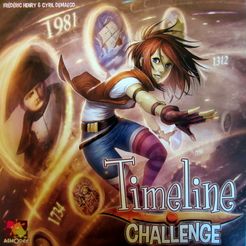
Better Late Than Never (Timeline Challenge)

They say that real life can direct the plot of a story.  Well, that's a matter of fact with this game.  Now, before you click off, let me sell you on this.  Imagine a game of figuring out dates, don't close yet, but actually has gameplay elements.  This is Timeline Challenge.


BACKGROUND: Timeline Challenge is a board/card game for 2-10 players by Cyril Demaegd and Frédéric Henry, art by Xavier Collette and Jérémie Fleury, and published by Asmodee in 2015.  It is an expanded sequel to Timelines.

GAMEPLAY: Each turn, all players are engaged in a Trial, depending on the space the leading player is on.  Generally, the Historical board (with the dials) is used to guess the the cards dates or orders. Players move spaces according to the Trial.  There are also 2 Challenge lines, which are played immediately once any player crosses that line, but are only played once.  The player in last starts, and continues clockwise. The winner of the Challenge moves ahead 3 spaces, and play continues as normal.


WINNING: The game ends once a player reached the center Finish space.  In the case of a tie, the tied players play one final Sudden Death Challenge.

CONCLUSION:  I want to summarize this game with 'this is Timelines', and to an extent, it is.  It uses the same premise and idea that the original uses.  But, because Timelines was so simple an idea, it became easy to be able to flesh it out and make it more tangible of a game.  Once you understand the Trials, the game becomes just as easy to understand, but with more mechanical depth (but not much) of the first game.  So, if you like the idea of Timelines, but want something that will last a little bit longer, this is the Challenge for you.

Wednesday, November 30, 2016

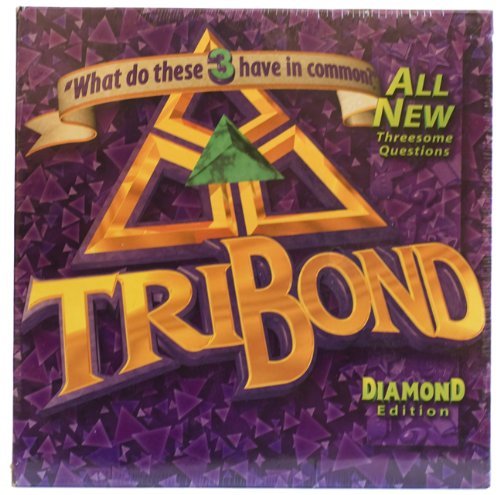
Three of a Kind (Tribond)

A baby, a tire, and an Eagle.  3 seemingly innocent items.  No connection between them, no alibi.  Their story checks out, but the puzzle eludes me.  What could such radically different objects have in common?  I twist them in my mind, scramble them like so many eggs.  That's when it hits me, the connection they all have:  They're all bald.  That's the bond I was looking for.

Image result

GAME DESCRIPTION: TriBond is a board game for 2 or more players or teams, and was designed by Ed Muccini, Tim Walsh, and Dave Yearick in 1989.  Players attempt to get all three of their pieces to the end by finding a common link between 3 objects, people, or terms given.

SET-UP:  The board has 3 small tracks, and each player places their pawns in all 3 starting positions, 1 per smaller board.


MOVEMENT:  During their turn, the player rolls the two dice.  The numbered die is used to determine how far the player will move if they answer correctly, and the Category die, with various shapes printed on it, determines whether the category for the clue is:

  • Entertainment: Popular Culture
  • Academics: Education & Literature
  • Wordplay: Puns, Homonyms, etc.
  • Sports:  Terms, Teams, and Names in Sports
  • Loose Connections: Connected in weird, unusual ways

CHALLENGES:  If a player manages to land on a Green space, they are allowed to Challenge any player in front of them that is not in the Home space.  These are printed on the side of the card, and have no category.  If the challenger guesses correctly first, their piece switches places with the other piece.  If the challenged guesses correctly first, the challenger's turn ends.

Image result for TribondImage result for Tribond

WINNING:  A player or team wins when all their pieces move into their respective Home squares.  This may be accomplished with either an exact or inexact roll, as long as the clues are guessed correctly.

CONCLUSION:  This is a classic in my home.  While we tended to skip the Sports questions, as most in my family have no real knowledge of that category, we still had a lot of fun.  I grew up playing it, seeing how things with no seemingly real connection could have not just a tie, but a strong one.  It's simple in concept, but first learning it tends to take time to get the idea down.  The simplicity of the rules also allows for more flexibility in house rules, allowing a more balanced play between everyone. This is a definite play for those who love words or trivia games.