Showing posts with label Dice. Show all posts

Wednesday, May 22, 2019

Pandemic 2: Electric Bugaloo (Pandemic: The Cure)

Note dated Jan 18, 201X (discovered on USB in Antarctic station)
So, the first Pandemic wasn't enough for you?  You had to go and cause another outbreak?  Fine, I've washed my hands of this mess.  If that's too much for you, you can go find the specialists who can stop this thing.  Oh, it's not as bad this time?  That's what you said last time, and we literally decimated the world.  It's your fault, you clean it up, you go find The Cure.
--XXX


BACKGROUND:  Pandemic: The Cure is a card and dice game for 2-5 players.  It was created in 2014 by Matt Leacock, Bernard Bittler, Philippe GuĂ©rin, Chris Quilliams and published by Z-Man Games, Inc. A rework of the popular Pandemic, players transport to different places to cure diseases.

GAMEPLAY:  Each turn, that players roll their dice and can either reroll them if it's not a Biohazard, or use the action on die.  Biohazards are used immediatly and raise the Infection track by one.  The syringe allows the colored dice to be moved from the locations to the Treatment Center in the middle of the table, or back to the Infection Bag.  The bottle is used to hold samples by taking the colored die and the sample die and putting them on the players card, which prevents them from using that die.  Once all their actions are done, the player can give samples to other players.


WINNING:  Once all that is done, players can roll the colored die in their sample bottles.  If they get a 13 or higher, one of those dice is placed on the "Cured" card, and the rest go back into the bag.  Rolling a 12 or less means that the dice used for samples are still unavailable to roll.  Then, once all 4 dice are on the Cured card, the players win.

INFECTION:  After a player chooses whether to roll for a cure or not, they then roll to Infect the regions by pulling dice equal to the Infection Rate on the board and rolling them.  Any crosses rolled are put in the CDC to be spent on face-up Event cards.  If at any point there would be more than 3 dice on an location, the Outbreak Meter rises, and that die is put to the next space.


LOSING:  Like most co-operative games, there are more ways to lose than to win; if there are 8 Outbreaks, if there aren't enough dice to draw from the Infection bag, or if the marker reaches the top of the Infection Track.

CONCLUSION:  It's a Pandemic game, first and foremost.  While it would seem that there would be a lot different with the dice mechanic and the events, there really isn't much different.  I will say that this is a little easier to win consistently, since it's easier to get to locations.  It also takes up way less room and time, if that becomes a factor in your game-playing decisions.  It takes exactly what worked in Pandemic and refines it, makes it smaller.  Any problems players might have with this game can be traced to Pandemic, so check my review there to see if this disease is fun for you to fight.

Wednesday, April 24, 2019

Stopping Off at Ballpoint Station (Railroad Ink)

Being a Railroad Manager is hard.  You have to divvy out coal, make sure the lines run smooth, and keep the tracks from falling apart.  Not to mention, everyone will judge you based on Sir Hatt's line quality.  Luckily, there's a way to make life a little easier, and test out the trains without worrying about laying down actual track: Railroad Ink!  Of course, you have to worry about things like lakes and meteors, but that should be nothing for a Manager like yourself.


BACKGROUND:  Railroad Ink is a roll and draw dice/board game for 1-6 players.  It was designed by Hjalmar Hach, Lorenzo Silva, and Marta Tranquilli in 2018, and published by Horrible Games.  It initally came as two seperate versions of the same game, Deep Blue and Blazing Red, with each having their own expansion in them.  Players build roads and railroads using randomly generated tracks.


GAMEPLAY:  Each turn, one player rolls the 4 white Route dice, and any expansion dice being used.  Players then draw all the routes on their board that are shown on the Route dice, and they must connect to either an Exit on the edge of the board, or another Route of the same type.  These routes may be flipped or turned to match the board, and only Stations (black squares) can connect Train Tracks with Highways.  On any route drawn, mark the round number in the top right.  Once all players have drawn, roll the dice again.

SPECIAL:  Once per turn, players may also draw 1 of the 6 Special Route indicated on their board.  These are all 4 branching paths that can have different connections.  These can be rotated, but must match at least one of the special paths.  A Special Route can't be used if it was already used by the player, and players may only draw 3 Special Routes on their board the whole game.


WINNING:  At the end of the 7th round (or 6th, depending on the version), players tally up their points based on the lengths of their Roads, Railroads, with penalties for roads that don't connect.  The player with the highest point total wins.  In the case of a tie, the player with the fewest roads/railroads that don't connect win, with that tie being shared.

CONCLUSION:  This is a solitaire game that you can play with a group of people.  Honestly, the only reason it's limited to 6 players is because of the amount of boards available.  The biggest weakness is because of it's single player mentality, it can take a lot longer waiting for players to plan and draw, and because of the format, you have to wait for players.  In short, if you are the type of player that gets overwhelmed with choice, or gets impatient waiting for other players, chug on by.  But, if that doesn't dissuade you, I'd recommend stopping at this station and trying it out.

Wednesday, January 2, 2019

Explosive Declaration (Le Boomb!)

5...Your palms are sweating as the die gets closer to you.
4...You breathe deep as the player before you rolls nothing.
3...You shake as the die was cast, and now you have the bomb before you.
2...Nothing.  You wait in silence, praying the bomb is moved.
1...YES!  The bomb is passed, you are safe, for now.
LE BOOMB!  You were so lucky...


BACKGROUND: Le Boomb is a dice game for 2+ players, and was created by H. Jean Vanaise & Pete Fenlon, and published by Mayfair Games.  In short, the game is hot potato with a die and a bomb.


GAMEPLAY:  Each turn, a player rolls the die and passes it.  If a player rolls the lit fuse, nothing happens. When a player rolls the bomb, they are passed it.  Then, once any player rolls the explosion, the player holding the bomb is out.

WINNING:  The game ends once all but 1 player is eliminated, the last player standing wins.

CONCLUSION:  If you've ever played Dreidal or LCR, you'll know exactly what kind of game you're looking at.  For those that haven't, this game can be summed up in 3 words: Short and simple.  There's no strategy, no mechanical complexity, just you and the luck of the die.  Again, I'm gonna recommend this to those people who are unwilling to play most board games, or maybe children who have a short attention span, but that's about it.  There's plenty of really good games that you can pass on something this simple.

Wednesday, September 12, 2018

Where Have All The Chickens Gone? (Chupacabra: Survive the Night)

There are those who stalk the night, rumored to be created when one betrays another.  They travel alone, with glowing red eyes and long, sharp teeth.  Their claws are stronger than bone, and they are faster than any beast.  You know they are around when the cries of your goats are silenced, and when the blood is gone from them.  They are El Chupacarbas, the Chupacabra.  And there's one BEHIND YOU!


BACKGROUND:  Chupacabra: Survive the Night is a dice game for 2-4 players.  It was designed by David Blanchard, Brian Frodema, John Jacobsen, and artist Alex Fernandez, and was published by Steve Jackson Games.  Players take the role of a Chupacabra and attempt to steal other players dice and eat all the cattle.

GAMEPLAY:  Each turn, all players roll their dice, and sort them into types.  Starting with the first player and going clockwise, each player with a pair of red eyes, or a Chupacabra, attacks.  It takes 2 Chupacabra to take 1 Bull, or 1 Chupacabra to take 1 Goat or 2 Chickens.  Groups, or Herds, may never be broken apart, so in order to steal a whole Herdfrom one player, the player must use the equivalent number of Chupacabras, i.e., rolling 2 Chupacabras can be used to steal 4 Chickens from a player, if they have 3 or 4, but may not be used to steal if they have more Chickens.  Players may also not steal dice if they have already been stolen from another player.


LOCO:  Once all players have either attacked or passed, all players roll both their stolen and their remaining dice, and attack again with the next player going first.  If a player ever ends up rolling all Chupacabras, they go Loco!  They can now steal any Herd, regardless of size.

WINNING:  Once a player is out of dice, they are eliminated.  The winner is the last player with all the dice.

CONCLUSION:  Chupacabra is a typical Jackson dice game.  Simple, easy, and to the point, there's a good amount going for it to help break up a typical game night.  Just like C'thulhu and Zombie Dice, it's a game entirely build on luck.  Surprisingly, the biggest weakness I have with the game is not in the mechanics, but the dice themselves.  This is designed to be a dice game that glows in the dark.  Now while that sounds like a really clever and neat idea, in practice it's far more underwhelming.  The dice really are too small for the paint to hold much of a charge, especially the red eyes, so it can e hard to identify what is which animal.  The paint itself can fade pretty quickly, making it hard to know what the animal was to begin with even in the light.  So while the game is fine, I would suggest that if it interests you, buy the game and make your own dice that don't rub off. 

Wednesday, March 21, 2018

They're Rolling the Hobbit to Isengard (Lord of the Rings: Journey to Mordor)

1 ring to rule them all
1 ring to find them.
4 Hobbits to battle them all
and 5 dice to blind them.


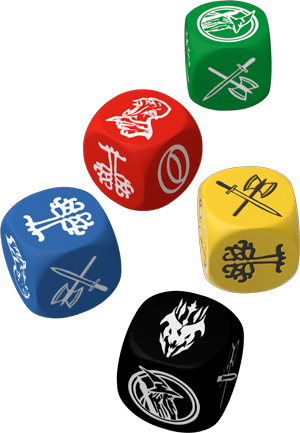
BACKGROUND:  Journey to Mordor is a dice game published by Devir and Fantasy Flight Games for 2 to 4 players.  Players take control of one of the 4 Hobbits to destroy the One Ring

GAMEPLAY:  Each player takes a color, and rolls the 5 dice on their turn.  They must keep at least 1 die per roll, and cannot keep two of the same on the same roll.

RESULTS:  Once they have finished the player marks off a location on their map for each Ring showing.  However, if more Orcs are shown than Fellowship swords, the player does not advance.  Nazgul cause the player who own the color on the die (or the roller if the die was black or that color isn't being played) to advance on their map below their route, while Gandalf makes it so 2 Nazgul must advance on any empty location.  Finally, the White Tree ends the players roll, but a player may ignore any symbols other than Nazgul.

ADVANCED:  In the advanced mode, there are additional rules for all locations save Bag End or Mordor.  For example, in Helm's Deep, All Orc results are doubled.  In Gondor, Nazgul only affect other players.


WINNING:  Once a player has crossed off the last location on the Nazgul path in Mordor, hethey are eliminated.  The player to make it to Mordor on their path wins.

CONCLUSION:  I do not enjoy playing this game.  There is no real choice or strategy made here, and what little strategy is there is made simply by not taking bad things.  The theme fares little better, as the point of the Fellowship was to band together to help each other, and all 4 Hobbits are fighting each other in this game.  The one compliment I can give this game is that the maps and dice are nice looking.  This is the game that you play with younger relatives or children in order to teach them the concept of strategy and pattern recognition, but don't expect to actually enjoy playing it.

Wednesday, March 7, 2018

Exterminate! Exterminate! (Dalek Dice)

The Doctor steps out of the TARDIS, a smile on his face.  "This, my little friends," he says, holding up an ordinary looking teapot.  "is a teapot.  BUT!  This is a teapot from tomorrow, taken from this place, and this cup is from yesterday."  The Daleks lights start flickering, realizing what this means.  The Doctor has stopped them in the past, present and future.   The Doctor pans to the camera, "And this is Dalek Dice."
CUE INTRO


BACKGROUND:  Dalek Dice was published in 2016 by Cubicle 7 Entertainment for 2 or more players.  You and your friends are Daleks, wanting to exterminate the humans before the Doctor shows up.

GAMEPLAY:  Each turn, a player rolls all the dice.  They must take 1 and only 1 TARDIS and EXTERMINATE (indicated by the lack of number), and at least 1 Human or Dalek die.  Each of the numbered die represents that many units.  Then players roll until they wish to stop or cannot roll anymore.


SPECIAL:  If 3 TARDIS' or are rolled, the player ends their turn and scores 0 for the round.  If a player rolls 3 EXTERMINATES, they will not roll anymore, and double their score on counted humans.  If a player would not be able to roll next turn, they will still score 5 points.  If there would be dice they could roll, they cannot score.

SCORING:  If a player manages to get more Daleks then Humans, the player counts up the collected amounts of humans and scores that many points.  A player may also score 5 bonus points if they would not be able to roll any longer.  If a player rolls more Humans than Daleks, they score 0 points.

WINNING:  The first player who hits 60 points at the end of their round wins.

CONCLUSION:  This feels like a Steve Jackson dice game.  Simple, easy, and to the point.  As long as you can count and roll, you can play.  Obviously, this is going to drive off people who dislike games of chance.  However, this is a light in-between game for other games or during your Doctor Who watch party.  For non-fans, I would consider sticking with Zombie Dice.

Wednesday, February 28, 2018

Luck Be a Lady Tonight (Rollers)

We see the players coming here, a piece of paradise.  Welcome, everyone to the years championship as we play down from 4, to a champion.  Ladies and Gentlemen, this is Rollers.


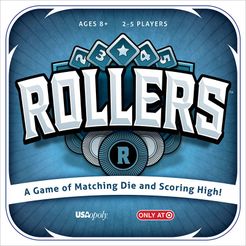
BACKGROUND:  Rollers is a dice game published by USAoploy for 2 to 5 players.  Rollers exclusive to Target.  Players attempt to make combinations of rolls to score points.

GAMEPLAY:  Each player is given a board and and 5 white and purple coins.  During a players turn, they roll all dice up to three times, and may not roll any dice they wish to keep.  If a player rolls a lightning bolt, they cannot keep any dice rolled, but all dice previously kept are set.  Any stars rolled are wild.


BOARD:  Each board has an Open and Closed section in the middle and bottom, respectively.  Once a matching combination is made, they may put a marker in the board  In order to "close", or put a marker in a closed slot, there must be a marker placed in the open slot.  If at any point a player has a section closed, they get coins equal to those numbers from all players who do not have that number closed.

WINNING:  Once a player closes all sections on their board, the round has ended.  The player who closed gets 2 points, with points indicated on the top of the board.  The player with the most coins gets 1 point.  Players reset the bottom and middle of the boards, and start again.  The player to hit 5 points first wins.  If multiple players hit 5 points, the player with the highest coin value wins.

CONCLUSION:  Rollers is a game of mostly chance, just like most dice game.  There is a small bit of strategy of when to keep and when to roll, but it tends to be a push your luck game.  It would find a home for people who love Yahtzee style games.

Wednesday, September 13, 2017

Last Chip Remaining (LCR)

It's the final showdown.  Uncle Jimmy has been sheriff for too long in these here parts, and you're the only one who can take him down a peg or three.  You lock eyes, and your hand hovers above your weapon of choice.  You grab it, and roll.  R, no!  You pass your last chip to Jimmy, and curse the heavens silently how LCR has betrayed you again.


GAME DESCRIPTION:  LCR, or Left Right Center is a simple dice game published by George & Company for 3 or more players.  It is a pure luck game, with the goal to be the only one left with any chips.

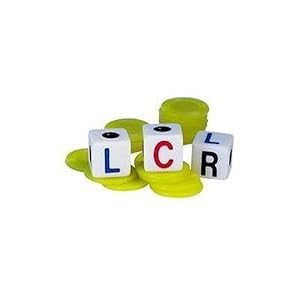
SET-UP/GAMEPLAY:  Each player begins with 3 Chips.  The starting player rolls the dice.  If R or L is rolled, the player passes chip(s) to the right or left, respectively, equal to the number of R's or L's rolled.  If C is rolled, it is placed into the center pot.  Dot's rolled have no effect.  Play then passes to the next player.

WINNING:  A player may only roll an amount of dice equal to the number of chips they possess.  A player incapable of rolling may still come back into the game if a player passes a chip to them.  The winner is the last player with any chips left.


CONCLUSION:  LCR is that game you play with your in-laws when they come down for Christmas who play more traditional games, or are too young for complex games.  It's alright if you want to spend a few minutes talking with people as a way to keep your hands busy. Otherwise, this is not a fun game.  It is a time waster, nothing more.  There is no strategy, no skill, nothing to put yourself into the game. If that's what your looking for, this does it well.  Otherwise, you can pass on this without missing on much.

AFTERTHOUGHTS:  There are variations of this game.  One is called Last Chip Standing, which plays the exact same but has a cowboy theme.  If you really want this game for a stocking stuffer or an in-law speaking piece, I'd recommend LCS.  There is  Last Chip Standing: Devil's Luck, which I have not played, but has more effects depending on what you roll.  The game doesn't change from being pure luck, but it does seem a little more something like Cthulhu Dice or Zombie Dice.

Wednesday, June 7, 2017

Don't Go Bacon My Heart (Pass the Pigs)

Don't be dis-gruntled by all these puns, just enjoy the game.  But be careful, there may be Truffle ahead.  Expect a twist in the tale.  And when it's time to Pass the Pigs, don't do it so ham-fisted.  After all, we don't need Pulled Pork.  


GAME DESCRIPTION:  Pass the Pig is a "Dice" game published by David Moffat Enterprises for 2 or more players.  Players attempt to gather points by rolling the Pigs.

PIGS:  The game contains a scorepad, pencils, and 2 small plastic Pigs.  Each turn, one player rolls the pigs onto a flat surface.  The player gains points depending on the position of the pigs.  If a pig is on its side, it gives the player 0 points.  If it's on its back, or standing up, it gives the player 5 points.  If on its snout, 10 points.  If its on both snout and ear, 15 points.

COMBOS:  In addition, if both Pigs are rolled in a specific pattern, the player will get more points.  For example, if both Pigs are lying on their back, then the player gets 20 points instead of just 10.  However, if the Pigs land touching each other, or if one is lying on its left side, and the other on the right, that player loses all points gained that round and the Pigs are passed to the next player.


WINNING:  At any point, a player may stop their roll, and keep the points that they gained that round.  Any player can win when they stop at a predetermined set of points.  However, if a player manages to roll the Pigs so that one Pig lands completely on top of the other, resting all 4 feet on the others back which is also on all 4 feet, then the player is out of the game.

CONCLUSION:  This is a strange game indeed.  It definitely plays similar to games like Zombie Dice.  However, whereas those games are built as dice games, this one feels less balanced.  According to Wikipedia, just landing on the highest points is a less then 1% chance to get it.  Because of that, it seems like there's something a bit too gimmicky.  And yet, I still enjoy it.  Maybe the gimmick is something I like, as a novelty.  I wouldn't recommend playing this weekly, but give it a chance, you might not think it so hogwash.

AFTERTHOUGHTS:  Thanks to Lizzy-thelizzard Gaming for the bevvy of Pig puns strewn throughout this review!

Wednesday, May 24, 2017

Five Dice, One Winner (Dice City)

Hear ye, hear ye, to the plight of the city!  Queen Statsia, of the Kingdom of Rolldovia, has decreed that there shall now be a new capital, to rival the old one.  Rumors of the old capital being pillaged and desecrated are greatly exaggerated, and as such, should be disregarded. Those who believe their city is the best of the land shall compete in a contest to see who deserves to be the new capital of Rolldovia!


GAME DESCRIPTION:  Dice City is a dice game for 1-4 players created by Vangelis Bagiartakis and published by Artipia Games.  Players roll, move, attack, and gather points to see whose city should become capital.

SET-UP:  Each player takes 1 Player Board, and 1 set of different colored dice (Red, Blue, Black, Yellow, White).  Split the Lumber Mill, Quarry, Mine, and Regular Army cards into 4 separate stacks face-up.  Shuffle the rest of the Location Cards and place them face-down. Next, draw 8 cards and place them together face-up, as the Display.  Place the Bandits Cards and Trade Ships in three separate piles, with each pile being indicated by the number in the bottom right.  Each Bandit pile will only have a number of cards equal to the total number of players, plus 2.

START:  All players roll their dice, and put them in the appropriate number (located on the top of the Player Board) and color (located on the side) location.  The player to have played a game most recently with dice rolling starts.  During their turn, each player has 4 steps to follow in order: Use Dice, Attack, Building & Trading, and End of Turn.


USE DICE:  During the first step, you may use an action by "spending" a die by moving it from the board.  These actions are:

  • Use the location beneath the die and resolve its ability.
  • Move another die to an adjacent space on that die’s row.
  • Reactivate a Deactivated location anywhere in your city.
  • Once per turn, discard four of the Location cards in the display that are available to build and reveal four new ones.
  • Once per turn, pass and gain a Pass Token.
  • Instead of a die, you may spend two Pass Tokens to gain one Resource of your choice, increase your army strength by 1 for the turn, or force all other players to re-roll one die of your choice.
     
Once all Dice are spent, the turn moves to the Attack step.

ATTACK:  During this turn, any Attack units used (indicated by a sword) increases your Army strength.  You may attack either Bandits, Locations, or Stock.  For Bandit and Location cards, you must spend a strength higher than the cards defense.  Note that not all Locations have a Defense, making them unable to be attacked.  For Bandits, you gain that Bandit card and place it off to the side, until all those Bandits are gone.  For Locations, place a Deactivation Token on the location.  That player cannot use that Locations ability without Reactivating it.  To gain Resources from another player, you must spend 2 times the Resource(s) you want to steal.  Your Army then returns to 0 at the end of the turn.  

BUILDING/TRADING:  Every other non-Bandit card has a cost of Resources, usually located in the top right, or the bottom for Trade Ships. During this step, you may spend your collected Resources to gain one of these cards.  Trade Ships will go off to the side.  Any Lumber Mill, Quarry, Mine, and Location card bought from the Display will go on the Player board.  These cards can be placed anywhere on the board, but will replace the effect underneath it.


END OF TURN:  If you have any Resources remaining, you may keep one of each kind, with the rest returned to their stock.  All Pass tokens collected remain with the player, however.  The player re-rolls all of the dice and places them back on their Player board.  Then the turn ends, and play passes to the next player.

VP:  Almost every card has a number in a star in the bottom right.  These are Victory Points.  You gain Victory Points from gaining that card, or from a Location's effect.  When you do, you gain VP token(s) equal to the points gained, and place them face-down.  When you attack and Deactivate a Location, gain VP token(s) equal to the deactivated card.

WINNING:  The game ends in one of 3 ways:  Either all three of the bandits piles or two or more of the trade ship piles have run out of cards, the location deck runs out of cards, or any player calls the game over when they have two or more rows on their board filled with built locations, none of which have Deactivation tokens.  The game continues until every player has had the same number of turns.  The player with the most Victory Points wins.

CONCLUSION:  This has always been a hard game for me to review.  There's a little too much down time in a four player game to end as quickly as it does.  I do like that while there is a lot of luck involved, it is aware and does a little to help mitigate it, but not in a way that feels forced.  Also, the single player mode helps to build strategy and see what play styles work for you.  Being able to adjust the difficulty also helps make the game more enjoyable as you see what works and what doesn't.  I would recommend this if you enjoy games like Dominion.  To everyone else, it may be a hard sell, but I would say if you do want to play this, either start with Single Player or limit to three players, as the down time is lessened.

AFTERTHOUGHTS:  A quick thanks to Slumpymaster for helping me with the single player part of this review.  You can check his stuff out over on the right.

Wednesday, November 2, 2016

Cards or Dice? Why Choose? (Combo King)

1, 2, 3, it's winner take all!  Energy is high, the risk is low, and the dice run wild here in our little casino.  Yahtzee has nothing on this!  So take the dice, play the cards, and see who has the right to claim the crown tonight and become the Combo King!

Image result for combo king board game

GAME DESCRIPTION:  Combo King is a game for 2-4 players published by Gamewright.  The object is to play a card, and roll the dice to match the requirement on the card.

SET-UP:  Each player is given 1 chip, and is dealt of hand of Combo cards.  Each player then rolls 1 die, with the first player being the player that rolled highest.

TURNS:  Each turn, a player plays a Combo card from their hand.  The top and bottom squares on the green felt background determine the rules to be played.  The bottom left shows a hand, with various fingers held up, or a "U".  This determines how many rolls you get to attempt to fulfill the card, with the "U" indicating the player or players roll until the card is completed.  The bottom right contains either a red, green, or black circle.  A green circle indicates that you can "save" dice, or put the off to the side during your next roll for the card.  Red and black indicate you cannot.  The top left determines how many players are involved, with 1 being only the player who played the card.


CHIPS:  At either the beginning or end of your turn, you may pay chips to apply an effect, located on the Chip Chart cards:

  • 1 Chip: Take another roll.  This can be used as long as you pay.
  • 3 Chips: Take another turn.  You can attempt the card you just played, or attempt a new one.
  • 5 Chips: You can either force your opponent to draw a card, or trade an opponent a card with one of their choice.
  • 7 Chips: Trade a card from your hand with one from the discard pile.
  • 9 Chips: Discard any card from your hand
SUCCESS:  If you succeed in fulfilling the cards requirements, you discard the card.  Then, you are given an amount of chips indicated at the top of the card.  However, if you fail a card twice, then on the next turn you can discard it and draw a new card as your turn.  The winner is any player who manages to discard their entire hand.


CONCLUSION:  Combo King is a dice and card game, pure and simple.  The game is focused on luck and RNG.  Still, it's a great game for all involved.  Kids can learn counting, math skills, and logic just by playing without the chips, and adults can learn simple strategy by learning when to spend chips, and when to bail on a card.  It's simple, quick, and enjoyable for those looking for a low-stress game, or as a wind down for game nights.

Wednesday, October 12, 2016

Flying Through Udder Space (Cosmic Cows)

Log entry 5978:  The Earth creatures known to the locals as "cow" simply fascinates us.  They seem so unaware and accepting of their fate when we abduct them.  So, while waiting for our Commander, we have decided to play a game, seeing who can capture the most.  Sub-Commander Draub wants to call it Space Cow Chess, but that's stupid.  We've agreed on "Cosmic Cows" until a better name can be chosen.  So for, I'm winning.

Image result for cosmic cows

GAME DESCRIPTION:  Cosmic Cows is a 2 player dice game published by Playroom Entertainment, and created by designed by Maureen Hiron.  The object is to move Cows from the center of the board to your "Win Zone".

SET-UP:  Set the board between both players.  Place the 9 Cows in the middle of the board, on the green "grassy" area. Each player is given a set of 5 matching dice.


MOVEMENT:  Each turn, players roll their set of dice up to three times.  Between rolls, they may set aside/re-roll any amount of their dice, and roll again, or stay with their current roll.  Cows move closer to the player who rolled according to a specific roll (similar to Yahtzee):

  • Pair:  Move the cow on the board in the column that matches the number you rolled 2 spaces towards you.
  • 3 of a Kind: Like the Pair, but move 3 spaces instead of 2.
  • 4 of a Kind: Like the Pair, but move 4 spaces instead of 2.
  • Two Pairs:  Move the two cows in the columns that match the number you rolled 2 spaces each.
  • Full House:  Move the cow in the column that matches the number of the pair you rolled 2 spaces, and the other cow that matches the number of the other dice you rolled 3 spaces.
  • 5 of a Kind:  Move the cow in the Super Beam Column closest to you.
  • Small Straight:  Move the cow in the Straight Column 3 spaces
  • Large Straight:  Move the cow in the Straight Column 4 spaces
  • Chance:  If no other conditions can be fufilled, or the player wishes to move this cow, add up the total number rolled.  If the total equals 10-12 or 23-25, move the cow in the Chance Column 3 spaces.  If the total equals 5-9 or 26-30, move 4 spaces.
WIN ZONE:  Each player has a Win Zone, indicated by the red spaces on the board.  When any player gets 3 cows in their Win Zone, they win the game.


CONCLUSION:  Cosmic Cows is like Space Yahtzee, in a way.  It can be fun to play through once, but due to it's reliance on luck and basic rules, it's hard to recommend after a couple playthroughs.  The fact that this game is for only 2 players makes it limited in where and with whom you can play this. This game would work great for kids who want something with a little more visual feedback than something Yahtzee or Farkle can provide.  It's a good choice to play a round if you're looking for something a little more intimate with someone close to you.

Wednesday, June 29, 2016

Gambling to the Top (Lords of Vegas)

The year is 1941, the place is a little desert town known as Las Vegas.  Your goal: to create a sprawling fortune the likes of which have never been seen before, by changing this small town of little notoriety into the biggest entertainment scene this side of the Rocky Mountains.  But your biggest obstacle won't be money or bringing in customers.  No, the biggest threat to your empire will be your former friends also wanting to become the Lords of Vegas.


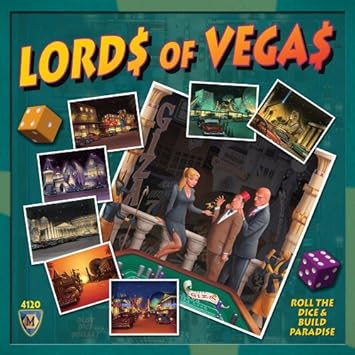
GAME DESCRIPTION: Lords of Vegas is a 2-4 player game published by Mayfair Games.  The objective is to build Casinos to gather points.  The winner is decided either by who has the most points when the End of Game card is drawn, or if any player manages to get to the end of the board before then.

THE BEGINNING: Play starts by selecting 1 of 4 colors, and placing the appropriately colored scoring counter on the board spot marked 1.  Each player than draws two Property cards from the deck.  The money on the card determines the total they start with, as well as the first 2 starting locations for each player, determined by placing the markers according to the alphanumeric location on the card (e.g. C4).

LOTS AND LOCATIONS: The game board is divided into 6 separate locations based on letters.  Each turn, a location card is drawn, and the player places a marker in that alphanumeric location, defined as that players Lot.  For every Lot, each player gains $1M.  The player may then spend money to buy a Casino in 1 of 5 colors.


CASINOS:  Casinos are how you'll make most of your money and get points.  Each turn, you may buy a location equal to the amount located on a location you already own a Lot on, or you may buy another location and place a Casino next to one you already own at twice the price printed on the board.  When you buy a property you'll notice a die number printed on the board.  That determines what the starting value of your property, and you'll place one of your dice into that Casino matching the number of pips shown. When a Property card is drawn that matches the color of a Casino, you'll gain that much money equal to the number of pips in all matching Casinos, and 1 point per matching Casino.

GAMBLING:  Any player may gamble at another players Casino, at a maximum of $5M per Casino.  If the player does not roll a matching number according to the boards wager space, they lose that money.  If they match a number, they gain that money from that player, with 2 and 12 doubling what they wagered.  If the player being bet against cannot pay the bank covers it.

STEALING:  If you place a Casino next to another player's Casino with the same color, the player with the highest numbered die now has control over all matched Casinos. All money and points will then go to that player.  If you have a die in a Casino or matched group of Casinos, you may spend money equal to the number of pips shown to re-roll all dice in each Casino.  You may also pay $5M per Casino to remodel the Casino to change it into a different color.  In the case of ties, you re-roll only the highest tied numbers until one player is definitively in control.


POINTS:  Each player gains a point times the number of matching colored Casinos when a property card is drawn.  However, there are bars of entry starting at 10 points called "Break".  To move past a break, you must have enough points to make it past it, with any excess points lost.

WINNING:  At the start of the game, the player shuffling the Location cards puts a special card called End of Game in the bottom quarter of the deck.  When that is drawn, all points are scored, all money distributed, and the game is over.  The winner is the player with the most points, or in case of a tie, the most money.  If you have managed to get 90+ points by the end of the game via the scoring system before the card is drawn, that player automatically wins (though this is rare).

CONCLUSION:  I've heard this called 'the fair, fun Monopoly', and I get why that comparison exists.  Like Monopoly, it can be a ruthless, cutthroat game that the luck of the dice (or cards, in this case) can factor in a huge lead or crushing defeat.  But this game can also whiplash any player into making a sudden comeback and cause come from behind victories.  It definitely has a strong give and take quality that makes it superior to standard board games.  This game is for strong friendships, risk takers, and deep strategy planners.

Wednesday, March 30, 2016

One of us, one of us (C'thulhu Dice)

You slip the comfy robe over you, and tie it tight.  You light the candles at the shrine, and give your offering to the great C'thulhu.  Tonight, you ask for his favour and aid to prepare for his coming.  But he is a fickle Eldritch, and you know that his 'aid' may only cause you to lose your mind.  You took that risk when you became a follower.  You know when it comes to C'thulhu, you might as well...roll a dice.


GAME DESCRIPTION: Cthulhu Dice was created by Steve Jackson Games.  Out of the bag, it can only support up to 6 people, but it's designed to hold as many as are willing and able to play.  The object is to not go insane, which is made difficult due to the C'thulhu die rolled each turn.

C'THULHU: C'thulhu is also a player in this game, represented by a pot in the middle.  Each turn, one player chooses any other Non-Cthulhu player, then rolls the dice and applies the appropriate effect:
  • Yellow Sign: Looks like a question mark with two extra symbols.  The player chosen loses 1 sanity to C'thulhu
  • Tentacle: The roller takes 1 sanity from the chosen player.  If the roller is currently at 0 sanity, then the sanity goes to C'thulhu
  • Elder Sign: The roller gains 1 sanity from C'thulhu.  If C'thulhu is a 0 sanity, nothing happens.
  • C'thulhu: Every player loses 1 sanity to C'thulhu
  • Eye:  Shaped like an Egyptian eye symbol, it is the wildcard roll.  The roller applies any other effect mentioned above.
The targeted player than "responds" by rolling the die. Play then continues on to the next person to the left from the roller.
SANITY: Every player starts with 3 sanity tokens.  Sanity tokens are what allow you to potentially win.  If you end up losing all 3 tokens, you go insane.  You will still roll when it's your turn.  Your opponent cannot respond to your rolls, however.  The only way to gain sanity back is if you roll the Elder Sign.  If only one player has sanity, they win.  If all players lose their sanity, C'thulhu wins.

CONCLUSION: A simple, quick party game.  The option of adding as many players as you want really helps the game.  It's pretty fun to pull this out as the night is winding down, and you've only got a few minutes to play.  The only real weakness this game has is it's almost entirely luck based, and it's simple.  If you want something quick, this is great.  If you're looking for something to just relax with and talk with your friends, this is definitely the game to do that.  You're just not going to find anything with real substance or skill here

Thursday, March 10, 2016

Mmm, brains (Zombie Dice)

Shambling through the forest, you hear a faint noise. You fall into a clearing and see them.  Two humans, both with tasty brains.  You haven't eaten in quite some time, and the shot you took awhile back is certainly slowing you down.  But you're hungry, and you need to take the risk.  You choose to shamble to them.  You manage to get both people's brains, but not without taking a shot in your shoulder.  But that's the risk you take when you're a zombie.  Now, you have to take the chance, and roll the Zombie Dice.


GAME DESCRIPTION:  Zombie Dice is a *ahem* dice game created by Steve Jackson Games.  You take the roll of a zombie during the zombie uprising.

PLAY:  Each turn, you take 3 dice at random, and roll an encounter to determine the outcome of that turn.  You can then choose to keep progressing and roll 3 more randomly selected dice, or you can pass to the next player.  The main objective of the game is to just keep eating brains from people without dying, until you become full.

DICE EFFECTS:  Each die has a different group of colored symbols on them.  The colors determine the difficulty of the roll, with green being the easiest, yellow the next difficulty, and red being the most difficult.  The shape of each die determines the effect of the encounter
  • Brain:  "Yummy." Each time this is rolled, the die goes off to the side.  If you pass, the total number of brains rolled increases your score permanently.
  • Shotgun: "Ouch." These also go off to the side.  If you get a total of three shotguns, your turn ends, and you gain 0 brains this turn.  
  • Footprints: "Almost."  Any footprints you roll this turn are re-rolled, decreasing the amount of dice you draw for this encounter.


WINNING:  The first player who collects 13 or more brains puts the game into the final round.  At this point, every other player gets one more turn to attempt to out-roll that player.  The winner is then declared after the last player ends their turn.  In the case of a tie, the players that tied each play one additional round.

CONCLUSION:  This is a nice little game to play after a high-stress event.  With little decision making involved, it's a nice game to with which to shoot the breeze.  It also makes for a simple ice-breaking game.  Of course, as with all of Steve Jackson's games, there is definitely some room for interpretation and house-ruling.  The expansions are also a lot of fun, such as including new effects, new ways to keep playing, and getting brains from Santa (if you don't end up eating his brain).  I do love this game, and recommend it for small parties and at the end of game nights.