Showing posts with label Tile. Show all posts

Wednesday, August 7, 2019

Maybe He Was Just a Dragon (TROGDOR!! The Board Game)

Deep in the heart of the peasant kingdom of Peasantry, there exists an order.  And though they may be few in numbers, the Keepers of Trogdor (The Board Game) are mighty in power.  They keep the mighty dragon alive and well, full of Majesty and Consummate V's, so that when Trogdor (The Board Game) awakens, the knights and archers of this land will not be able to slay him.  So, join the order, and help Trogdor (The Board Game) burninate the land and destroy the land of Peasantry.


BACKGROUND:  Trogdor! The Board Game is a co-operative tile game for 1-6 players.  It was created in 2019 by Boardelectrix (Mike and Matt Chapman), James Earnest, and written with  Loneshark Games.  All players work together to burninate the countryside and cottages, eat or burn the peasants, and avoid letting Trogdor perish.

GAMEPLAY:  Each players turn consists of 2 phases, their actions and the boards actions.  On their turn, the player draws and uses 1 of the 2 Trogdor Action cards, which determine how many AP (Action Points) and ability the player has that turn, or they may discard it for 5 AP.  AP is spent to have Trogdor either move orthnologically, Chomp and eat a Peasant, Burrow through a tunnel to the other tunnel tile, Hide in a mountain tile to become impervious to damage, or Burninate the tile.  Players don't have to use all their AP, but it's lost at the end of the turn.  Players may also use their Keepers of Trogdor abilities or Item cards once on their turn, unless otherwise stated, and items must be recharged to use it again, as indicated by the card.


PEASANTS:  Once a player has taken their turn. the board takes its moves.  The turn player draws a Movement Card.  Place Peasants in un-Burninated cottages according to the Peasant meter in the top right corner to equal the amount on the board.  Then, the Peasants move according to the peasant arrow.

KNIGHTS:  Finally, the knights and archers move according to the movement path on the right.  If a knight moves into Trodgors space, he takes damage.  The archer shoots both directions of the last direction he moved (if he moves west, he shoots east and west), except in his own space. If Trogdor takes damage, a 3rd knight spawns, the Troghammer.  He acts like a Knight, but can also move if one of his cards is drawn.  Peasants, Knights, and Archers have "wrap-around", so if they move off the board in one direction, they appear in the appropriate tile on the opposite direction.


BURNINATE:  The goal of the game is to Burninante all the tiles.  When a tile is Burninated, it's flipped over.  Cottages can only be Burninated if it and all surrounding tiles are Burninated.  If a Peasant is on a tile that is Burninated, they are drawn and given a movement path, and go into the void afterwards, Burninating any tiles along the way.  Knights can repair any cottage along their path, and Peasants sometimes can repair tiles according to their movement.


WINNING:  The players win if all tiles and cottages are Burninated, and no more Peasants are on the board.  However, everytime Trogdor takes damage, he loses a Peasant from the Trog-meter.  If he were to take damage while no Peasants were in the Trog-meter, he has FIERY RAGE!  The player draws 5 Movement cards, and follows their paths, Burninating every tile and cottage along the way.  For this action, Trogdor has Wrap-around, and immediately sends all Knights and Peasants into the Void.  If all tiles and cottages are Burninated, and there are no Peasants left, the players still win.  If not, the players lose.

CONCLUSION:  Oh man, this one is crazy. First off, note that there are 2 major points of criticism, the decks and the cooperation.  There's an amount of luck that goes into co-op games that can frustrate a lot of players, and some players just don't work together well.  So, now that that's out of the way, I can talk about the positives, and there are a lot.  First, it's FREAKING TROGDOR!  Obviously, if you don't know the theme, you won't be as excited as I am, but that's okay.  This game plays incredibly well for those who aren't aware of the theming.  In addition, even if you don't, it's easy to see that a lot of care was put into the theme of this game.  Now, the gameplay.  If you have ever played the original Trodgor, there's some inspiration from that, such as Troggie not getting the Wraparound, but the other characters do.  The game feels great, being able to control 1 character amongst the party, but due to his level of strength and abilities, it nevers feels too broken or ridiculous.  Actually, like most co-op games, it's really hard to win, but you never feel like it's because you can't do something, it's more like you are either just unlucky, or (more likely) you didn't plan ahead.  So go and visit this pleasant kingdom of Peasantry, I know I will again sometime soon.

AFTHERTHOUGHTS:  For a bonus, I'll link the original source and some additional flavor for the game:
DRAGON: https://www.youtube.com/watch?v=90X5NJleYJQ
RULES SONGS: http://trogdorboardgame.homestarrunner.com/rulebookEP.html
SOUNDBOARD: http://trogdorboardgame.homestarrunner.com/soundboard/

Wednesday, July 3, 2019

Celebrations Overwhelming (Lanterns: The Harvest Festival)

The harvest has come in, the season is cooling, and it's time.  Looking over the crisp blue lake, a single light starts floating over it.  Then another, and another.  Soon, the Royal blue of the lake is interspersed with specks of colors, from ivory to emerald, amethyst to crimson.  The crowd gathers as the wind lifts high the symbol of the The Harvest Festival, the Lanterns.


BACKGROUND:  Lanterns: The Harvest Festival is a tile game for 2-4 players.  It was created in 2015 by Christopher Chung, and is published by Foxtrot Games.  Taking on the role of the artisans, each players is making a dedication at the palace lake to gain the most honor and become the most respected in the land.

GAMEPLAY:  Each turn, players will take the following 3 actions; they can exchange a Lantern card, make a Dedication, or place a Lake tile.  They must be taken in this order.  First, players may choose to spend two red Favor Tokens to trade a colored Lantern card for another available one.  Then, players may choose to return to the supply an appropriate number of Lantern cards to gain Dedication token.  Finally, the player must play a Lake tile from their hand so that one of its sides lines up with those on the board.


LAKE:  If the player places a Lake tile next to another so that the color of their tile matches an adjacent side of another Lake Tile, that player receives a matching Lantern card.  If there is a Platform, indicated by a symbol in the middle, that player gains a Favor token.  Finally, each player, starting with the player who is currently taking their turn, gains a Lantern card (if available) according to the side of the tile 'facing' that player.  If a player wants to gain a white Lantern, for example, they need to orient the card so that the white side would be aligned with their 'area' of the table.

WINNING:  The game ends when all Lake tiles are placed, and each player gets one last turn for Exchanging Lanterns and Dedications.  Each Dedication token has a number of 'Honor' on it.  Each player adds up all their Honor, and the player with the most Honor wins.

CONCLUSION:  Lanterns is a neat strategy game that can initially trip you up, but is actually easy once you get the hang of it.  It's biggest issue is that there are quite a few games where catching up with an opponent who plays perfectly optimal and draws even kind of well can be discouraging, but that's the risk you run when you can mitigate the luck as much as you can.  The favor tokens don't really feel great in gaining them, either, as I've seen too many games where players just can't get them, which can slow the game down a bit.  That being said, the game is fun, and the strategy is there.  It can be tempting to match two sides to get 2 Lanterns, but if they don't help your strategy, it might be better not to do that, and just get the Lantern color you do need.  If you like games of strategy and tile placement, this is one festival you shouldn't miss out on.

Wednesday, June 12, 2019

WarGames Never Changes (Fallout)

War.  War never changes. We know that all too well, but this time feels so much more real.  Maybe because I wasn't there for the bombs in Hiroshima, for the Great War and it's consequences.  Maybe it's because I have to deal with this, here and now.  Or maybe it's because there's a spider crawling up my leg as I write this.  That's life in the wasteland, in the world of Nuclear Fallout.


BACKGROUND:  Fallout is a Strategy board game for 1-4 players.  It is based on the 2015 game, Fallout 4.  It was designed by Andrew Fischer and Nathan I. Hajek, and published by Fantasy Flight Games.  Players align with various groups to battle against their rivals and the wasteland itself, to become the best faction and rule the wasteland.

GAMEPLAY:  Each player has 2 actions they can take on their turn:

  • EXPLORE:  Flip over a tile face-down Map tile when on an adjacent space.
  • MOVE:  Gain 2 movement points.  A Movement point is used to move the player to an adjacent spot, seperated by white lines.  Difficult terrain, marked by a red line, requires spending 2 movement points.   (These can be used during or after any action during the players turn.)  
  • ENCOUNTER:  If the players location has either a Wasteland or Encounter icon, they can choose to have the next player draw from the matching deck and read the text in italic and next to each number.  Once the player chooses which number they want/can fulfill, the reading player reads their result under the chosen text. 
  • QUEST:  Some Objectives require the player to take this action to complete.  Whenever an Objective is fulfilled, the player takes the rewards from underneath, and reveals a new one at the end of the turn.
  • FIGHT: If a player is in a space with a face-up enemy, or in an adjacent while they have a ranged weapon, they may choose to fight it.
  • CAMP:  The player heals 3 HP, Unexhausts all items, and gains a Well-Rested trait, to spend to reroll for a test or battle.


COMBAT: When a player Fights, they roll the 3 VATS dice, attempting to roll the matching body parts indicated on the enemy token.  However, any stars, or Hits, deal that much damage to the player.  If the weapon the player is using has a SPECIAL letter, and the player has that letter, they may reroll.  If the number of dice hit the enemy is equal to its level, indicated in the green gear, the enemy is defeated, the player gains XP on their board equal to its level, and a new enemy is placed face-down on the original starting space of that enemy.

LEVEL:  Once the XP peg reaches the end of the board, it goes back to the beginning (adding remaining XP), and the player draws two new random SPECIAL letters, keeping only one.  If it's one the player already has, they draw a one shot Perk card indicated by the letter they kept.

ENEMIES:  Once all players have taken their 2 actions, a player draws an Agenda card.  The symbols on the bottom of the card activates all matching face-up enemies, and flip over all face-down enemies face-up.  Any activated enemy moves a space closer to the nearest adventurer.  Any activated enemy in a space with a player fights them.

TESTS:  Some Encounters requires a player to do a test, indicated by SPECIAL letters and a number. The player rolls the VATS dice, attempting to get a number of Hits, equal to or higher thant he printed number.  Any SPECIAL letters the player has on their board matching the letters printed lets the player re-roll any dice per matching letter. 


DEATH:  If at any point the green Rads and red Health marker at the bottom of a players board meet, then the player's figure is placed on the Crossroads Camp space.  Their Health goes back up to full, while their Rads stays the same, and they discard all non-equipped inventory cards. If a players Rads are at the highest point, they lose the game and are eliminated.


WINNING: The game ends if any Faction reaches the end of their track, or if any player reaches the goal on their private Agenda card.

CONCLUSION:  Fallout is an incredibly detailed game, faithful to its source material.  However, just like Dark Souls, that dedication to theme leads to a mechanically clunky and slow game.  Even when playing with people who try to make the most out of their turn and plan on other players turns, it takes a while due to combat, and tests.  That is not to say it is a bad game, but that it merely appeals specifically to fans of Fallout, such as the Dark Souls game appeals to its player base.  If you are such a fan, try it out, see what you think.  Anyone else, this is one Fallout you're best avoiding.

Wednesday, May 22, 2019

Pandemic 2: Electric Bugaloo (Pandemic: The Cure)

Note dated Jan 18, 201X (discovered on USB in Antarctic station)
So, the first Pandemic wasn't enough for you?  You had to go and cause another outbreak?  Fine, I've washed my hands of this mess.  If that's too much for you, you can go find the specialists who can stop this thing.  Oh, it's not as bad this time?  That's what you said last time, and we literally decimated the world.  It's your fault, you clean it up, you go find The Cure.
--XXX


BACKGROUND:  Pandemic: The Cure is a card and dice game for 2-5 players.  It was created in 2014 by Matt Leacock, Bernard Bittler, Philippe GuĂ©rin, Chris Quilliams and published by Z-Man Games, Inc. A rework of the popular Pandemic, players transport to different places to cure diseases.

GAMEPLAY:  Each turn, that players roll their dice and can either reroll them if it's not a Biohazard, or use the action on die.  Biohazards are used immediatly and raise the Infection track by one.  The syringe allows the colored dice to be moved from the locations to the Treatment Center in the middle of the table, or back to the Infection Bag.  The bottle is used to hold samples by taking the colored die and the sample die and putting them on the players card, which prevents them from using that die.  Once all their actions are done, the player can give samples to other players.


WINNING:  Once all that is done, players can roll the colored die in their sample bottles.  If they get a 13 or higher, one of those dice is placed on the "Cured" card, and the rest go back into the bag.  Rolling a 12 or less means that the dice used for samples are still unavailable to roll.  Then, once all 4 dice are on the Cured card, the players win.

INFECTION:  After a player chooses whether to roll for a cure or not, they then roll to Infect the regions by pulling dice equal to the Infection Rate on the board and rolling them.  Any crosses rolled are put in the CDC to be spent on face-up Event cards.  If at any point there would be more than 3 dice on an location, the Outbreak Meter rises, and that die is put to the next space.


LOSING:  Like most co-operative games, there are more ways to lose than to win; if there are 8 Outbreaks, if there aren't enough dice to draw from the Infection bag, or if the marker reaches the top of the Infection Track.

CONCLUSION:  It's a Pandemic game, first and foremost.  While it would seem that there would be a lot different with the dice mechanic and the events, there really isn't much different.  I will say that this is a little easier to win consistently, since it's easier to get to locations.  It also takes up way less room and time, if that becomes a factor in your game-playing decisions.  It takes exactly what worked in Pandemic and refines it, makes it smaller.  Any problems players might have with this game can be traced to Pandemic, so check my review there to see if this disease is fun for you to fight.

Wednesday, January 30, 2019

These Pecan Sandies Might Kill You (Forbidden Desert)

Pain.  That's the first memory you have.  The second is one of falling out of the sky.  The third is flying over the Forbidden Desert.  That would explain the heat.  You cough, and hear the creak of various seats and metal around you.  You call out, and everyone seems to be intact, but you quickly come to the conclusion that unless you can find that flying machine that brought you here, you're going to all perish from dehydration.  Let's just hope it get's up in the air...


BACKGROUND:  Forbidden Desert is part of the Forbidden series of survival co-operative games.  It is for 2-5 players, and was designed by Matt Leacock, artists C. B. Canga and Tyler Edlin, and published by Gamewright.  By taking a role, players work together to collect all the pieces of the machine and fly out before they die.


GAMEPLAY:  Each turn consists of a sequence of 2 events: A player may take up to any 4 combination of actions, and then Sandstorm cards are drawn.  These actions consist of removing sand markers on their tile or any orthogonally (or any non diagonally) from them, moving orthogonally to a space with less than 2 sand markers on it, flipping face-up a sand free tile they are on, and picking up a part.  At any point a player may share with another player water or items with a player they share a space with.

SANDSTORM:  The 5 by 5 grid will always have an empty space, where the storm is.  At the end of a turn, flip Sandstorm cards equal to the number on the Sandstorm Meter level, move the indicated number of tiles so that the 'storm' moves in the direction on the card, then place sand markers on the tiles moved.  If the storm can't move, nothing happens.  If a Storm Picks Up card is drawn, raise the Meter level, and draw that many cards next turn.  If a Sun Beats Down card is drawn, all players lose a level of water on their cards.


END:  Some tiles have arrows to determine where an Machine piece will end up being.  Players must find all 8 'clue' tiles to find where the Machine pieces will be, gather them up, and get to the Launch Pad! tile.  However, there are three ways to lose:  If any player reaches the skull and crossbones on their canteen or the on the Sand Storm meter, or if there are no more sand markers to add to the board.

CONCLUSION:  After reviewing Forbidden Island, and playing Forbidden Sky (expect a review on that one as well), I can confidently say that this is so far, my favorite version of the Forbidden series of games.  The flow feels a lot better, without losing the struggle of obtaining victory.  I would say the biggest problem I had was something a lot of co-op board games struggle with, and that's punishing a larger group than a smaller one.  It would make sense to go through a game with a full party and win more often than with 2 or 3 players, but it always seems like the opposite happens.  Still, this is a great game, and the best in the franchise, so go out and uncover your own copy today at your local game store.

Wednesday, January 16, 2019

Diggy Diggy Hole (Splendor)

You turn the jewels in your hand, checking the quality carefully.  True, you may be some minor noble who doesn't know a Princess cut from a Radiant, but that's beside the point.  These look good, and you have always been able to find contacts to make them seem better.  Your job isn't to make, it's to sell the splendor of these jewels, and sell you shall...


BACKGROUND:  Splendor is a tile collection game for 2 to 4 players, and created by Marc AndrĂ© with art by Pascal Quidault, and published by Space Cowboys.  Each player attempts to collect gems to gather more ways to collect gems and gather Nobles to your side

GAMEPLAY:  3 rows of 4 development cards are laid face-up.  Each turn, players may either gather 2 gem tokens of 1 kind, 3 gem tokens of all different kinds, 1 "wild" gold token and reserve a card in their hand so only they may play it, or spend their gems back to the center in order to buy a development card, according to its cost on the bottom left.  Players may only have 10 tokens at any time, returning any excess back to the center.


DEVELOPMENT:  Development cards count as 1 free gem in their top right each turn, and unlike the tokens, players are not limited to how many they can hold.  Development cards are also the only way to collect Nobles.  Nobles can only be collected at the end of a turn, when a player has the number of developments indicated on the Nobles card.

WINNING:  Nobles and various Development cards have Prestige Points in the top left.  The first player to reach 15 Prestige wins.

CONCLUSION:  Splendor is, should I say it?  Splendid.  There's a lot to like about this game.  It's easy enough that I can realistically teach all but the youngest of players how to play, but a depth most simpler games fail to reach.  The complaints I have are minor at best, laughably silly at worst.  First, games tend to be way too short.  It feels like you've just bought your first 2nd level Development, and the game is over.  The other is the amount of players.  Obviously, re-balancing this game would be hard for more than 4 players, but I would really like to make it so that might whole game night group of 5-8 players can play this together.  With the release of the Cities of Splendor expansion, that may end up becoming more of a reality sometime down the line.  Until then, as I said, this game is a Splendor to behold.

Wednesday, October 24, 2018

Who Ordered Dominoes? (Pip)

Welcome to the next week of Theme Month.  This time we look into a variation of one of the most well-known games, Dominoes.  Now, there are more variations of Dominoes then there are of almost any game, such as Spinners, Forth-Two, and Threes and Fives, so I had to really narrow it down to the one I thought had the most impact on me, or the one I played more recently, Pip!


BACKGROUND:  Pip is a tile game published in 1991 by Puremco.  It is a variation on the game of dominoes, with a few new twists thrown in.

GAMEPLAY:  Just like in Dominoes, players start with a hand of 9 tiles (15 for 2 players), while the rest remain face-down. The turn plays along the chain of dominoes by matching the same number of dots, or pips, on both sides.  If a player cannot play, they draw from the stock pile, and then must either play a tile or pass to the next player clockwise.

SPECIAL:  Unlike most Dominoes, there are 5 special tiles, which have effects when played, but which still must be matched:

  • Pip: Represented by a P with 3 arrows on the bottom, is a wild and can represent any tile.
  • S: Skip the next player
  • R: Reverses play order
  • A: Gives that player an additional turn.
  • D:  The next player draws a tile from the stock pile. If there's none in the stock pile, the player using the D tile passes a tile from their hand to the next player.


STARTING:  The game starts by any player first playing either the double 1 tile, or the double "Pip" tile, which turns into double ones.  If neither is drawn, one player draws from the stock, and the next player draws until a tile can be placed.  The next player then starts with either a 1 or a pip horizontal to the tile.  The next players then play on either the un-played side of the original domino, or on the previously played domino.  Players are free to play on either side of any domino, or on the top and bottom of the starting tile once both sides of the starting tile have had play.

DOUBLES:  When a Double is played, it is placed vertical to the tile.  Then, unless it is the starting tile, the next three plays must be played on the double using either a corresponding number tile or a wild-pip tile, until it makes a three tile path, which any player may play on.


WINNING:  The round is over when any player runs out of tiles in their hand, or when no player can place a tile from his hand, and the stock pile has been depleted, called blocked.  Players then score the tiles in their hand, with Pips being their number, Specials (besides Pip) worth 25, single Pips worth 20, and double Pips worth 50.  If a player ended with 0 tiles in hand, they score -10 points, to a minimum score of 0. The next round starts with either a double Pip or double 2, with the starting tile being the round number.  The player with the lowest score at the end of the 9th round wins.

CONCLUSION:  Pip is a Dominoes game.  Shocking, I know, but let me explain what I mean.  At the end of the day, even with it's special center piece holder, or its weird tiles, or even its ability to play more tiles, it is Dominoes.  Sure, it may look flashier, but unlike the other games I've reviewed this month, there's not a lot that changes it from just playing Dominoes.  Now, does that mean that you shouldn't play it, that it's just the same game with another skin, like most 'versions' of Monopoly?  Not necessarily.  While it is true that Pip is just Dominoes, it does have enough to be surprising, to stand out that it really is worth a look.  Just, if you want to try it, expect it to be Dominoes, and nothing else.

Wednesday, April 4, 2018

The Game of Zen (Tsuro)

Since the beginning, humanity has struggled to achieve a state of mind where one could accept all, and stress would no longer affect them.  Some have called this Zen, others meditation.  And although the name changes, the path still remains as elusive and unfocused as the path one walks on in Tsuro.


BACKGROUND:  Tsuro is a tile based board game. It was published in 2004 for 2 to 8 players by Calliope Games.  Players create paths to further their own pieces and eliminate opponents. 

GAMEPLAY:  Each player has a hand of three tiles.  On a players turn, they place a tile in front of their pawn, and follow the path of white until it stops, with other players moving if they have a path in front of them, then play passes to the next player.  Players may not deliberately cause themselves to be eliminated unless their only action is to do so.


WINNING:  When a player goes off the board, they are eliminated from the game.  If a pawn runs into another players pawn, both players are eliminated.  Shuffle any eliminated players hand back into the deck.  The last player standing wins.

CONCLUSION:  Tsuro is a very relaxing game, but that doesn't mean it isn't cutthroat or strategic.  Due to the simplicity, there is an ease of understanding the game for all audiences, and yet there's a layer of strategy not found in games even kids could play.  At the end of the day, games take so little time that you don't have to worry about losing, as you'll generally be able to play again in 10 or 15 minutes.  Tsuro is a game that all people should at least attempt, and that most would be able to enjoy.

Wednesday, February 21, 2018

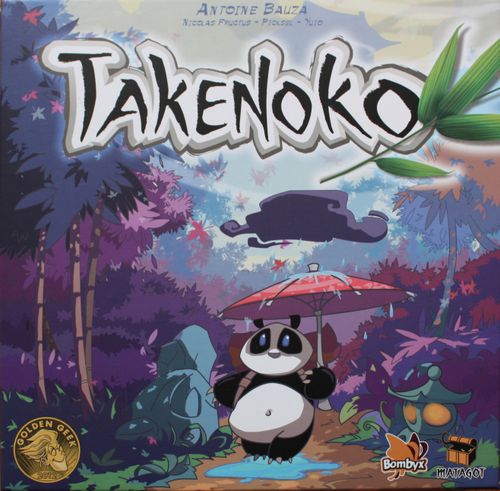
The Sad Panda Garden (Takenoko)

Japan has entered diplomatic talks with China, and it looks like they are finally on the mend.  I have been given an exclusive interview with the Chinese ambassador.  I can only imagine that they will be a kind, sensitive soul with...wait, you're telling me the ambassador is a panda?!


BACKGROUND:  Takenoko is a board game published by Bombix for 2 to 4 players. 

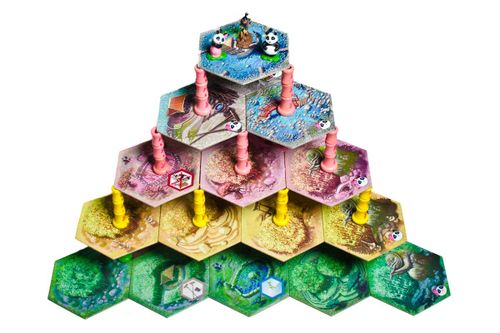
GAMEPLAY:  Each player takes a turn by first rolling the weather die and applying the effect, then selecting 2 different actions to take in any order they wish.  Players may build more land and place a new colored tile down, move the farmer or panda figure to grow or eat 1 bamboo if possible, respectively, irrigate the land so bamboo may grow, or draw new objectives.

WEATHER:  The die rolled at the beginning has various effects depending on what was rolled.  This does not count as any action.

  • SUN:  The player gains an an additional action that is different to the others.
  • RAIN:  The player may grow bamboo on any irrigated plot, up to 4 sections tall.
  • WIND:  The player may choose to take the same action twice, or keep the two seperate actions
  • STORM:  The lightning scares the panda, allowing the player to move the panda and have him eat a Bamboo section.
  • CLOUD:  The player gains an improvement to put in their reserve.  Improvements cannot be placed on tiles with an improvement on it.  Improvements can either prevent the panda from eating in that tile, allow a tile to grow without being irrigated, or double the amount of growth for bamboo.
  • QUESTION MARK:  The player chooses what weather action to take.


OBJECTIVES:  Each card has an objective to complete.  Plot objectives require the land tiles to be built and irrigated in specific patterns.  The Gardener requires 1 or more bamboo shoots to be grown in a specific color, amount, and with or without certain improvements.  The Panda objectives require you to eat specific colors of bamboo and return them to the pool of bamboo  The Emperor is given to the first player to hit a required number of objectives, and gives every player one more turn until the end.  If at any point an objective is finished, a player may place and score their objective card, regardless of turn order.

WINNING:  Once all players have taken their last turn, players discard any objective cards not scored, and total up the points on each objective card scored.  The player with the most points wins.  In the event of a tie, the player with the most Panda objective cards wins.

CONCLUSION:  Takenoko is a deceptively simple game that evolves rapidly into a deep strategy game.  It's simple enough on the surface that children can easily grasp the idea and just play, with simple colors and movements. However, it can easily become a cutthroat game of planning and prevention of other scoring with a group of older teens or adults.  The fascinating thing with this game is, even with as much strategy as this game has, games will seldom exceeds an hour.  This is a great game for dipping your toe into more obscure board games, or even just to play with a group that loves them.

Wednesday, September 6, 2017

Math-ominios (Quartile)

You are in for a treat tonight.  Oh, that music you're hearing is just a selection of blues music from the great Fats Domino.  There's pizza in the kitchen, "freshly" delivered from Domino's.  And in the living room, we have the game once the other 2 are here.  That's right, if you couldn't tell from my oh so subtle hints, we're playing...Quartile.  Did that throw you off?  You'll see soon enough, my friend...


GAME DESCRIPTION:  Quartile is a tile based game published by SimplyFun for 2 to 4 players.  Just like most domino based games, the goal is to score high by placing tiles around the board in clever ways.

SET-UP:  Shuffle the tiles in the Quarry, or the pool of tiles, face-down.  Each player draws 4 tiles, and places 1 starting tile in the middle of the table, away from the Quarry face-down.  Each player places 1 tile from their hand face-down, then reveals it.  The player with the lowest number starts.  Flip the starting tile face-up, and return the tiles to the owners hands.

PLACEMENT:  Each turn, a player must play a tile from their hand face-up next to at least 1 tile that is already on the table, and in a way that both pips on the tiles add up to the center number on the tile being laid down.


SCORING:  Once the objectives for placement have been met, the player then scores the number in the center of the recently placed tile times the number of sides that have been fulfilled.  For example, a player will always score the number x1 on the first 2 turns, as there is no way to score multiple sides.  However, if there is a tile played with the pips on the side and top both adding with the tiles they are touching. they will score the center number x2.

WINNING:  Once all tiles have been placed, add up each players total, with the winner being the player who scored the most.

CONCLUSION:  It's a variation on Domino's, pure and simple.  Sure, it's interesting, and different strategy's are used to play better, but it's Domino's.  If you don't like Domino's, you aren't going to like this one.  If you do, then you'll probably like this version.  If you haven't ever played Domino's, the only thing I can say is to give it a try before you play Quartile.  I wish I had some deep profound thing to say, but it's Domino's, and that's it.

Wednesday, June 28, 2017

Arabian Nights, like Arabian Days (Shahrazad)

One more night, one more day to live.  Shahrazad crafts her stories so well, just to keep the king wanting to know more.  The stories live on, and continue to keep her alive.  However, who knows how much the king will like the next story?  Time will tell, and so will Shahrazad.


GAME DESCRIPTION: Shahrazad is a tile game published by Osprey Games for 1-2 players.  The goal is to play matching tiles to score points, either solo or cooperatively.

SET-UP:  Shuffle the tiles and place them face-down.  The player or players are dealt 2 tiles, and 1 is place face-up in the middle.  If playing with 2 Players, keep your hand secret, but you may discuss what is in your hand without revealing it.

TURNS:  A turn consists of drawing 1 tile from the deck, and placing it face-up directly above or below a tile, or in the next row to the left or right touching the tile and offset half-way up or down the tile.  Alternatively, a player may swap a tile from their hand instead of playing a tile, but they must play 2 tiles next turn, and cannot swap that turn.  In a single player game, columns have a max limit of 4, whereas with 2 players the max limit is 3.


SCORING:  Each tile is 1 of 4 colors: red, black, yellow, and blue.  Each tile also has a number in the top corners, and the goal is to play the numbers left to right from lowest to highest.  If there is a tile that has a lower number to its right, flip over the higher number.  Then, follow the tiles from left to right as a path.  Any tile that does not make from the far left tile(s) to the far right tile(s) is flipped, and gaps and flipped over tiles do not count.  If an entire column is flipped, score 0 points for that round.  Finally, count how many tiles of matching colors there are for each color, and score once for each color, and the highest amount of matching tiles of that color.

POINTS:  Once you have scored, remove any face-down tiles for the rest of the game, shuffle and re-deal.  Once you have played and scored 2 rounds, the game is over.  Add up both sets of points to determine your final score.

CONCLUSION:  Shahrazad is a score attack game, where the object is less about winning and more about personal challenge.  This game is going to appeal to a very small demographic, especially since games like Solitaire exist, making it easier to play with a standard deck instead of having to buy a whole new game.  This game is also designed to be played with 1 player more than it is with a friend.  The restriction of 3 tiles per column just adds to the difficulty, even if you now have twice as many tiles as before.  Shahrazad is a niche game, but I can see the appeal, if only for solo players.

Wednesday, May 24, 2017

Five Dice, One Winner (Dice City)

Hear ye, hear ye, to the plight of the city!  Queen Statsia, of the Kingdom of Rolldovia, has decreed that there shall now be a new capital, to rival the old one.  Rumors of the old capital being pillaged and desecrated are greatly exaggerated, and as such, should be disregarded. Those who believe their city is the best of the land shall compete in a contest to see who deserves to be the new capital of Rolldovia!


GAME DESCRIPTION:  Dice City is a dice game for 1-4 players created by Vangelis Bagiartakis and published by Artipia Games.  Players roll, move, attack, and gather points to see whose city should become capital.

SET-UP:  Each player takes 1 Player Board, and 1 set of different colored dice (Red, Blue, Black, Yellow, White).  Split the Lumber Mill, Quarry, Mine, and Regular Army cards into 4 separate stacks face-up.  Shuffle the rest of the Location Cards and place them face-down. Next, draw 8 cards and place them together face-up, as the Display.  Place the Bandits Cards and Trade Ships in three separate piles, with each pile being indicated by the number in the bottom right.  Each Bandit pile will only have a number of cards equal to the total number of players, plus 2.

START:  All players roll their dice, and put them in the appropriate number (located on the top of the Player Board) and color (located on the side) location.  The player to have played a game most recently with dice rolling starts.  During their turn, each player has 4 steps to follow in order: Use Dice, Attack, Building & Trading, and End of Turn.


USE DICE:  During the first step, you may use an action by "spending" a die by moving it from the board.  These actions are:

  • Use the location beneath the die and resolve its ability.
  • Move another die to an adjacent space on that die’s row.
  • Reactivate a Deactivated location anywhere in your city.
  • Once per turn, discard four of the Location cards in the display that are available to build and reveal four new ones.
  • Once per turn, pass and gain a Pass Token.
  • Instead of a die, you may spend two Pass Tokens to gain one Resource of your choice, increase your army strength by 1 for the turn, or force all other players to re-roll one die of your choice.
     
Once all Dice are spent, the turn moves to the Attack step.

ATTACK:  During this turn, any Attack units used (indicated by a sword) increases your Army strength.  You may attack either Bandits, Locations, or Stock.  For Bandit and Location cards, you must spend a strength higher than the cards defense.  Note that not all Locations have a Defense, making them unable to be attacked.  For Bandits, you gain that Bandit card and place it off to the side, until all those Bandits are gone.  For Locations, place a Deactivation Token on the location.  That player cannot use that Locations ability without Reactivating it.  To gain Resources from another player, you must spend 2 times the Resource(s) you want to steal.  Your Army then returns to 0 at the end of the turn.  

BUILDING/TRADING:  Every other non-Bandit card has a cost of Resources, usually located in the top right, or the bottom for Trade Ships. During this step, you may spend your collected Resources to gain one of these cards.  Trade Ships will go off to the side.  Any Lumber Mill, Quarry, Mine, and Location card bought from the Display will go on the Player board.  These cards can be placed anywhere on the board, but will replace the effect underneath it.


END OF TURN:  If you have any Resources remaining, you may keep one of each kind, with the rest returned to their stock.  All Pass tokens collected remain with the player, however.  The player re-rolls all of the dice and places them back on their Player board.  Then the turn ends, and play passes to the next player.

VP:  Almost every card has a number in a star in the bottom right.  These are Victory Points.  You gain Victory Points from gaining that card, or from a Location's effect.  When you do, you gain VP token(s) equal to the points gained, and place them face-down.  When you attack and Deactivate a Location, gain VP token(s) equal to the deactivated card.

WINNING:  The game ends in one of 3 ways:  Either all three of the bandits piles or two or more of the trade ship piles have run out of cards, the location deck runs out of cards, or any player calls the game over when they have two or more rows on their board filled with built locations, none of which have Deactivation tokens.  The game continues until every player has had the same number of turns.  The player with the most Victory Points wins.

CONCLUSION:  This has always been a hard game for me to review.  There's a little too much down time in a four player game to end as quickly as it does.  I do like that while there is a lot of luck involved, it is aware and does a little to help mitigate it, but not in a way that feels forced.  Also, the single player mode helps to build strategy and see what play styles work for you.  Being able to adjust the difficulty also helps make the game more enjoyable as you see what works and what doesn't.  I would recommend this if you enjoy games like Dominion.  To everyone else, it may be a hard sell, but I would say if you do want to play this, either start with Single Player or limit to three players, as the down time is lessened.

AFTERTHOUGHTS:  A quick thanks to Slumpymaster for helping me with the single player part of this review.  You can check his stuff out over on the right.

Wednesday, December 7, 2016

First floor: Haberdashery, Shoes, and Poodles (Vanished!)

Up and down, down and up.  The elevator moves, as do the people.  Watch closely and wait for the next guest.  Will it be the Beautiful Lady, with curly locks of gold?  Or maybe it's the maid, carrying her vacuum?  Or maybe the Socialite, with his charming smile and random guest he talks to.  Here one moment, gone the next, the Paternoster vanished, and came right back.

Image result for vanished board game

GAME DESCRIPTION: Vanished! is a tile game published by BePuzzled, now known as University Games.  Players attempt to match characters in their hand with the characters on the elevator, or Paternoster.

SET-UP:  Players begin by taking a whole set of Character cards, identified by their teal background, and place them in their hand.  The Elevator cards, which are smaller and on cardboard, are shuffled and placed face down into 2 rows, leaving 1 middle spot open on the right.  The Pawn is placed next to the empty space.

MOVEMENT:  The first player rolls the die, and moves the pawn clockwise around the pile.  Each player then places the character card they believe matches the Elevator card face-down from either their hand, or their discard pile.  Once every player has chosen a card, flip over the cards and the Elevator card.  Any matching cards are discarded, and all non-matching cards are placed back in the players hand, including previously discarded cards.  Finally, flip the Elevator card face-down, and place it in the empty spot not next to the Pawn.  The game ends when 1 player has discarded all of their cards.


TEMPO:  If a player matches a tile with a card from their discard pile, they gain a Tempo Chip.  If a player spends a Tempo Chip, they may move the pawn 1 space either clockwise or counter-clockwise. Tempo Chips may only be played after the die has been rolled, and a player may spend as many Tempo Chips as they have to keep moving the pawn.

CONCLUSION:  This is probably one of the hardest games to master, even though it is one of the simplest games to learn.  This game is all about memorization, predicting, and planning.  This isn't the easiest game to get a group of friends into, but if your group enjoys puzzles, then Vanished might just be the game for you.

AFTERTHOUGHTS:  So, not long after I started this, I found that Vanished is no longer in print.  However, there is an updated version called Paternoster, which apparently plays the exact same.

Wednesday, September 21, 2016

Friendship First (Carcassonne)

Ah, the city of Carcasonne.  With it's winding roads, beautiful landscapes, peaceful monasteries, and sprawling river, it's like a bit of paradise on earth.  Well, except for the highwaymen, broken roads, and cities that seem to just end into nowhere.  This wondrous and prosperous city holds an unfortunate secret sprawling back from its creation.  Do you wish to uncover that secret for yourself?  Then lets go back to the founding and building of Carcasonne.

Image result for carcassonne game

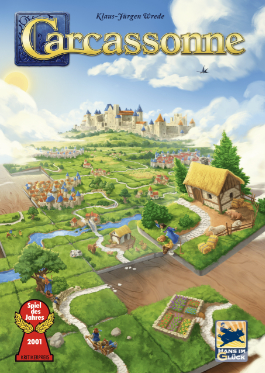
GAME DESCRIPTION:  Carcasonne is a tile based game set for 2 to 5 players, originally created in German.  Each turn, players attempt to build and control the countryside using Tiles and 'meeples'.  Points are determined via a scoring board, and the one in the lead at the games end wins.

BACKGROUND:  The term Meeple is one generally used in tabletop games.  Originating from Carcassone and the words 'my people', it usually refers to the tokens seen in this game, vaguely human shaped and generally 1 solid color.

SET-UP:  Each player chooses 1 of 5 colors, and gets all the Meeples of that color in front of them.  The larger Meeple is placed on the scoring board at the start, or at 0 points.  The starting tile is then placed, noted for it's dark coloring on the back.  All the other Tiles are shuffled and placed face-down.


TURN:  The first player then draws a tile, and connects it to the current face-up Tiles in an appropriate manner (roads, buildings and grass connect only to roads, buildings, and grass respectively).  That player may then place a Meeple (if they have any) on tile they just placed, with a Meeple on a road as a highwayman, a city as a Knight, or a Monastery as a Monk.  However, if a Meeple is already on a connecting tile (such as in the city, or on the same road), then you are not allowed to place a Meeple on that tile.

SCORING:  At the end of a players turn, players will score.  If a road is closed by a city, village, or loops back on itself, it has ended, and any Meeple on any point of that road gets 1 point per tile with that road, and is then moved off the tile back to the owner, allowing the player to place that Meeple on a later turn.  Any city that is closed off also returns to the owner(s), and each connecting city tile is worth 2 points, with any Coat of Arms also worth 2 points.  A Meeple on a monastery that is surrounded by Tiles in all 8 directions also returns to the player, and that player gets 1 point per tile, or 9 points.


CONTESTED LOCATION:  If a city or road was not originally connected, but became so later with more than 1 Meeple on said location, then it becomes contested.  If there is an even amount of more than one color, those players gain the total amount of points.  However, if there is more of one color than any other, that player gets all the points.  All Meeples are still returned to the owners.

GAME END:  Once the final tile is placed, the game ends.  All Meeples still in play are still given points.  All Highwaymen are given 1 per road tile.  All Knights are given 1 point per connecting city, and 1 point per Coat of Arms.  Each Monestary is worth 1 point, and 1 per surrounding tile.

CONCLUSION:  I have learned to enjoy Carcassonne, but it took me a little time.  The game seems intimidating to a new player, and rightly so.  The complex strategies of when to place Meeples and where to place Tiles really does change up the game drastically.  It's a fun game, but don't expect a new player to love it on their first try.  Still, if you are looking for a solid game with highly complex strategies, there's a reason why players keep coming back to Carcassonne.

AFTERTHOUGHTS:  Now, these are merely the beginning rules.  I have decided not to include the "Supplementary Rules", which introduces Farmers, River Tiles, and Abbots and Garden Tiles.  This blog is meant as an overview for newer players of both the game, and tabletop games in general.  The rules claim that it is better to introduce these to new players later.  I tend to agree, having played this with most of the Supplementary Rules already introduced to me on my first play-through.  Now, this may be why I had such a hard time enjoying the game, but I have grown to love it.  I would just caution others to introduce these rules to newer players later.

Wednesday, August 31, 2016

Circles, Stars, and Diamonds (Qwirkle)

Shapes have rained down upon the board, and connections come and go as easily as the tide.  You move this way and that, hoping to find a connection that other have missed, that will give you the points to take the lead.  That is what you find, that buried in the board is just what you hoped to find: A Qwirkle.


GAME DESCRIPTION:  Qwirkle is a tile based game for 2 to 4 players.  The object of the game is to match similar tiles of color and shape and have the most points at the end of the game.

SET-UP:  Each player begins with a hand of 6 tiles that are kept secret from the other players.  All other tiles are kept hidden either face down or placed into a bag as the 'deck'.  Turn order is decided by whomever has the longest set of tiles of either matching color of all different shapes, or matching shapes with all different colors.  No tiles matching the exact shape and color may be counted.  The first player begins by playing their longest set face-up in a row or column.  The player turn ends, and is given 1 point per tile.  All players must draw from the 'deck' so their hand is back up to 6 tiles.

Image result for qwirkle

PLAYING:  The next player may play any amount of tiles that share either a color or shape to the current tiles on the board in any 1 direction.  No tile may repeat in color and shape in any line, and plays must be played only in 1 direction.  Points are then given to the player, with 1 point per tile played, as well as 1 point per tile from the connected line.

EXCHANGE:  If a player cannot or does not wish to play, they may instead trade any non-zero amount of tiles into the 'deck'.  This action ends their turn.

QWIRKLE:  If any player manages to make a line of 6 tiles on their turn, they get a Qwirkle, and a 6 point bonus on top of their current points.

ENDING:  Play ends when a player successfully plays all their tiles when the 'deck' is empty, preventing the players from refilling their hands.  The first player to do so will gain a 6 point 'Finish First' bonus.  All points are then tallied, and the winner is the player with the most

CONCLUSION:  Qwirkle is a simple game that can be played by most people.  Kids can play it because it isn't limited by reading, just colors and shapes.  Most adults can play it because it is incredibly simple, if restrictive to certain types of color blindness.  The barrier of entry is pretty low, making it a great game to introduce to people who don't play a lot of tabletop games outside of stuff like Dominoes, Monopoly, and Scrabble.  I can definitely recommend this game for those looking for a more relaxed atmosphere.

Wednesday, July 20, 2016

The Name of This Game Means Brain?! (Ubongo)

Maybe that piece goes there?  But that leaves you with a long piece that doesn't quite fit.  Time to clear the board, and turn some pieces.  But if that goes there, then where does the square piece go?  Or the L shape, how does it fit?  Your brain keeps spinning and grinding , solving the puzzle of Ubongo.


GAME DESCRIPTION:  Ubongo is a 2-4 player board game similar to tangram puzzles.  Each player races to be the first to complete their puzzle by combing certain pieces into their board.

PUZZLES:  Each player is given a board, and the starting player decides which side of the board to use (3 or 4 pieces). The player then rolls the die, and each player takes the pieces that match up with the symbol rolled.  The first player to fill in the white on their board completely with all their shapes calls out "UBONGO!", and players continue to do so until either all players finish, or there is only 1 player left who hasn't finished.  The players then collect their points, and are given new boards.


POINTS:  Each player takes one of 4 pawns, and places it on the long scoring board.  This board will be filled up with gems of various colors.
  • The first player to complete their board can move up to 3 spaces in any direction, and collects the 2 gems closest to their pawn on that row.  
  • The next player may move up to 2 spaces and collects their 2 gems.  
  • The third may move up to 1 space and collects their 2 gems.
  • The 4th player cannot move at all, and must take the 2 gems closest on that row.

WINNING:  The game ends if all gems have been removed, or 9 rounds have passed, depending on the players.  The player with the most gems of 1 color wins.  In the case of any ties, victory is determined by the tied players next most collected gems,

CONCLUSION:  As I mentioned, this game revolves around tangrams, or fitting various shapes into a bigger shape. Strategy and puzzle solving skills are the strongest points here.  This can easily put off a lot of players, as not being good at these kinds of puzzles can hinder your enjoyment so that there's no way to get victory.  Also, sometimes your brain just doesn't work, and certain layouts don't make sense.  I enjoy the scoring system, as it could've been easy just to give players points based on how fast they finished, but decided to change it up so even the slower players can still end up having a solid victory.  For puzzle fans everywhere, Ubongo is the way to go.

Wednesday, February 10, 2016

From Sheep to Stone to Wheat to Wood (Settlers of Catan)

Welcome to the Island of Catan, home to...well, nothing yet.  This is where you come in.  You are here to establish a new settlement on this empty island, alongside and against fellow entrepreneurs.  But be warned, thieves lurk around every corner, waiting to steal your sheep.  Establish a base, build an army, make life successful for all, and some day you may become ruler of this island!


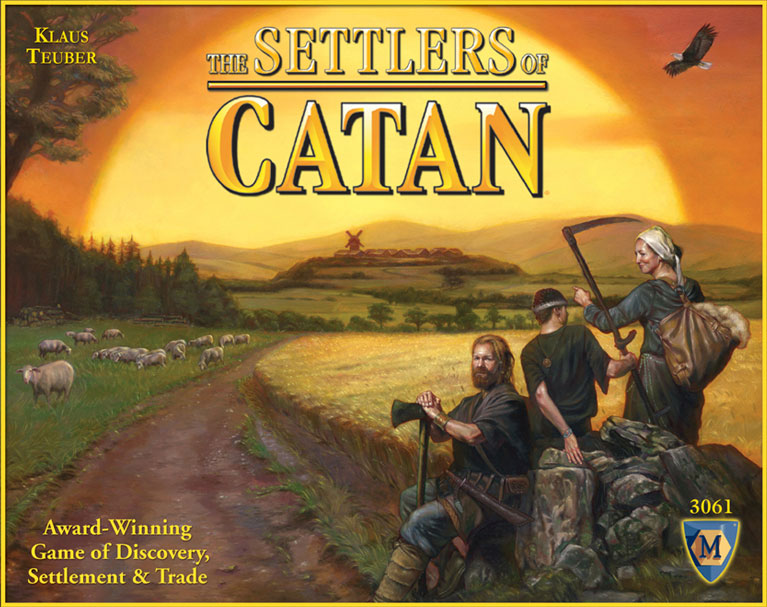
GAME DESCRIPTION: A 2-4 player board game, each player attempts to create roads, settlements, towns, and armies to gather "victory points", or VP.  The game begins by each player placing 2 settlements, 1 while going around once clockwise, then the 2nd while going counter-clockwise, starting with the last player to place their first one.

RESOURCES:  There are 5 resources:  Brick, Ore, Wool. Grain, and Lumber.  All are used to buy roads and new settlements, upgrade settlements to cities, or obtain resource cards.

ROADS/SETTLEMENTS:  These are the meat of the game. Each tile has a number printed in the middle that determines when a particular resource is gathered.  At the start of each turn, the player rolls the dice.  When a player has a settlement located next to the number rolled, they obtain the resource from that location.  Roads are used to extend your area of control, allowing you to build more settlements elsewhere.  You may only build roads off of settlements, and settlements off of roads


TRADING:  During a players turn, they may offer trades to any other player for what seems fair or needed to both sides, or trade in 4 of one type of resource for 1 of any other type.  At the boarders of the map are "Port towns".  Once a player has a settlement located on one of those port towns, they can either trade 3 of any one kind type of resource for 1, or 2 of one specific type for any 1 resource of the players choice, depending on which port the player has.

THIEF:  When a "Knight" Resource card is played, or a 7 is rolled, every player with more than 7 resources in their hand must discard half their hand.  In addition, the player who rolled it places it on top of any number they choose.  If their is a settlement connected to that number, that player loses one of their resources to the roller.  And, until a Knight is player, or a 7 is rolled, no players are allowed to gain any resource when that number is rolled.

RESOURCE CARDS: These cards have varying effects, such as automatically gaining one VP, pushing you to victory, or gaining a knight, allowing you to move the thief token and steal one players card.  But you must wait one turn after purchasing any of these cards before you can play them.  Resource cards must stay in front of the player until the end of the game, as they are a permanent effect.

Related image

VICTORY POINTS:  The aim of the game is to get to 10 VP.  The player who has the most knights in front of them at any point will obtain the "Largest Army" card, granting them 1 VP. The person whose has the longest unbroken road tokens in a row also gains 1 VP, and the "Longest Road" card.

CONCLUSION:  It's hard to make a decision one way or the other.  This game requires a lot of time, patience, and planning.  The dice element of this game makes it so that it is easy to hardly get any of a particular kind of resource, and an overabundance of another.  On top of that, it is fairly easy to forget certain rules due to the rather large abundance of them.  Even with these flaws, the game does make it so that no one person can ever get too far ahead of the rest.  The dice element I called out also makes it so that even the player in last can still have a strong chance of winning.  It's a great game for an intense, small group game night. But I think I'll pass on playing for a while.

Thursday, January 21, 2016

Who's the traitor? (Betrayal at House on the Hill)

You and your friends walk up the to the old abandoned house on the hill.  It was always rumoured to be haunted, but ghosts don't exist, right?  As you and your friends enter the entrance hall, the door slams shut, locking itself.  It's then you realize, all of your friends are stuck here, and you need to watch out one of for your friends Betrayal at the House on the Hill.


GAME DESCRIPTION: Betrayal at House on the Hill is a strategy role playing game.  Taking the role of one of six explorers, you and a small band of friends must explore the haunted manor.  However, the rooms are never the same.  Rooms are drawn from a stack of 'cards', so that door you open may end up being a Larder, a pentagram chamber, or a game room.  There are three floors, and some rooms are exclusive to certain floors.

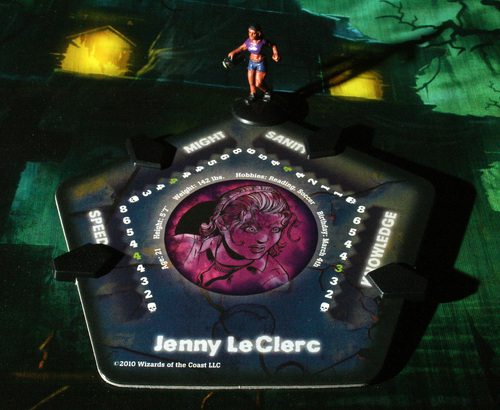
SET-UP:  There are 6 characters to choose from.  Each player takes one of the character tokens and matching character board.  Then, place the Starting Basement, Ground Floor, and Top Floor face-up.  Shuffle the rest of the floors together.

CHARACTERS: Each of the 6 character has 4 stats, with differing strengths and weaknesses.  For example, Ox starts out with higher strength than any other character, but lower sanity than anyone.  The Professor has fairly low speed, but high Intelligence.  Each character also has a counterpart to choose from:  Ox can be replaced with "Flash", and gypsy Madame Zostra can be played instead of Spanish beauty Vivian Lopez.

ROOM TILES: As you travel into each room, one of three things may happen;  You may have an event exclusive to that room, you may find an item, or a dread omen may occur.

  • EVENT:  You can encounter ghosts, hidden rooms, or even your future self.  Each event requires you to either roll to fulfill a certain event, or follow a certain task
  • ITEM: You may find any number of healthful items that will increase one of your stats
  • OMEN: This is similar to Items squares, but this adds one new task.  Each time you take an omen, you make a roll to see if the traitor is revealed.


THE TRAITOR:  If you roll and fail the Omen roll, the traitor is revealed.  Until this time, no character can die.  But, now the rules have changed.  According to the omen discovered and the room it was discovered in, the traitor is discovered.  At this point, the traitor plays against the rest of the players to determine the winner, with over 60 different scenarios and even more win conditions.

CONCLUSION: This is one of those games that you can easily lose yourself into the characters of the game, and the conversations of the friends.  However, this is one of those games that can take from thirty minutes to a good solid couple hours or longer.  Then, when the Traitor is discovered, the board may be set up in such a way that the Traitor or the Heroes lose quickly without a way of countering.  Still, if solid, long RPG's are your cup of tea, then I would highly recommend Betrayal at House on the Hill.  Win or lose, the story you discover is worth your time.

The clock is ticking, the omens being found.  Will the snake god Ouroborous devour everyone? Will cannibals eat your friends?  Or will Hell itself  envelop the house and you with it? You'll find out soon enough when you discover the Betrayal at House on the Hill?