Showing posts with label Animal. Show all posts

Wednesday, February 21, 2018

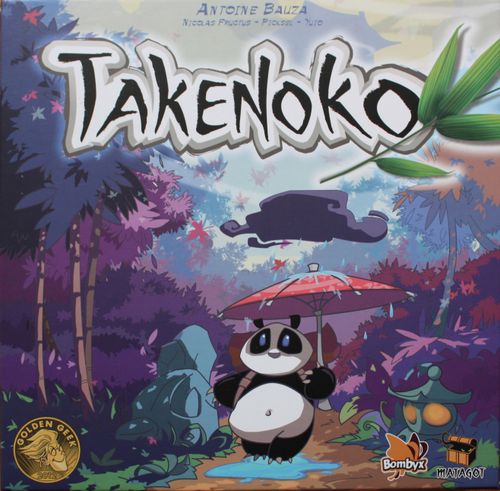
The Sad Panda Garden (Takenoko)

Japan has entered diplomatic talks with China, and it looks like they are finally on the mend.  I have been given an exclusive interview with the Chinese ambassador.  I can only imagine that they will be a kind, sensitive soul with...wait, you're telling me the ambassador is a panda?!


BACKGROUND:  Takenoko is a board game published by Bombix for 2 to 4 players. 

GAMEPLAY:  Each player takes a turn by first rolling the weather die and applying the effect, then selecting 2 different actions to take in any order they wish.  Players may build more land and place a new colored tile down, move the farmer or panda figure to grow or eat 1 bamboo if possible, respectively, irrigate the land so bamboo may grow, or draw new objectives.

WEATHER:  The die rolled at the beginning has various effects depending on what was rolled.  This does not count as any action.

  • SUN:  The player gains an an additional action that is different to the others.
  • RAIN:  The player may grow bamboo on any irrigated plot, up to 4 sections tall.
  • WIND:  The player may choose to take the same action twice, or keep the two seperate actions
  • STORM:  The lightning scares the panda, allowing the player to move the panda and have him eat a Bamboo section.
  • CLOUD:  The player gains an improvement to put in their reserve.  Improvements cannot be placed on tiles with an improvement on it.  Improvements can either prevent the panda from eating in that tile, allow a tile to grow without being irrigated, or double the amount of growth for bamboo.
  • QUESTION MARK:  The player chooses what weather action to take.
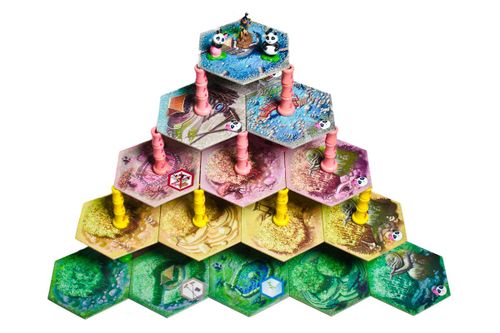


OBJECTIVES:  Each card has an objective to complete.  Plot objectives require the land tiles to be built and irrigated in specific patterns.  The Gardener requires 1 or more bamboo shoots to be grown in a specific color, amount, and with or without certain improvements.  The Panda objectives require you to eat specific colors of bamboo and return them to the pool of bamboo  The Emperor is given to the first player to hit a required number of objectives, and gives every player one more turn until the end.  If at any point an objective is finished, a player may place and score their objective card, regardless of turn order.

WINNING:  Once all players have taken their last turn, players discard any objective cards not scored, and total up the points on each objective card scored.  The player with the most points wins.  In the event of a tie, the player with the most Panda objective cards wins.

CONCLUSION:  Takenoko is a deceptively simple game that evolves rapidly into a deep strategy game.  It's simple enough on the surface that children can easily grasp the idea and just play, with simple colors and movements. However, it can easily become a cutthroat game of planning and prevention of other scoring with a group of older teens or adults.  The fascinating thing with this game is, even with as much strategy as this game has, games will seldom exceeds an hour.  This is a great game for dipping your toe into more obscure board games, or even just to play with a group that loves them.

Wednesday, June 21, 2017

How to Steal Their Dragon (Dragonology)

Good morning, intrepid adventure!  How would you like to travel to exotic lands, meet fantastical creatures far beyond your imagination, and perhaps even discover untold riches, hmmm?  That's right, this can all be yours, if you act now!  Just grab your Journal, and come join fellow thrill-seekers like yourself in Dragonology!


GAME DESCRIPTION: Dragonology is a Board Game published by Sababa Toys, and based on the fictional encyclopedic book Dragonology book.  The object of the game is to search the globe for information on Dragons to become the Master Dragonologist.

SET-UP:  Each Dragon is placed on the board in its specific location.  Each player is dealt 1 red Bit of Knowledge card and 3 Transportation Tickets.  The rest are placed face-down on the board.  Each player reveals their Bit of Knowledge card and places their figure in the City indicated on the card.  Then, each player rolls the Dragon Die.  The player with the highest roll goes first, with the Dragon's Eye being the highest number.


MOVEMENT:  To move, the player may either roll the die, or discard 1 Transportation Ticket.  If the die is rolled, the player moves that many spaces, or to any Dragon's home city if the Dragon's Eye is rolled.  If the player discards a Ticket, they may move according to the Ticket used:
  • Air (Hot Air Balloon & Airplane):  The player may move to any space on the board.
  • Sea (Steamboat):  The player may move from one Port, indicated by an anchor symbol, to any connecting Port over any blue Ocean/Sea spaces
  • Land (Locomotive, Camel, Elephant, & Stagecoach):  The player may move to any space in that continent.
SPACES:  When landing on a space, there are 4 actions that can happen.  Landing on a blank does nothing.  Landing on a Port, City, or Dragon's Home allows the player to draw a Bit of Knowledge or Transportation Ticket.  If a player lands on a "B", they draw a Bit of Knowledge card, and if they land on a "T", they draw a Ticket.

DRAGONS:  Once a player has collected 3 matching Bit of Knowledge cards about a specific dragon, they then must either use a Ticket, or roll exactly to land on that Dragon's home.  Then, they discard those Bit of Knowledge cards and collect, or Master, the Dragon figure.


KNOWLEDGE:  If a player lands on a space with another player, they may trade cards, or Bump them.  A Bump Challenge is conducted by the challenging player wagering any number of Cards OR Tickets in Rock, Paper, Scissors.  The winner takes all wagered cards.  In addition to Dragon Bit of Knowledge cards, there are special Spells and Charms Bit of Knowledge cards that have various effects:
  • Wild:  This card may be used as any third Dragon Bit of Knowledge card.
  • Snatch:  Steal a random Bit of Knowledge from any player.
  • Hypnotize:  The player may request a specific Dragon's Bit of Knowledge card from any one player.  If they have it, the player gives 
  • Master Claw:  If a player lands on a Dragon's home that has already been collected, they may steal the Dragon from the player.
  • Déjà vu: Take another turn.
  • Confusion:  Take all others players Bit of Knowledge cards, shuffle them and deal them out, not including yourself, 
  • Swoop:  Move another players piece to any space.  This may only be played if the player has collected any of the following dragons: American Ampithere, Cockatrice, European Dragon, Frost Dragon, Gargouille, Marsupial Dragon, or Wyvern.
  • Shield:  This protects a player from Bump Challenges, Snatch, or Hypnotize.  This effect can only protect against one card per Shield.

DRAGON'S EYE:  Once a player has collected 3 Dragons, they can then advance to the Island of Winged Serpents.  If a player rolls the die to land there, they must roll the exact number to land of the Island.  Once a player has landed on the Island, they are immune to all Spells and Charms.  Then, during their turn, if the player rolls the exact number of spaces or a Dragon's Eye, they reach the Dragon's Eye on the board.  If they roll lower, they advance that many spaces, and must wait until their next turn to attempt to reach the Eye.  If they roll higher, the player stays there, and attempts to roll the next turn.  The player that manages to reach the Dragon's Eye on the board with 3 or more Dragons wins, and signs their name on the Record Sheet, stored in the Secret Envelope.

CONCLUSION:  Dragonology is a beautiful game, with cards reflecting its theme well, a gorgeous board, and detailed figurines that are better than some Mini-figs I've seen.  The problem comes down to its gameplay: It feels like every bland board game ever created.  For how pretty the game looks, the generic gameplay kills it.  Now, this wouldn't be so bad if the gameplay was shorter, but games tend to last at least an hour or so.  If you have kids who are interested in dragons, it's worth playing once or twice.  Otherwise, the only way I can recommend it is if you can find it at a thrift store for cheap, and only for the figurines.

Wednesday, June 7, 2017

Don't Go Bacon My Heart (Pass the Pigs)

Don't be dis-gruntled by all these puns, just enjoy the game.  But be careful, there may be Truffle ahead.  Expect a twist in the tale.  And when it's time to Pass the Pigs, don't do it so ham-fisted.  After all, we don't need Pulled Pork.  


GAME DESCRIPTION:  Pass the Pig is a "Dice" game published by David Moffat Enterprises for 2 or more players.  Players attempt to gather points by rolling the Pigs.

PIGS:  The game contains a scorepad, pencils, and 2 small plastic Pigs.  Each turn, one player rolls the pigs onto a flat surface.  The player gains points depending on the position of the pigs.  If a pig is on its side, it gives the player 0 points.  If it's on its back, or standing up, it gives the player 5 points.  If on its snout, 10 points.  If its on both snout and ear, 15 points.

COMBOS:  In addition, if both Pigs are rolled in a specific pattern, the player will get more points.  For example, if both Pigs are lying on their back, then the player gets 20 points instead of just 10.  However, if the Pigs land touching each other, or if one is lying on its left side, and the other on the right, that player loses all points gained that round and the Pigs are passed to the next player.


WINNING:  At any point, a player may stop their roll, and keep the points that they gained that round.  Any player can win when they stop at a predetermined set of points.  However, if a player manages to roll the Pigs so that one Pig lands completely on top of the other, resting all 4 feet on the others back which is also on all 4 feet, then the player is out of the game.

CONCLUSION:  This is a strange game indeed.  It definitely plays similar to games like Zombie Dice.  However, whereas those games are built as dice games, this one feels less balanced.  According to Wikipedia, just landing on the highest points is a less then 1% chance to get it.  Because of that, it seems like there's something a bit too gimmicky.  And yet, I still enjoy it.  Maybe the gimmick is something I like, as a novelty.  I wouldn't recommend playing this weekly, but give it a chance, you might not think it so hogwash.

AFTERTHOUGHTS:  Thanks to Lizzy-thelizzard Gaming for the bevvy of Pig puns strewn throughout this review!

Wednesday, October 26, 2016

Tick Tick Boom (Exploding Kittens)

Can you hear that hissing?  Can you smell the sulfer and litter mix?  It's getting closer.  Closer and closer until your loss, closer and closer until your dead.  The hissing, it sounds like a bomb, but it's more.  Oh, my dear friend, it is much more.  But that won't matter soon.  The last thing you'll worry about is that kitten, blowing up and ending your life. Watch out for the EXPLODING KITTENS!!!

Image result for exploding kittens

GAME DESCRIPTION:  Exploding Kittens is a card game for 2-5 players.  Each turn players must draw cards and avoid getting an Exploding Kitten.

SET-UP:  Before the game begins, remove all Exploding Kitten and Defuse cards, then shuffle the rest of the deck.  Each player begins with 1 Defuse card and 4 randomly dealt cards.  Shuffle all Defuse cards into the deck, as well as Exploding Kitten cards equal to 1 less than the total number of players.  If there are only 2 players, shuffle 2 Defuse cards into the deck.  Any cards left are removed for this game.

Image result for exploding kittens

CARDS:  Each turn, a player may play any cards during their turn, or end the turn.  Once a card's effect is resolved, you may continue to play cards, or end the turn.  Each player ends their turn by drawing a card.
  • Exploding Kitten:  These black border cards, when drawn, mean an immediate loss unless a Defuse card is played, and discard all cards as well as this card.
  • Defuse:  If a player draws an Exploding Kitten card, they may play a Defuse card.  The player discards the defuse and places the Exploding Kitten card anywhere in the deck they wish.
  • Nope:  If a player plays a card, any other player may cancel it by playing a Nope card, and discard both cards.
  • Attack:  The player who plays an Attack card does not draw, and the next player takes 2 turns in a row.
  • Skip:  The player ends their turn immediately without drawing a card.
  • Favor:  Forces another player to give up a card of their choosing to the player of the Favor card.
  • Shuffle;  Shuffle the deck.
  • See the Future:  Look at the top 3 cards of the deck, and place them back in the same order.
  • Kitten Cards:  These cards have only images on them, and must be played as a matching combo of 2 or 3 of a kind.

Image result for exploding kittens

COMBOS:  Combo's are advanced rules which, when played correctly, ignore the text on the card and are instead applied accordingly.
  • 2 of a Kind:  If 2 matching icons (located at the top left) are played, randomly take 1 card from any opponent.
  • 3 of a Kind:  If 3 matching icons are played, name a card from a specific opponent.  If they have it, it's now yours.  If not, nothing happens.
  • 5 Different:  If 5 different icons of any card are played, you may take any 1 card from the discard pile and add it to your hand.
WINNING:  When an Exploding Kitten is drawn, and the player does not or cannot play a Diffuse card, they are eliminated for that game.  The game ends when there is only one player left.  They are now the winner.

CONCLUSION:  Exploding Kittens is a card version of Russian roulette, plain and simple.  The randomness nature of the game will definitely put off more than a few people, but the simplicity of the rules combined with the fact that the game is random gives most players a chance to win, even if they play 'badly'.  It makes for a great intermission game for longer gaming sessions and wind downs on game nights.  It's a fun, enjoyable little game that both younger and newer players can pick up.

Wednesday, October 19, 2016

That Rabbit's Dynamite (Killer Bunnies and the Quest for the Magic Carrot)

Round and Round the Bunnies go,
Shot at and Burned and Turned into dough,
magical carrots are sought from afar
while Bunnies are Drowned in pits of tar,
all while we Watch
and Laugh.

Image result for killer bunnies

GAME DESCRIPTION:  Killer Bunnies is a card game developed by Playroom Entertainment for up to 8 players.  Each player attempts to find the Magic Carrot card that determines the winner.  Each player also attempts to gather Bunnies and keep them alive, while eliminating and killing other players Bunnies.

SET-UP:  The main deck and Carrot cards are placed in the center, next to the Starter Card: "Kaballa's Market".  Each player starts with 7 cards in their hand, and will always have 7 cards in their hand, minimum.  Place the small green Cabbage and blue Water cards in the middle, and place the small orange Carrot cards off to the side.  Then, each player places two cards horizontally in front of them, in a single column.  This is your run, and you should always have 2 cards in the run at the end of your turn.

RUN:  At the start of the turn, each player flips the top Run card over, and moves the bottom Run card to the top.  If it is a Bunny, it is played in front of that player, to the side of any other Bunnies (think of playing the Bunnies in one big circle).  Some cards cannot be played without Bunnies.

Image result for killer bunnies

IMMEDIATE:  If you get a Play Immediately card, it is played and resolved right away, regardless of turn order.  If you get a Kaballa Dolla, it is placed in face-up front of you.  Kabala Dolla's are spent before you reveal your top Run card at the Market.  Then, draw back up to 7 cards.

DEATH:  Most Play Immediately, as well as any successful Weapon cards and other various cards will Kill or Eliminate a Bunny.  Killed Bunnies go to the discard pile, and all other Eliminated Bunnies (such as Abduction) are placed where the card's effect states.  All cards have a small pink or white rectangle on their left side.  If a player has no Bunnies when any card with a pink rectangle is revealed from the Run, that card cannot be used, and is discarded as play continues.

SPECIAL:  Some cards have Special or Very Special at the top instead of Run.  Special cards may be played before you play your top Run card as well as in your Run.  Very Special cards can be played at any time from your hand, or in your Run.  Any Special or Very Special card in your run may be played off to the side to be played at any time.

Image result for killer bunnies

DICE:  There are various colored dice used in Killer Bunnies.  On the right side is a column of boxes, sometimes no colors, one color, or a bunch of colors.  The colors indicate which colored die or dice you roll.

TRIPLETS:  If a player has 3 Bunnies of the same color or name, they then play the 2nd card in their run at the time of the reveal.  Then, both cards in their Run are revealed during their turn, and place both cards in their Run instead of just 1.

WINNING:  Once the last player has bought or chosen the last Carrot card, the game is over.  If any player does not have a Bunny in play, they must give all their Carrot cards to the player with any Bunny and the most Kaballa Dolla left. A player then takes the small Carrot cards and reveals them one at a time.  Each time a small Carrot is revealed, the large corresponding Carrot card  is eliminated and turned face-down.  The last Carrot revealed determines the winner.

CONCLUSION:  The best way to describe this game is Rabbit Russian Roulette: The Card Game.  It is incredibly easy to lose your Bunny right before the game ends, or not get a Bunny for most of the game.  Still, the luck factor makes it so that even if you only get 1 Carrot the whole game, you can still end up winning, making it possible for even beginners and first timers to come out winning.  There are very few games where newer players have a chance to come out ahead, making this a rather strong recommendation.  Plus, the wacky build-up and planning ahead don't feel gimmicky, and the cultural references are all over the place, from puns like the Holy Angle, to the more obscure Red Dwarf reference in the Holographic Bunny.  This game is silly, luck-driven, and a whole lot of fun for the whole family.

AFTERTHOUGHTS:  One of the difficulties reviewing this game is the Expansions.  With the edition I played having one built in, and a dozen expansions, the gameplay has altered from one version to the next.  Still, with the extra cards and rules I've played with, the game changes a fair amount, allowing the game to have more life just from including or excluding a version of it.

Wednesday, October 12, 2016

Flying Through Udder Space (Cosmic Cows)

Log entry 5978:  The Earth creatures known to the locals as "cow" simply fascinates us.  They seem so unaware and accepting of their fate when we abduct them.  So, while waiting for our Commander, we have decided to play a game, seeing who can capture the most.  Sub-Commander Draub wants to call it Space Cow Chess, but that's stupid.  We've agreed on "Cosmic Cows" until a better name can be chosen.  So for, I'm winning.

Image result for cosmic cows

GAME DESCRIPTION:  Cosmic Cows is a 2 player dice game published by Playroom Entertainment, and created by designed by Maureen Hiron.  The object is to move Cows from the center of the board to your "Win Zone".

SET-UP:  Set the board between both players.  Place the 9 Cows in the middle of the board, on the green "grassy" area. Each player is given a set of 5 matching dice.


MOVEMENT:  Each turn, players roll their set of dice up to three times.  Between rolls, they may set aside/re-roll any amount of their dice, and roll again, or stay with their current roll.  Cows move closer to the player who rolled according to a specific roll (similar to Yahtzee):

  • Pair:  Move the cow on the board in the column that matches the number you rolled 2 spaces towards you.
  • 3 of a Kind: Like the Pair, but move 3 spaces instead of 2.
  • 4 of a Kind: Like the Pair, but move 4 spaces instead of 2.
  • Two Pairs:  Move the two cows in the columns that match the number you rolled 2 spaces each.
  • Full House:  Move the cow in the column that matches the number of the pair you rolled 2 spaces, and the other cow that matches the number of the other dice you rolled 3 spaces.
  • 5 of a Kind:  Move the cow in the Super Beam Column closest to you.
  • Small Straight:  Move the cow in the Straight Column 3 spaces
  • Large Straight:  Move the cow in the Straight Column 4 spaces
  • Chance:  If no other conditions can be fufilled, or the player wishes to move this cow, add up the total number rolled.  If the total equals 10-12 or 23-25, move the cow in the Chance Column 3 spaces.  If the total equals 5-9 or 26-30, move 4 spaces.
WIN ZONE:  Each player has a Win Zone, indicated by the red spaces on the board.  When any player gets 3 cows in their Win Zone, they win the game.


CONCLUSION:  Cosmic Cows is like Space Yahtzee, in a way.  It can be fun to play through once, but due to it's reliance on luck and basic rules, it's hard to recommend after a couple playthroughs.  The fact that this game is for only 2 players makes it limited in where and with whom you can play this. This game would work great for kids who want something with a little more visual feedback than something Yahtzee or Farkle can provide.  It's a good choice to play a round if you're looking for something a little more intimate with someone close to you.

Wednesday, October 5, 2016

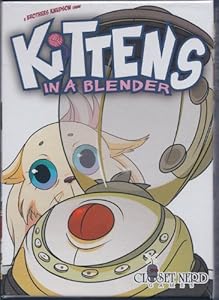
Anyone for Furry Smoothies? (Kittens in a Blender)

October marks the start of Theme Month, where each review will revolve around a single theme or concept.  This year, the theme is "animals".  The month will begin with a nice glass of blood, fur, and cat spirits, as we blend up our first game: Kittens in a Blender.  Just, watch out for any dogs wandering in.

Image result for kittens in a blender

GAME DESCRIPTION:  Kittens is a Card Game designed by the Brothers Knudson for 2 to 4 players.  The object is to amass a furry pile of cats in the Box, while killing off your opponents with the Blender.

SET-UP:  The over-sized Blender card is placed face-up in the box top, and set in the middle of the table.   The base of the box is placed next to it.  These will be the Blender and the Box, respectively.  The space in between is the Counter. Each player then selects of a color, designated by the background of the Cat cards.  Then, each player is dealt 6 cards.

Image result

PLAYING:  Turns consist of playing 2 cards, applying their effects, and drawing back up to 6 cards. If the deck ever runs out, play continues without drawing:

  • Kittens:  A kitten may be played in the Box, the Blender, or on the Counter.
  • Blend!:  When this is played, all Kittens in the Blender are removed for the game, all Kittens in the Box are saved, and all Kittens on the Counter are moved to the Blender.  Saved Kittens count towards your total point value at the end.
  • Blend Pulse:  Similar to Blend, with the addition of cancelling a Blend card.  Blend and Blend Pulse cards stay in front of you.
  • Kittens on the Move:  Move a specified amount of Kittens the specified amount of spaces (if it says 1 space, you can move the Kittens from the Box or the Blender to the Counter, or vice versa, but you cannot move the Kittens from the Box to the Blender, as that is considered 2 spaces.)
  • Dogs in the Kitchen:  Every players hand is rotated to the appropriate player.
  • Kittens in the Blender/Box/Counter:  All Kittens move to the place the card specifies.
  • These Cats in the Blender:  Move all Kittens of a specified color to the Blender.

Image result

SCORING:  The game ends when all 16 Blend and Blend Pulse cards have been played.  All saved Kittens are worth 2 points, and Blended Kittens are worth -1.  In the case of a tie, a winner is decided by whomever has the most Blend and Blend Pulse cards in front of them.

CONCLUSION:  Kittens in a Blender sounds like one of those twisted games that can't help but get a laugh from how messed up the concept is.  Yet, the game plays simply, fairly quickly, and gets a laugh in a good way.  The art is so cute and appealing, and really gets what it was going for.  This game does require you to be okay with having vast amounts of luck and RNG be against and with you.  The games time requirements makes it easy to play multiple rounds if you just keep losing.  Kittens in a Blender can make for a great, silly time with some close friends.