Wednesday, December 7, 2016

First floor: Haberdashery, Shoes, and Poodles (Vanished!)

Up and down, down and up.  The elevator moves, as do the people.  Watch closely and wait for the next guest.  Will it be the Beautiful Lady, with curly locks of gold?  Or maybe it's the maid, carrying her vacuum?  Or maybe the Socialite, with his charming smile and random guest he talks to.  Here one moment, gone the next, the Paternoster vanished, and came right back.

Image result for vanished board game

GAME DESCRIPTION: Vanished! is a tile game published by BePuzzled, now known as University Games.  Players attempt to match characters in their hand with the characters on the elevator, or Paternoster.

SET-UP:  Players begin by taking a whole set of Character cards, identified by their teal background, and place them in their hand.  The Elevator cards, which are smaller and on cardboard, are shuffled and placed face down into 2 rows, leaving 1 middle spot open on the right.  The Pawn is placed next to the empty space.

MOVEMENT:  The first player rolls the die, and moves the pawn clockwise around the pile.  Each player then places the character card they believe matches the Elevator card face-down from either their hand, or their discard pile.  Once every player has chosen a card, flip over the cards and the Elevator card.  Any matching cards are discarded, and all non-matching cards are placed back in the players hand, including previously discarded cards.  Finally, flip the Elevator card face-down, and place it in the empty spot not next to the Pawn.  The game ends when 1 player has discarded all of their cards.


TEMPO:  If a player matches a tile with a card from their discard pile, they gain a Tempo Chip.  If a player spends a Tempo Chip, they may move the pawn 1 space either clockwise or counter-clockwise. Tempo Chips may only be played after the die has been rolled, and a player may spend as many Tempo Chips as they have to keep moving the pawn.

CONCLUSION:  This is probably one of the hardest games to master, even though it is one of the simplest games to learn.  This game is all about memorization, predicting, and planning.  This isn't the easiest game to get a group of friends into, but if your group enjoys puzzles, then Vanished might just be the game for you.

AFTERTHOUGHTS:  So, not long after I started this, I found that Vanished is no longer in print.  However, there is an updated version called Paternoster, which apparently plays the exact same.

Wednesday, November 30, 2016

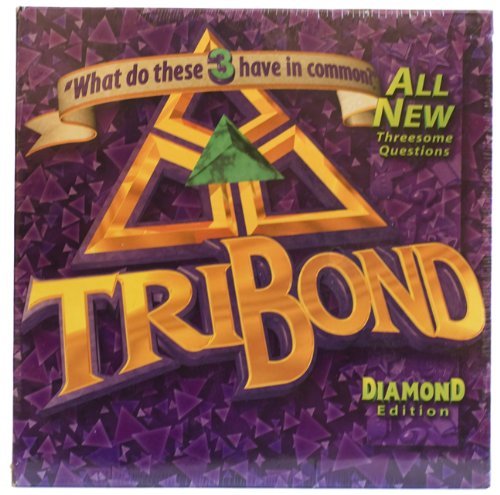
Three of a Kind (Tribond)

A baby, a tire, and an Eagle.  3 seemingly innocent items.  No connection between them, no alibi.  Their story checks out, but the puzzle eludes me.  What could such radically different objects have in common?  I twist them in my mind, scramble them like so many eggs.  That's when it hits me, the connection they all have:  They're all bald.  That's the bond I was looking for.

Image result

GAME DESCRIPTION: TriBond is a board game for 2 or more players or teams, and was designed by Ed Muccini, Tim Walsh, and Dave Yearick in 1989.  Players attempt to get all three of their pieces to the end by finding a common link between 3 objects, people, or terms given.

SET-UP:  The board has 3 small tracks, and each player places their pawns in all 3 starting positions, 1 per smaller board.


MOVEMENT:  During their turn, the player rolls the two dice.  The numbered die is used to determine how far the player will move if they answer correctly, and the Category die, with various shapes printed on it, determines whether the category for the clue is:

  • Entertainment: Popular Culture
  • Academics: Education & Literature
  • Wordplay: Puns, Homonyms, etc.
  • Sports:  Terms, Teams, and Names in Sports
  • Loose Connections: Connected in weird, unusual ways

CHALLENGES:  If a player manages to land on a Green space, they are allowed to Challenge any player in front of them that is not in the Home space.  These are printed on the side of the card, and have no category.  If the challenger guesses correctly first, their piece switches places with the other piece.  If the challenged guesses correctly first, the challenger's turn ends.

Image result for TribondImage result for Tribond

WINNING:  A player or team wins when all their pieces move into their respective Home squares.  This may be accomplished with either an exact or inexact roll, as long as the clues are guessed correctly.

CONCLUSION:  This is a classic in my home.  While we tended to skip the Sports questions, as most in my family have no real knowledge of that category, we still had a lot of fun.  I grew up playing it, seeing how things with no seemingly real connection could have not just a tie, but a strong one.  It's simple in concept, but first learning it tends to take time to get the idea down.  The simplicity of the rules also allows for more flexibility in house rules, allowing a more balanced play between everyone. This is a definite play for those who love words or trivia games.

Wednesday, November 23, 2016

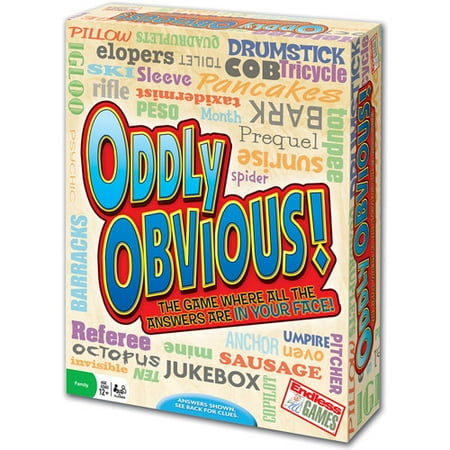
The Answers are There (Oddly Obvious)

The clue: Musical leg.  Your eyes scan the card, trying to make sense of it, match anything to it, even in the most ridiculous fashion.  Then, the person to your right answers Drumstick, and they get the point.  You can't believe you missed it, it was Oddly Obvious.


GAME DESCRIPTION:  Oddly Obvious is a party game published by Endless Games for 3 to 10 players.  The object is to guess the most correct answers off the cards from the word-play and puns given.

SET-UP: 1 person places a card into the clip so that the questions, classified as Side A and Side B are hidden, but the large printed words are facing everyone else.

PLAYING: The person reads the first clue of side A or B, and everyone has 1 chance to guess the correct answer.  The first person to guess correctly gets 1 point, depicted in the form of a colored token.  The catch is that the answer will always be one of the large print words displayed on the front.


WINNING:  The winner of the round is determined by which person has the most tokens once all clues one 1 side have been read and resolved.  In the case of a tie, the tied people attempt to solve 1 more clue read on the other side. In either case, the person who wins gets the card, and a new card is set-up.  Once 1 person gets 5 cards, they win.  If you feel obliged, the winner then reads the cards for the next game.

CONCLUSION:  This is a simple game, quick and easy to understand.  First off, this game is entirely about reading, so anyone with dyslexia or that just has a hard reading English should be given notice.  Next, this is a loud game, with no turns and no real control of volume, so the current person reading the card should be listening carefully, as many games tend to have 2 people answer in near unison.  But, despite all that, I would definitely check this game out.  It's quick, the rules are malleable enough to allow for shorter or longer games, and it gave me a new appreciation for word play.  Since this game in no longer being published, it may be a little harder to obtain a copy.  But, if you can get it online or at a thrift store, it's definitely worth it.

Wednesday, November 16, 2016

What kind of Cheese are you? (Imaginiff)

If you were a bridge, which bridge would you be?  Maybe London Bridge, where it's always falling down.  Or perhaps you're The Golden Gate, sturdy despite all the earthquakes.  You might even be Sydney bridge, noted for the culture you bring as you lead people to the Opera House.  What about your closest friend, or the friend you last spoke to?  And what would they say?  Just Imagine If...


GAME DESCRIPTION: Imaginiff is a board game for 3 to 8 players, and was published by Buffalo Games Inc.  Players are asked what kind of silly, specific thing one of their friends are.  For this review, I'll be talking about the 10th anniversary edition.

SET-UP: Each player takes a  colored piece, and places it on the space in the outer ring of the inner swirled circle. Players also get the 6 numbered cards matching their color.  The object of the game is to reach the inside of the circle. The outer ring contains the numbers 1 through 8.  First, write in all players names in the outer ring, so each name gets its own number.  Then, write in any mutual friends or acquaintances you may have in any remaining spots.  Place the grey question mark pawn on the outer ring at 1.

TURNS:  Each player rolls the die, and moves the grey pawn either direction equal to the number rolled.  Then, the player draws a card and says "Imagine if" and the persons name the pawn landed on, and proceeds to read the rest of the card, and it is placed where every player can see it.  Then, every player will pick a number from their cards that correspondences to what they believe is the most accurate choice, and lay it face down.


CHALLENGE: Sometimes Challenge cards may come up in the deck.  In this case, the player does not roll, but just reads the card.  This card instead applies to all people in the outer ring, and players pick the number that matches the person written down that most closely fits the card.

MOVEMENT:  Once each player has made a decision, flip the cards face-up.  All players who have picked the most popular answer(s) move 1 space, with the player who read the question this turn moving 2 spaces if they chose the popular answer.  If a player

CONCLUSION: Imaginiff is kinda like Buzzfeed quiz: the game.  This game is a lot of fun, and can make for a pretty good icebreaker.  I would suggest either playing with all 8 players, or actually have all players know all people written down who aren't there.  Still, this game can be hilarious if played with the right group, and makes for a nice casual game for a game night, or for a longer game between sessions of large box games.  It's also pretty great for days you might spend with your extended family, and see just how well you know them.