So, you think you've become a Pokemon master? You've collected all 16 badges, and managed to defeat two versions of the Elite Four? You've managed to capture all 256 from both the Kanto and Johto regions? Well, my friend, there's a whole new world for you to explore, with a brand new group of Legendaries and new ways to battle. Now, let's see how you do in the Hoenn region, and see if you are truly a Master Trainer.

BACKGROUND: In 1996, a set of Japanese RPG video games, titled Pokemon Red and Blue. were released and later translated to English. It instantly became a huge success, and spawned a cartoon series, a Trading Card Game, a few various spin-off games, as well as various direct sequels to the game. In time, the cartoon itself grew and had the main character travel to the new locations from the games. Pokemon Master Trainer is set within the Advanced generation of the cartoon series, which focuses on the Hoenn region
GAME DESCRIPTION: Pokemon Master Trainer was developed in 2005 for 2 to 4 players. The object is to move along the board, collecting various cards and Pokemon Chips.
SET-UP: Each player is represented by a trainer token, with characters from the cartoon. Then, each player begins with 3 Pokemon cards and 3 items cards. Finally, each player is given Pokemon Chips, or PC's. The object of the game is to collect the most amount of PC.
MOVEMENT: Each player spins the spinner and moves that many spaces, then applies the space they landed on. However, if you spin a 0, you do not move nor do you get the effect of the space you landed on. Spaces can gain or lose CP, encounter Pokemon or events, draw item cards, and battle various players.
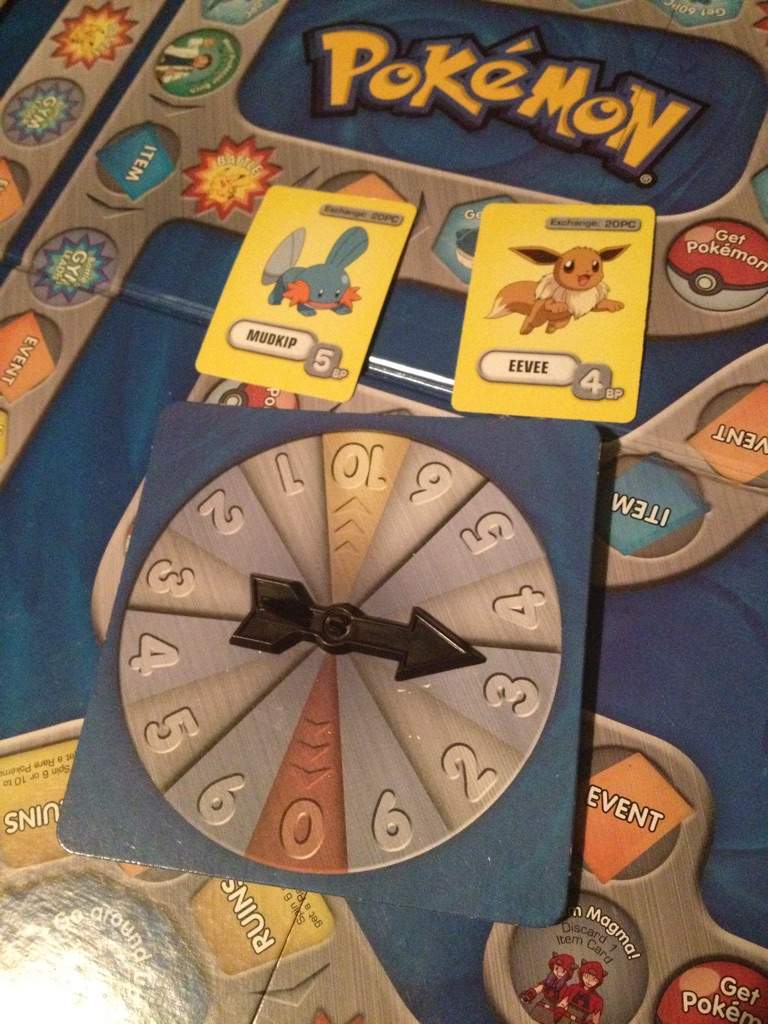
ITEMS: Item cards are used to enhance your Pokemon's BP, or Battle Points, or increase your spinners number for movement or capturing Pokemon. You cannot use Pokeballs when you directly battle another player or a Gym Leader. Also, you are only allowed the use of 1 item per turn.
CAPTURE: In certain spaces and events, you can encounter and capture various Pokemon from the past 3 generations, from Bulbasaur to Salamence. You select a Pokemon from your team, and have it battle a random Pokemon from the deck, or one from the discard pile. Then, after playing a card, you and the player to your left spin. You add your number to your Pokemon, the opposing player adds it to the one your attempting to capture. In the case of ties, both players spin and compare. If your number is higher, or you spin a 10, it is yours. If it's lower, or you spin a 0, it is placed face up in the discard pile.

BATTLE: Battling other trainers have similar rules to Capturing Pokemon. Both players choose 1 of their Pokemon, then they play an item. Afterwards, both players spin. Any 10 is an instant win for that player, and 0 an instant loss. Compare the total numbers to see who wins. The player who won gets to take the opposing players Pokemon they battled. If they only have 1, the player then gives up 20 PC.
GYM BATTLE: There are also Battle Gym Leader Spaces. Again, battling is similar to Capturing a Pokemon, with the challenging player choosing a Pokemon, and may play an item. Both players spin and see who wins. 10 is an automatic win, 0 an automatic loss. If you win, gain 2 Pokemon cards, and the gym leader goes out of play. If you lose, you give up 20 PC to the bank, and the Gym Leader is put at the bottom of the deck.

LEGENDARY: If you draw or land on a Ruins, you then draw a Pokemon from the Rare Pokemon Pile. These are usually the Legendary Pokemon from the games, such as Mewtwo, Suicune, or Rayquaza. In this case, you do not battle with one of your Pokemon, and you cannot use items. You spin, and if you land on a 6 or 10, you capture that Pokemon. If you spin any other number, the Pokemon goes back into the deck and is shuffled.
CP & GOAL: If you ever run out of CP, you must draw a Smile Loan card. This gives you 100 CP, but you lose 120 CP once you reach the goal. Each player ends up with a set amount of bonus CP depending on when they reached the goal.
CONCLUSION: Regardless of the seemingly complex and intricate detail of the rules, this plays rather simply. But, is it any fun? Well, if you want a simple, quick Pokemon themed game, then this game works. It plays a bit like Game of Life, but with enough differences to make the game stand out, and be it's own thing rather than feel like a re-skin. It works thematically because it tries to add more than just a different board with different words but the same effects. The Capturing and Battling system is different, and they work. Now, is it compelling? Not really. The reason why the first Master Trainer works so well is that it feels like you're traveling around and collecting Pokemon to build a strong team and fight the Elite Four. Sure, it needs some slight polishing, but the length just adds to the experience. This one just feels like they cut out too much to make it streamlined. It's not bad, but it lacks in depth the previous one had. Still, it's nice to pull this one out for a quicker Pokemon themed experience, and this is a must have for every up and coming Pokemon Master.
AFTERTHOUGHTS: One final thought before I wrap this up is the name. If you've read this blog before, you'll notice that I reviewed Pokemon: Master Trainer already, but that was a different game. This version is actually the 3rd of Pokemon: Master Trainer named games. Now, this is a problem, as that makes it difficult to actually find both this version of the game, as well as the previous version. This may sound like common knowledge, but DO NOT NAME YOUR GAMES THE SAME THING! This could have easily been solved with subtitles, such as "Master Trainer: Hoenn Version" or "Master Trainer Advanced". Imagine if all versions of Munchkin were just called Munchkin. Yeah, not a good idea. Even if you only sold a half dozen copies of your game because it was an awful game, you should still title the name slightly different, so this doesn't happen. It's silly, it's dumb, and it's rude.


