Wednesday, March 13, 2019

Planet of the Boars (Zoon)

Earth: 2808
Humans have long since abandoned the planet, but their legacy lives on.  Now, we who were once mere creatures, have become something so much more.  We are the dominant species, Rhinogoths and Monkus, Warus and Boarix.  We have taken over, and we will fight until one of us is dominant on the entire planet.  We are the Zoon, more than beast, more than human!


BACKGROUND: Zoon is a strategy card game for two players.  It was created in 1999 by Migou Auteurs, Robert Cepo, Nicolas Pilartz, with art by Robert Cepo.  It was most recently published by West End Games.  Players each take a deck of cards and attempt to capture the others Emblem, marked with a flag.

GAMEPLAY:  The game starts with both players setting up their "Zoons", or cards face-down on an imaginary board of 6 by 6 in their first two rows, with 3 Trump Zoons in their hands.  Each card has a movement printed on it, and each player, on their turn, move any Zoon according to their movement.  Instead of moving, a player may instead play a Trump from their hand.


COMBAT:  Whenever a Zoon moves into a space with an enemy Zoon, combat happens.  Players rotate their cards, and pick a corner on the opponents Zoon.  Flip the card, and the player who has the higher number wins.  The losing Zoon is discarded, and either moves into the space to which it was advancing, or stays where it was.  In a tie, the Zoon that moved moves back to where it approached from.  If a Star is hit, apply the effect that is on the Tribes card.

TRUMP:  Some Trumps apply once when they are played and are discarded.  Others, like Weapon Trumps, return to their hand unless the player hits their X effect.  Most Trump cards, however, require a specific type of Zoon to be in a specific position.  If a battle is used with a Trump, use the Trump as the attack unless it states otherwise.

WINNING:  Each player has an Emblem somewhere on the board.  A player wins when they defeat the opponents Emblem.

CONCLUSION:  The first thought most people will have about this game is that it's a card game version of Stratego, and not unfairly.  On its own, Zoon has a fair amount of issues.  First off, the imaginary board: This is an aspect that gets frustrating, and while not hard to imagine or use tokens or even make a custom one on a blank mat, it can still be confusing where anything is.  You constantly have to check where your cards are, unless you have a superhuman memory, which can slow the game down.
Its biggest issue, however, lies in the combat.  The spinning is a neat trick, but once you see a Zoon, it tends to go from a 1/4 chance of hitting the big numbers to 1/2, once you know where they are.  I'd roll a D4 to keep things level, and mark the cards appropriately. The thing I can see a lot of players complaing about is the victory conditions, as it is easy to have almost nothing, be in a bad spot, and still win.  However, I thing that's the games strength, as it is so incredibly easy to bounce back that it never feels like you can't.  I did enjoy this game, but it's a shame that this is the game we got, when it could be a lot better.  Still, I'd rather play this than Stratego.

Wednesday, February 27, 2019

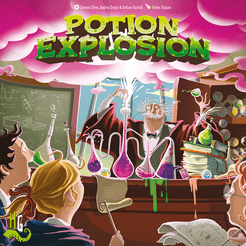
A Magical Crush (Potion Explosion)

Greetings, my young appren'tices.  Welcome to the lab, where all our most vile and powerful potions are brewed.  I, Professor Severel Snipes, will be your professor.  I will teach you how to brew fame and fortune, bottle emotions, and even cork up Times aging effect. All you have to do is take a chance, and work hard.  That?  That was just a Potion Explosion, the first of many here.


BACKGROUND:  Potion Explosion is a marble based game for 2-4 players.  It was created by Stefano Castelli, Andrea Crespi, Lorenzo Silva, and Giulia Ghigini in 2015, and published by Horrible Games.  Players gather ingredients to create potions to score points.

GAMEPLAY:  Each turn, a player may take an ingredient from the Dispenser from rows 1-8.  If 2 or more marbles with matching colors ever during this time, the player gathers all marbles that match, and continue as long as 2 or more marbles collide.  This is called an Explosion.  Then, the player places all the marbles in their hand onto 1 or both of their potions, or onto their Ingredient Pool to save for later.  If neither works, all remaining are put back into the dispenser.  Whenever a potion is finished, it is placed off to the side, and replaced at the end of the players turn.


MARBLES:  Players may also take another marble once during their turn by taking a Little Help Token, which costs the player 2 Victory Points.  Players can also drink any of their potions for a one time effect.  In either case, if 2 or more marbles Explode from either of these events, players do not gather more marbles.

WINNING:  If a player gets collects 3 of the same potions, or 5 different kinds of potions, the player gathers a Skill Token.  Players cannot get a Skill Token if they already have got one for fulfilling that requirement.  When the Skill Token pile runs out, all other players take 1 final turn.  Then, every player counts the Victory Points from all Skill Tokens, collected potions, and all Little Help tokens.

CONCLUSION:  Mechanically, this game is similar to something like Bejeweled or Candy Crush.  The thing is, that's fascinating to see something like that in a board game, a mechanic that seems like it wouldn't be translatable to a real world setting, and yet here it is.  The game is fun, too, if you like match-3 types of games.  The biggest weakness I see with it is that it takes a little bit to get a handle on how the Explosions work.  Once you do, it's fun to see all the ways you can take advantage of it, and can blow your mind.

Wednesday, February 20, 2019

Gateway Pipeweed (Portal of Heroes)

Once upon a time, in a land of dwarves and elves, where cats could talk, and will o' the wisps danced in the dark, there stood a magician.  Molthar, who cast a spell of darkness, until the Portal of Heroes would open up, and bring those who would stop him.  Do you have the courage to step through the Portal?


BACKGROUND:  Portal of Heroes was designed by Johannes Schmidauer-König
and Dennis Lohausen in 2015, and published by AMIGO.  Players attempt to gather Pearl cards and Character cards to collect points.

GAMEPLAY:  Each turn, a player takes 3 actions of any combination of the following:  They may remove all 4 face-up numbered Pearl cards and replace them; they may take either of the two face-up Character cards or draw one from the deck, and put it on one of their two Portals right side up, discarding one if they take a third; they may Activate a character; or they may take either a face-up Pearl card or one from their deck into their hand.


CHARACTERS:  Each Character requires a specific combination of Pearl cards to activate it, from a specific number of Numbers, to a pair or straight.  When a Character is activated, that player flips the card upside down, gains the Power Points and other effects now at the top, and puts it off to the side.  Some Character cards grant you Diamonds, or effects that are used before, during, or after your turn  Diamonds are indicated by taking a Character card face-down, and are used to raise a Pearl cards number by 1.

WINNING:  Once any player has gathered 12 or more Power Points, the game comes to an end by first finishing the current round (the player to the right of the starting player ends their turn), and all players get 1 final turn.  The player who has the most Power Points wins, with ties going to the tied players with the most Diamonds.

CONCLUSION:  Portal of Heroes is a nice little game that is obviously inspired by more classic card games and trick taking games, and wears that influence on its sleeve.  Mechanically, it has a lot going for it.  It plays smoothly, the turns are never obnoxiously long, and the amount of strategy to go for certain cards always ends up being varied for that reason.  The two biggest issues with this game are complexity and its theme.  First, it doesn't stand out as anything than generic fairy tales.  I've passed this game multiple times on the shelf without realizing it was there because it doesn't pop out that well.  The other is that it's one of those 'tricky to understand, easy to play', which is a shame because that will keep people from playing it without a good teacher there, and even then it might be frustrating.  Still, if you like Hoyle deck card games, or stuff like the Fox and the Forest, then give this a try.  It might take you through a portal of fun.

Wednesday, February 13, 2019

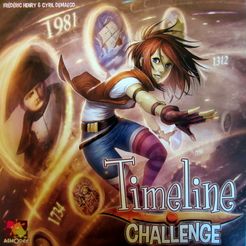
Better Late Than Never (Timeline Challenge)

They say that real life can direct the plot of a story.  Well, that's a matter of fact with this game.  Now, before you click off, let me sell you on this.  Imagine a game of figuring out dates, don't close yet, but actually has gameplay elements.  This is Timeline Challenge.


BACKGROUND: Timeline Challenge is a board/card game for 2-10 players by Cyril Demaegd and Frédéric Henry, art by Xavier Collette and Jérémie Fleury, and published by Asmodee in 2015.  It is an expanded sequel to Timelines.

GAMEPLAY: Each turn, all players are engaged in a Trial, depending on the space the leading player is on.  Generally, the Historical board (with the dials) is used to guess the the cards dates or orders. Players move spaces according to the Trial.  There are also 2 Challenge lines, which are played immediately once any player crosses that line, but are only played once.  The player in last starts, and continues clockwise. The winner of the Challenge moves ahead 3 spaces, and play continues as normal.


WINNING: The game ends once a player reached the center Finish space.  In the case of a tie, the tied players play one final Sudden Death Challenge.

CONCLUSION:  I want to summarize this game with 'this is Timelines', and to an extent, it is.  It uses the same premise and idea that the original uses.  But, because Timelines was so simple an idea, it became easy to be able to flesh it out and make it more tangible of a game.  Once you understand the Trials, the game becomes just as easy to understand, but with more mechanical depth (but not much) of the first game.  So, if you like the idea of Timelines, but want something that will last a little bit longer, this is the Challenge for you.