Wednesday, February 13, 2019

Better Late Than Never (Timeline Challenge)

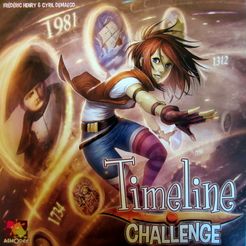
They say that real life can direct the plot of a story.  Well, that's a matter of fact with this game.  Now, before you click off, let me sell you on this.  Imagine a game of figuring out dates, don't close yet, but actually has gameplay elements.  This is Timeline Challenge.


BACKGROUND: Timeline Challenge is a board/card game for 2-10 players by Cyril Demaegd and Frédéric Henry, art by Xavier Collette and Jérémie Fleury, and published by Asmodee in 2015.  It is an expanded sequel to Timelines.

GAMEPLAY: Each turn, all players are engaged in a Trial, depending on the space the leading player is on.  Generally, the Historical board (with the dials) is used to guess the the cards dates or orders. Players move spaces according to the Trial.  There are also 2 Challenge lines, which are played immediately once any player crosses that line, but are only played once.  The player in last starts, and continues clockwise. The winner of the Challenge moves ahead 3 spaces, and play continues as normal.


WINNING: The game ends once a player reached the center Finish space.  In the case of a tie, the tied players play one final Sudden Death Challenge.

CONCLUSION:  I want to summarize this game with 'this is Timelines', and to an extent, it is.  It uses the same premise and idea that the original uses.  But, because Timelines was so simple an idea, it became easy to be able to flesh it out and make it more tangible of a game.  Once you understand the Trials, the game becomes just as easy to understand, but with more mechanical depth (but not much) of the first game.  So, if you like the idea of Timelines, but want something that will last a little bit longer, this is the Challenge for you.

Wednesday, February 6, 2019

On Board, I'm the Captain (Coup)

Royalty.  The good life, the pampered position.  But you never know when some rich duke is gonna want to sign you up for marriage, or if some wanna-be assassin is going to try to take your life.  So, what do you do?  Even in the future, things aren't all that great, and it can be just as easy to Coup as be Coup-ed...


BACKGROUND:  Coup is a hidden role card game created by Rikki Tahta in 2012 and published by Indie Boards & Cards.  Players attempt to gather up coins and take the others influence down.

GAMEPLAY:  Each player starts with a pair of Role cards, kept hidden from the other players.  Each turn, players can take 1 of 7 actions.  Some of these actions are dependent on Coins, such as performing a Coup requires 7, and is required if a player starts with 10+ Coins.  Some actions are determined by the Influence cards, and most of these can also be blocked by other Influence Cards, but no player is technically required to have that Influence card in their hand.


CHALLENGE:  If, at any point, a player takes an action from a Influence card, another player can challenge that they have that card in their hand, or the player that would be affected if it is a single effect, like assassination or stealing Coins.  The challenged player reveals a Influence from their hand.  If they do not have that card, the effect is nulled, and the challenged player discards an Influence card..If they do have that card, the effect applies and the challenging player discards an Influence card, while the challenged player shuffles the revealed card back into the deck and draws a new Influence card.

WINNING:  The player who has the last Influence wins the game.

CONCLUSION:  I can honestly say that Coup is a fine game.  I will give it credit for being one of the few Hidden Role Werewolf-esque games to be drastically different than Werewolf, and causing players to directly fight each other rather than relying on subterfuge and misdirection as strongly as most other games in the genre.  In addition, it also has a thematic component, being in the Resistance universe, but that only goes so far, and it doesn't have much of a connection personally.  If you like the Resistance universe and that helps sell this game for you, great, it's a fine universe, but not one I'm invested in.  That being said, it is nice to have a game like Coup for those that want to play Werewolf of Secret Hitler, but have fewer players.  Coup is meant for that, and it's worth checking out, but it still won't replace some of the other games I've reviewed better (again, see Secret Hitler, The Resistance, or One Night).

Wednesday, January 30, 2019

These Pecan Sandies Might Kill You (Forbidden Desert)

Pain.  That's the first memory you have.  The second is one of falling out of the sky.  The third is flying over the Forbidden Desert.  That would explain the heat.  You cough, and hear the creak of various seats and metal around you.  You call out, and everyone seems to be intact, but you quickly come to the conclusion that unless you can find that flying machine that brought you here, you're going to all perish from dehydration.  Let's just hope it get's up in the air...


BACKGROUND:  Forbidden Desert is part of the Forbidden series of survival co-operative games.  It is for 2-5 players, and was designed by Matt Leacock, artists C. B. Canga and Tyler Edlin, and published by Gamewright.  By taking a role, players work together to collect all the pieces of the machine and fly out before they die.


GAMEPLAY:  Each turn consists of a sequence of 2 events: A player may take up to any 4 combination of actions, and then Sandstorm cards are drawn.  These actions consist of removing sand markers on their tile or any orthogonally (or any non diagonally) from them, moving orthogonally to a space with less than 2 sand markers on it, flipping face-up a sand free tile they are on, and picking up a part.  At any point a player may share with another player water or items with a player they share a space with.

SANDSTORM:  The 5 by 5 grid will always have an empty space, where the storm is.  At the end of a turn, flip Sandstorm cards equal to the number on the Sandstorm Meter level, move the indicated number of tiles so that the 'storm' moves in the direction on the card, then place sand markers on the tiles moved.  If the storm can't move, nothing happens.  If a Storm Picks Up card is drawn, raise the Meter level, and draw that many cards next turn.  If a Sun Beats Down card is drawn, all players lose a level of water on their cards.


END:  Some tiles have arrows to determine where an Machine piece will end up being.  Players must find all 8 'clue' tiles to find where the Machine pieces will be, gather them up, and get to the Launch Pad! tile.  However, there are three ways to lose:  If any player reaches the skull and crossbones on their canteen or the on the Sand Storm meter, or if there are no more sand markers to add to the board.

CONCLUSION:  After reviewing Forbidden Island, and playing Forbidden Sky (expect a review on that one as well), I can confidently say that this is so far, my favorite version of the Forbidden series of games.  The flow feels a lot better, without losing the struggle of obtaining victory.  I would say the biggest problem I had was something a lot of co-op board games struggle with, and that's punishing a larger group than a smaller one.  It would make sense to go through a game with a full party and win more often than with 2 or 3 players, but it always seems like the opposite happens.  Still, this is a great game, and the best in the franchise, so go out and uncover your own copy today at your local game store.

Wednesday, January 23, 2019

Beast Wars (One Night Ultimate Werewolf)

Thud.
That's all you hear, all you want to hear as you run through.  The adage holds true, don't outrun the beast, outrun your friends.  The howl pierces your ears and sends shivers down your spine.  Just keep running, you tell yourself, but you know it's too late when you skid to a stop, and see the den.  The den with 2 other werewolves.  This is the One Night, and the Ultimate Werewolf is here.


BACKGROUND: One Night Ultimate Werewolf is a hidden role game for 3-10 players.  It was created by Ted Alspach, Akihisa Okui, and Gus Batts,and published by Bézier Games in 2014.  Like in typical Werewolf fashion, players take either the role of Werewolves or Villagers, and attempt to kill the other.

GAMEPLAY:  Each player is dealt a random number token, and character role face-down.  There are more role cards dealt face down in the center.  Then, all players close their eyes, called the Night Phase. Using either the app or reading the effects from a narrator, the role cards are read in a specific order with various effects happening


WINNING:  Once all roles have been read, and all the effects determined for the night, the Day Phase happens, where players vote off a character or characters in the case of a tie.  The player voted off reveals the card in front of them, which is not necessarily their starting card.  Generally, is a Wolf is voted off, the Villagers win, and vice versa, but sometimes that may differ depending on the card.

CONCLUSION:  When I first heard the concept, Werewolf in 1 night, I admit that I was...hesitant.  Part of the fun is detection, and reading people, which one night wouldn't allow for very well, so I thought. Yet, this feels like the natural evolution of where Werewolf should go.  The game seem short initially, but that allows for a more intense guessing of characters.  The roles are fun and unique, and the game flows well once you get the hang of it, which takes less than a minute.  I would love a Mafia skin of this game, as there is already an Alien, Vampire, and Super Villains version of this game.  Obviously, purists and people who love longer Werewolf games aren't going to like this as much, and because the app is so helpful and fluid, this will turn some people off who enjoy narration and putting their own twist on the world, but I still say those people should at least try this version out, if not to replace the other version, than at least to give these worlds a fair chance.