Wednesday, August 3, 2016

Mercy Never Changes (It Came To Pass)

And so it was written that there would be a game.  A game to bring family together.  A game that would involve counting, indeed, counting!  And this game would need to have strategy, to teach the little children, and train the minds of the people.  And one more thing was needed: This game would require quick reflexes, to train the body of the people.  And so...It Came To Pass.

It Came to Pass

GAME DESCRIPTION:  It Came To Pass is a fast paced card game for 2 to 8 players.  The object of the game is to get the total amount of points in your hand as close to 0.  All points in a players hand are counted against them.  The player with the least amount of points is declared the winner.  The game starts with every player having 6 cards in hand, and flipping 1 card over to start the discard.

PLAYING:  Each turn begins by drawing one card from the deck or top of the discard pile to start the turn, and discarding one.  Each Numerical card in your hand is worth that many points.  Charity cards are worth 0 points.  All cards that match the color of any Charity in your hand are worth 0 points. Desolation cards are worth 25 points, and can only be discarded if the last card is a matching color, or played on a Mercy.


OPTION CARDS:  Every other card is called an Option Card, and can be added in or left out.  Each have their own point value and effect
  • Repentance (20 points):  Reverses the direction of play.
  • Unbelief (20 points):  Skips the next player.
  • Pride Cycle (20 points):  Each player passes 1 card to the next player.
  • Secret Combination (20 points):  The player compares hands with the next player, sets aside one of them, and they now play as a team.  This has no effect if there are only two teams of players or two players.
  • Justice (20 points):  The next player must either play another Justice, a Mercy, or draw cards equal to the amount written on all Justice cards played.
  • Mercy (50 points):  Players race to be the first to play any card, and play continues to the next player of the that player.

THE END:  A round can end in 2 ways; either a player gets their hand down to 0 points, which ends the round instantly, or if a player says "Pass".  If a player Passes, they end their turn, cannot alter it in any way, and play continues until play reaches the player who passed.  If the player who passed has the lowest value, they subtract 20 from their current score.  If another player has the lowest score, the player who passed gains 10 points plus that players score.

CONCLUSION:  Upon first glance, this seems to be a Mormon themed Uno, but don't discount it.  The unique take on "forcing" teams and rushing to play on a Mercy adds a quickness that I found lacking in regular Uno.  The game plays well, even if a bit rough with the Mercy that, let's face it, adds a mechanic that can easily be seen unfair to slower players.  The game still plays quick outside of that, and flows in a way a lot of mainstream card games never really seemed to grasp.  For a fast action Game Night, a Family Home Evening, or just having some quick fun with a group of like minded fellows, It Came To Pass is worth trying out.

Wednesday, July 27, 2016

Movin' on Up (The Great Dalmuti)

One minute you're at the bottom of world, worse than dirt, and the next you're living it up in your nice castle, worries of survival barely noticeable.  But once the fates have dealt your hand, you'll fight for your position, fending off those lower than you to keep your prize.  You plan out strategies, desperate to stay at the top in The Great Dalmuti.


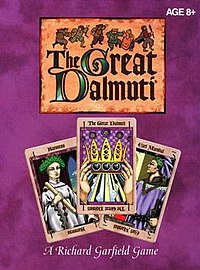
GAME DESCRIPTION:  The Great Dalmuti is a card game designed for 5-8 players.  The object of the game is to be the first player to get rid of all the cards in your hand.  Play continues until only 1 player still has cards in their hand.

SET-UP:  Each player draws a card to determine their position, from Great Dalmuti (1) to Peasant (12) with Jester (Wild) being higher than Peasant.  The player with the lowest numbered card is the Greater Dalmuti, and the next player is the Lesser Dalmuti.  The player with the highest numbered card is Greater Peon.  The Lesser Peon is the player with the 2nd highest number.  All other players become Peasants.  All players sit in a circle, starting with the Greater Dalmuti. To their left sits the Lesser Dalmuti, then all the Peasants. The Lesser Peon sits to the left of the last Peasant, and the Greater Peon should be to the right of the Greater Dalmuti.

TAXATION:  At the beginning of each game, the Greater Peon must give up their 2 lowest cards to the Greater Dalmuti, while the Greater Dalmuti gives 2 cards of their choice to the Greater Peon from both their starting hands.  This applies to the Lesser Peon, who must only give up 1 of their lowest card to the Lesser Dalmuti, as the Lesser Dalmuti gives up 1 card to the Lesser Peon.


REVOLUTION:  If any player is dealt both Jesters, then that player may shout "Revoultion", which eliminates the taxation rule.  If the Greater Peon has both Jesters, they call "Greater Revolution", which has the Greater Peon and Greater Dalmuti switch places with each other, as do the Lesser Peon and Lesser Dalmuti.

PLAYING:  Once everything above has been resolved, play begins.  The Greater Dalmuti starts by playing any number of matching cards.  The next player to the left, the Lesser Dalmuti, must either play the same number of cards at a lower value, or pass.  It's at this point the Jester can be played with any card to change it's value to match the card it's played alongside.  If played alone, the Jester's value is 13. Play continues for this round until everyone passes once. The Greater Peon takes all the cards away, and the player who played last starts the next round.


GOING OUT:  The first player to successfully play all their cards first will, upon the next game, be the Greater Dalmuti. The next player to get rid of all their cards will take the Lesser Dalmuti position.  Then all the Peasants positions are determined, with the last player to go out taking the Lesser Peon's position, and the Greater Peon being the player who failed to go out.

CONCLUSION:  Great Dalmuti is a fun game with no real winner decided at the end.  Sure, you can give people points decided on their position, or just whomever became Dalmuti the most, but I feel that kinda defeats the purpose. Sometimes games are played just to socialize or shut your brain off for awhile, which this one excels at with its basic rules and calming tone.  Sure, expect to have players who are determined to win at all costs, but this game allows those to play alongside those people who just play for fun, not easy for a game to do.  Sure, some players will feel locked out or picked on, but not game was meant for every player.  Still, for a game whose playtime you can control (mostly), try The Great Dalmuti.

AFTERTHOUGHTS:  So, if you've ever played Scum, President, or some variation, then this game should sound familiar to you.  Your next thought may then be, "Well, why should I buy this over a pack of playing cards, which are cheaper and easier to get ahold of?" and "Why do I think in italics?"  Well, I can't answer the latter, but the former is easy enough.  The Great Damuti is so great (heh, easy pun) because it flows better by changing out the number of game winning cards.  There are a dozen Peasant cards, the highest value card, but only 1 Great Dalmuti, the lowest card.  In this case, people can't end up hoarding High cards like in Scum, because the amount has varied so noticeably.   The Great Dalmuti doesn't favour the player at the top, like Scum does, but it does still make it an enviable position.  10/10 times I'd prefer Great Dalmuti over Scum.

Wednesday, July 20, 2016

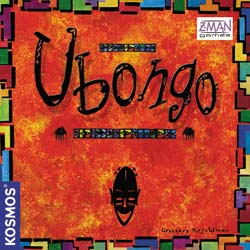
The Name of This Game Means Brain?! (Ubongo)

Maybe that piece goes there?  But that leaves you with a long piece that doesn't quite fit.  Time to clear the board, and turn some pieces.  But if that goes there, then where does the square piece go?  Or the L shape, how does it fit?  Your brain keeps spinning and grinding , solving the puzzle of Ubongo.


GAME DESCRIPTION:  Ubongo is a 2-4 player board game similar to tangram puzzles.  Each player races to be the first to complete their puzzle by combing certain pieces into their board.

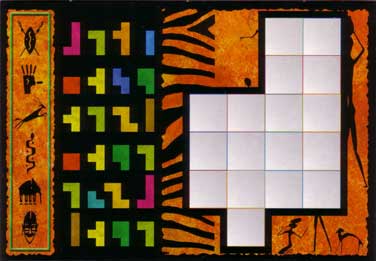
PUZZLES:  Each player is given a board, and the starting player decides which side of the board to use (3 or 4 pieces). The player then rolls the die, and each player takes the pieces that match up with the symbol rolled.  The first player to fill in the white on their board completely with all their shapes calls out "UBONGO!", and players continue to do so until either all players finish, or there is only 1 player left who hasn't finished.  The players then collect their points, and are given new boards.


POINTS:  Each player takes one of 4 pawns, and places it on the long scoring board.  This board will be filled up with gems of various colors.
  • The first player to complete their board can move up to 3 spaces in any direction, and collects the 2 gems closest to their pawn on that row.  
  • The next player may move up to 2 spaces and collects their 2 gems.  
  • The third may move up to 1 space and collects their 2 gems.
  • The 4th player cannot move at all, and must take the 2 gems closest on that row.

WINNING:  The game ends if all gems have been removed, or 9 rounds have passed, depending on the players.  The player with the most gems of 1 color wins.  In the case of any ties, victory is determined by the tied players next most collected gems,

CONCLUSION:  As I mentioned, this game revolves around tangrams, or fitting various shapes into a bigger shape. Strategy and puzzle solving skills are the strongest points here.  This can easily put off a lot of players, as not being good at these kinds of puzzles can hinder your enjoyment so that there's no way to get victory.  Also, sometimes your brain just doesn't work, and certain layouts don't make sense.  I enjoy the scoring system, as it could've been easy just to give players points based on how fast they finished, but decided to change it up so even the slower players can still end up having a solid victory.  For puzzle fans everywhere, Ubongo is the way to go.

Wednesday, July 13, 2016

Romancing the Throne's Daughter (Love Letter)

Your hand is trembling.  Your heart thumping harder than it ever has.  You pull your cloak a little tighter, hoping no one notices you out here.  Then, a branch snaps, and you turn, ready to run.  But it's just the palace guard you arranged to meet out here.  Without a word, you pass the letter to him, and he merely nods.  You watch as he travels back to the castle, carrying the only chance to woo the princess, your Love Letter.


GAME DESCRIPTION:  Love Letter is a 2-4 player card game.  The goal is to be either the only player left, or have the highest card in your hand by each rounds end.  Each player starts with 1 card in their hand, and 1 card is removed.  Each turn, the current player draws a card, plays 1 of their cards, and the turn ends.  

CARDS:  Each card has a different rule when played, and a different value:
  • GUARD (1):  Choose a player, and name a non-Guard card they have in their hand.  If they have that card, they discard it and are out for that round.
  • PRIEST (2):  Allows you to peek at 1 players hand.
  • BARON (3):  Compare hands with another player, and the player with the lowest card is out for the round. 
  • HANDMAID (4):  Prevents you from being affect by any card until your next turn.
  • PRINCE (5):  One player, which can include you, must discard their entire hand. 
  • KING (6):  Trade your hand with any other player.
  • COUNTESS (7):  A high card, but is discarded if you draw either the King or Prince.
  • PRINCESS (8):  If she is discarded for any reason, you're out for the round.

WINNING:  Each game is divided into rounds.  A round ends when the cards run out, or only 1 player is left.  If there is more than 1 player left, the player with the highest value card wins the round.  Then, that player gets a Token of Affection.  When you get the appropriate number of Tokens, you win.


CONCLUSION: This is another quick game you can play in between rounds and during breaks.  But unlike most games like this, this game isn't as easy to master.  This game relies on heavy bluffing, planning ahead, and a bit of luck to pull out a win.  I'm really bad at this game, but I've managed to win a few rounds, and even a game or two.  Players may be put off by it's apparent simplicity, but it's definitely harder than it looks.  

AFTERTHOUGHTS:  The other really interesting thing about Love Letter is the different versions.  With Munchkin, Batman, Adventure Time, and more, there's a lot of ways to play.  Each version I've managed to get my hands on has altered the rules slightly, making it less of a 're-skin' and more of a unique version,  My favorite would be the Batman version, as it streamlines a game that's already pretty quick.  I'd recommend checking them out.