Wednesday, July 6, 2016

A Rough Sketch (Telestrations)

How on earth did this happen?  Sure, World Tree may not have been the most obvious clue, but as you go through the sketches, it turns into Redwood, tree house, and...floating castle?  Maybe the stylized design wasn't the best, but the final clue, flying wizard tower, is so far removed from the original clue that you wouldn't have believed it if you hadn't seen it.  That's the kind of wackiness seen from Telestrations.


GAME DESCRIPTION:  Telestrations is a 4-8 player party game, with up to 12 players available in the party pack edition. Combining the classic Telephone game with Pictonary, players will draw a topic, and get other players to guess correctly.

PLAYING:  Each player is given a card, with 6 clues.  A player rolls the die, and writes down the Secret Word that matches the die roll on the inside flap of their sketchbook, then proceeds to draw that word on slot 1.  Once time is up, or you are done, pass your sketchbook to the next player.  Then, players write down what they think the word is on the next page.  Again, sketchbooks are passed, and players draw the previous players guess.  Play continues like this until each player gets their original sketchbook back.

TIMER:  Sometimes people want to make their message clear, and can take a bit longer than everyone else, slowing the game and making the game less enjoyable.  Luckily, there is a 90 second timer that players can use to speed up the game.


SCORING:  The game is divided into 3 rounds.  At the end of each round, when sketchbooks are gathered up, each player takes turns showing the clues and drawings.  Then, a point is given to two players, one for guess and one for drawing.  Also, if the last guess is exactly the same as the player's Secret Word, the player who wrote the original word also gets 1 point.  At the end of the third round, total up the points

CONCLUSION:  This is a more relaxed game, with points ultimately just rewarding humor rather than great drawing skills.  Because of this, it might be seen as a more casual game, which is not an unfair assessment.  This is one of those games that you play as downtime, or in between long games.  Quick to learn, quick to play, this might be avoided by people more interested in more in depth games, but it's still good for a laugh on a Saturday night. Especially when you start throwing in your own groups in-jokes.

AFTERTHOUGHTS:  So, this game has also been unoffically known as Fax Machine, offically released online under Drawception, and various names and places elsewhere.  The big advantage this game has is in the social aspect, and the convienence.  Sure, you can just buy a pack of notebooks and pencils and use those, but Secret Words become chaotic that way, and it's harder to clean up.  If you aren't strapped for cash, I would say this is definitely the better option.  The markers also add a level of fairness by limiting the thickness of lines, making it simpler for less experienced artists, and forcing those with art talents thatare noticeably better to limit their drawings.

Wednesday, June 29, 2016

Gambling to the Top (Lords of Vegas)

The year is 1941, the place is a little desert town known as Las Vegas.  Your goal: to create a sprawling fortune the likes of which have never been seen before, by changing this small town of little notoriety into the biggest entertainment scene this side of the Rocky Mountains.  But your biggest obstacle won't be money or bringing in customers.  No, the biggest threat to your empire will be your former friends also wanting to become the Lords of Vegas.


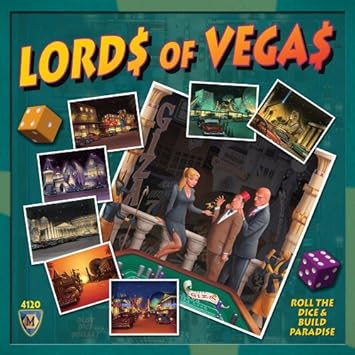
GAME DESCRIPTION: Lords of Vegas is a 2-4 player game published by Mayfair Games.  The objective is to build Casinos to gather points.  The winner is decided either by who has the most points when the End of Game card is drawn, or if any player manages to get to the end of the board before then.

THE BEGINNING: Play starts by selecting 1 of 4 colors, and placing the appropriately colored scoring counter on the board spot marked 1.  Each player than draws two Property cards from the deck.  The money on the card determines the total they start with, as well as the first 2 starting locations for each player, determined by placing the markers according to the alphanumeric location on the card (e.g. C4).

LOTS AND LOCATIONS: The game board is divided into 6 separate locations based on letters.  Each turn, a location card is drawn, and the player places a marker in that alphanumeric location, defined as that players Lot.  For every Lot, each player gains $1M.  The player may then spend money to buy a Casino in 1 of 5 colors.


CASINOS:  Casinos are how you'll make most of your money and get points.  Each turn, you may buy a location equal to the amount located on a location you already own a Lot on, or you may buy another location and place a Casino next to one you already own at twice the price printed on the board.  When you buy a property you'll notice a die number printed on the board.  That determines what the starting value of your property, and you'll place one of your dice into that Casino matching the number of pips shown. When a Property card is drawn that matches the color of a Casino, you'll gain that much money equal to the number of pips in all matching Casinos, and 1 point per matching Casino.

GAMBLING:  Any player may gamble at another players Casino, at a maximum of $5M per Casino.  If the player does not roll a matching number according to the boards wager space, they lose that money.  If they match a number, they gain that money from that player, with 2 and 12 doubling what they wagered.  If the player being bet against cannot pay the bank covers it.

STEALING:  If you place a Casino next to another player's Casino with the same color, the player with the highest numbered die now has control over all matched Casinos. All money and points will then go to that player.  If you have a die in a Casino or matched group of Casinos, you may spend money equal to the number of pips shown to re-roll all dice in each Casino.  You may also pay $5M per Casino to remodel the Casino to change it into a different color.  In the case of ties, you re-roll only the highest tied numbers until one player is definitively in control.


POINTS:  Each player gains a point times the number of matching colored Casinos when a property card is drawn.  However, there are bars of entry starting at 10 points called "Break".  To move past a break, you must have enough points to make it past it, with any excess points lost.

WINNING:  At the start of the game, the player shuffling the Location cards puts a special card called End of Game in the bottom quarter of the deck.  When that is drawn, all points are scored, all money distributed, and the game is over.  The winner is the player with the most points, or in case of a tie, the most money.  If you have managed to get 90+ points by the end of the game via the scoring system before the card is drawn, that player automatically wins (though this is rare).

CONCLUSION:  I've heard this called 'the fair, fun Monopoly', and I get why that comparison exists.  Like Monopoly, it can be a ruthless, cutthroat game that the luck of the dice (or cards, in this case) can factor in a huge lead or crushing defeat.  But this game can also whiplash any player into making a sudden comeback and cause come from behind victories.  It definitely has a strong give and take quality that makes it superior to standard board games.  This game is for strong friendships, risk takers, and deep strategy planners.

Wednesday, June 22, 2016

The Next Big Series (Channel A)

Have you ever wanted to produce an anime?  Have you had just the best idea ever, and no one to share it with?  Good news, that's what this game is all about.  Pitch your idea against various players, give it a strong name, and maybe you'll be the next big name on Channel A.


GAME DESCRIPTION: Channel A is a card game designed for 3 to 6 players or teams, with the primary goal to have your anime chosen by the current Producer.

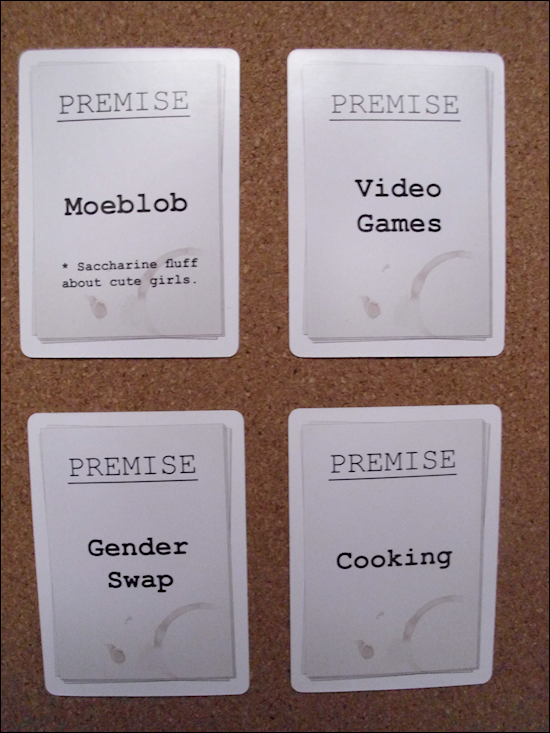
THE PREMISE:  Every player has a hand of 10 Title Cards.  Each turn, the current Producer takes 5 Premise Cards from the deck.  Premise cards are what structure what the theme of the anime will be, such as Aliens, Cooking, or Video Games.  Players will make an anime based on 2 Premise cards chosen by the Producer.


TITLE CARDS: Title Cards are what make up your hand.  Players make the title of their anime using up to 4 cards for that round, and are first played face-down.  Then, each player takes a few minutes to explain their title and plot in any order they wish.  Any simple articles (a, the, and) are free to use any time and do not count against you.

POINTS: Once all the Titles have been revealed and anime pitched, the Producer then picks the anime they liked, and points are distributed to the players.  Whoever has the most points by the time the game ends wins, generally so that every player has had the same amount of time to be Judge.


CONCLUSION: First off, if you nothing about or don't enjoy anime, then you may want to skip over this one for now.  This is a game about creativity, planning, social cues, and a little bit of improvising.  I said in my last review that games without much structure don't play well, but what I mean by that is if there is no obvious flow, the game grinds to a halt.  This game allows for relaxed, free flow playing, and adaptability in rules on a group-by-group basis.  I love story telling games like this, and I think it did well in its format.

AFTERTHOUGHTS: Could this work as a western focused theme of live action or animated series?  Absolutely, no question.  Video Games?  Considering a lot come from Japan, sure.  Movies?  Books? A bigger stretch, but yeah.  It ultimately works due to the structure of Eastern Animation titles, but I think it'd be neat if there were more games like this that were themed differently.

Wednesday, June 15, 2016

Okay, guys, who is it? (Are You The Traitor?)

The moment of truth is at hand.  You know the key must be destroyed, but who do you to trust to do the task?  Which wizard won't wield the wizardly wonder of the world?  And which will?  Perhaps the most important question is this: Are YOU the traitor?


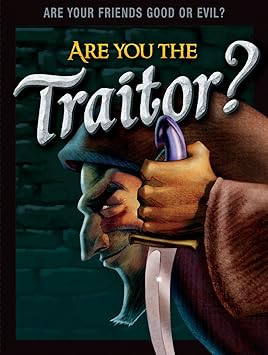
GAME DESCRIPTION: Are You the Traitor? is a social card game for 4-10 players.  Each round, every player is given a character card face-down.  Once obtained, the two wizards will reveal themselves, and both are given either a good wizard card or evil wizard card that they keep secret.

OPTIONAL REVEALS:  If you are playing with more than 5 players, then the Keyholder will reveal themselves to everyone but the wizards.  If you are playing with more than 7 players, all Traitors will reveal themselves to the other traitors.


TARGETS: Each player, outside of the Traitor, has a target they're looking for.  The Guard and Good Wizard are trying to find the Traitor, the Evil Wizard is looking for the Key Holder, and the Key Holder is looking for the Good Wizard.  When a player believes that they have the correct player, they call "Stop!" and make their accusation.

TREASURE: If a good player (Key Holder, Good Wizard, Guard) guesses correctly, everyone on that team gains a treasure card.  If they guess incorrectly, the Evil team (Traitor, Evil Wizard) will instead gain the treasure.  The reverse holds true for the Evil team.  Once a player is called, all cards are revealed, shuffled, and dealt again face-down.  Once a player gets to 10 Treasure points, they win.

CONCLUSION: First off, I'm bad at playing Are You the Traitor.  But honestly, I can't say I have ever truly enjoyed playing it based on its own merits.  It is one of the most open games I've ever played, but that seems to be to its detriment.  Without some kind of actual gameplay to keep conversation going, there's not a lot to talk about, and it either goes off the rails, or you become focused on giving clues to subtly reveal yourself.  The problem I found was that actually playing the game makes the conversation stilted.  I like the social aspect, but the games rules seem to prevent actual conversation.  I just can't recommend this one when there are better games in this style like Resistance and Secret Hitler.