Wednesday, June 8, 2016

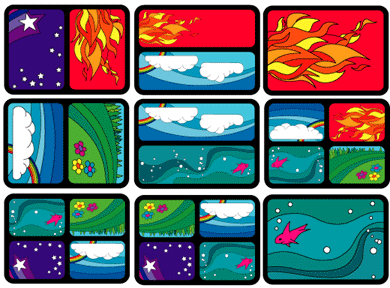
Connecting the Elements (Aquarius)

Groovy man, just let the feel of nature surround you.  feel the fire burn, smell the clean water, see the nice green grass grow.  And when all is calm, when the beauty of the world surrounds you, and all the pieces come together, you can truly discover peace into Aquarius.


GAME DESCRIPTION: Aquarius is 2-5 player card game, where the object is to complete a seven card link of a specific element.  Each turn, a player draws a card, and plays either an element that can link with another element already on the table, or an Action Card.

LINKING: In order to play an element, you must play it in a standard grid formation (long side touching long, short side touching short) and all sides touching another card must match one of the elements on that side.  You cannot move cards already in play, and all cards must line up perfectly/no skewed placement.


ACTION: There are various Action Cards you can play in place of an Element Card:

  • Trade Goals: You can swap goals with any player.
  • Rotate Goals: Every player passes their goal card to the next player in the order decided by the current player.
  • Shuffle Hands: Gather all the cards in every players hands, shuffle them and re-deal them evenly, starting with yourself.
  • Trade Hands: You can swap your hand with another players.
  • Zap A Card: Take any card on the board, and add it to your hand.  Your hand size increases from 3 to 4 until the next turn.
  • Move A Card: Take any card on the board, and move it to another legal spot.
WINNING: Each player has a secret goal card, known only to them.  The way to win is to complete your goal by legally matching 7 elements together that correspond with your goal card.

CONCLUSION: This is one of those games that feels quick and easy, but gets tricky due to luck and directly opposing strategies from other players.  It's not a long game, so it's easy to get a round or two in between long campaigns, or during a quick break or some down time.  In addition, the simplicity of the rules allows even youngsters to learn the game, with rule-sets added for simpler play.  Now, the version I played and reviewed was the 2nd edition, which changed a couple cards from the first edition.  Any differences in review or gameplay will be due to this.

Wednesday, June 1, 2016

In his house at R'yleh (Elder Sign)

Log #19: The natives no longer visit my place of residence. indeed, they now seem to fear and shun me.  Every attempt to get closer now results in nervous glancing, and hastily constructed excuses.  I believe that if it were to originate from a source, it would have been the day the man who delivered the obsidian statue and the letter, which states, ad verbatim:
"If you wish to know more, visit me near the sea at midnight in two days.
Ph'nglui mglw'nafh Cthulhu R'lyeh wgah'nagl fhtagn."
The line does not seemingly translate from any known language, but this may be a chance to discover the truth.  It may be the only chance left to me to discover the truth behind this cult, and the image left known as the "Elder Sign".


GAME DESCRIPTION:  Elder Sign is a 1-8 player game designed around the C'thulhu mythos published by Fantasy Flight Games.  Each player takes the role of an Investigator.  The object of the game is to seal away the current Ancient One away by travelling to various locations and gather Elder Signs.  Be warned, the longer you play, the more chance there is that the Ancient One will awaken and devour everyone.

INVESTIGATOR:  Each player will take a Investigator card and token. Each Investigator has a sanity and health meter off to the side of their portraits on their respective cards.  They can never go over their maximum number (barring specific circumstances), and if a player loses all their health or sanity, they are devoured.  The player returns all their items and trophies to the bottom of their respective decks, then take a new Investigator with the appropriate starting items, and add one Doom counter on the Doom Track.


ANCIENT ONE AND TIME:  At the start of the game, a random Ancient One card is drawn.  In the center is a number that determines the number of Elder Signs used to seal him away.  At the end of each Investigators turn, the clock advances three hours.  At Midnight, the player draws a Mythos card and resolves it.  Sometimes, the Mythos card will put Doom counters on the Ancient One's Doom Track.  Get enough Doom counters, and the Ancient One awakes.

ADVENTURE:  The majority of play takes place at one of these adventure cards.  Each card has a list of tasks you must complete, in any order or down the list.  In order to complete these tasks, you roll all available green dice, and try to match the symbols on 1 row at a time.  If you manage to match the symbols, you complete the task by placing all appropriate symbols in the row, and roll for the next task.
  • If you fail to roll appropriate symbols, you lose 1 die, and try again.  In this case, you may take a die, and 'focus' it by placing it on your character token.  If you lose too many dice to not longer be able to succeed, then you suffer the penalties, located in red at the bottom, and trigger any Terror effects.
  • If you finish all tasks, you take the card as a trophy, as well as all rewards, located in white at the bottom.

MONSTERS:  Every so often, a Monster will add or replace a current task with their own.  If you complete a Monster's task as well as the Adventure card, you gain it in addition as a trophy.

ENTRANCE:  If you don't feel like you can complete an adventure safely, you can instead choose to stay at the entrance to heal for free, or spend your collected trophies to buy health, spells, items, and even Elder Signs.

SPECIAL ITEMS:  There are three different types of item cards: Common, Unique, and Spells.  These have various effects from re-rolling, to adding the red and/or yellow die to your next adventures rolls, to locking a die until it needs to be used by any Investigator you share a room with.  Allies can also be gained with their own effects.  The Footprint, or Clue Token, can be spent to re-roll the dice if an Investigator failed to complete a task with no penalty.  An Investigator can keep spending Clue Tokens to re-roll.


BATTLE THE ANCIENT ONE:  If the Ancient One's Doom Track becomes full before their sealed away, then every current Investigator battles the now awake Ancient One.  At Midnight, the Ancient One attacks rather than a Mythos Card being drawn, and neither player assistance nor focusing may be used, but any items may.  Every time you meet the Ancient One's combat task, remove 1 Doom Counter.  If you no longer can, then your turn ends, and the clock advances.

THE END:  If any Investigator manages to gain Elder Signs equal to or greater the number needed to seal away the Ancient One, or all Doom counters are removed once the Ancient One is awake, then all Investigators, including the devoured ones, are victorious, and all human players win.  If all Investigators are devoured, then the Ancient One wins.


CONCLUSION:  I've played both this and the similar Arkham Horror, which was also reprinted by Fantasy Flight Games.  I liked the idea of Arhkam Horror, but the rules were shaky and hard to understand, the gameplay monotonous, and it felt unfair to a large group (which shows how confusing the rules were).  Elder Sign, I'm glad to admit, solved a lot of those problems.  It's rules are clear, and the turns are quick for a large box game.  The travelling is limited to going where you need to, as opposed to wandering.  It is a great introduction for players not used to "Big Box games", or games with a lot of rules and moving parts. If you're looking for a rich story-telling experience, and deep lore, there are other games.  But for a well-built Lovecraft themed adventure that plays well, even alone, then you might want to check this one out.  

AFTERTHOUGHTS:  Elder Sign can also be found on PC and Android under Elder Sign: Omens.  The game plays well there, and the hotseat function allows players to easily access their Investigator.  Certain rules have updated to take advantage of the digital layout, such as new locations and added difficulties.  Even so, it's almost a different experience, and I prefer the tactile feel and flow of conversation the physical copy has to offer.  On the flip side, it's cheaper to get it digitally, and plays smoother with less hassle.  Really, you can't go wrong getting both if you can afford it, or picking the one you'll most likely use otherwise.

Wednesday, May 25, 2016

Never the same way twice (Fluxx)

Here it is, the chance you've been waiting for.  The cards are set, and the goal is in your grasp.  One card left to play, and you can win it all!  But, what's this?!  NO, you chance at winning was here in an instant, and gone in a flash.  But that's the break, kid.  That's what happens when the game is in Fluxx.


GAME DESCRIPTION: Fluxx is a 2 to 6 player card game with one simple rule: draw 1 card, and play 1 card.  What makes this game so unique and bizarre is that fact that  the players can alter the rules and win conditions with their cards.  So what starts out as a simple play of 1 card and be as free or restrictive as the players choose.

CARD TYPES:  Fluxx has 4 types of cards:

  • Keepers: These green cards generally don't do a lot early game.  The standard rule is that you may have as many of these in front of you at any time
  • Goals: The Pink Goal cards create the current win condition.  The standard rule states that there can be only a goal at a time.  Goal cards generally require you to have a group of specific Keepers in front of you to win,
  • Actions:  The blue Actions cards are generally one use.  They can do anything from steal Keepers to trade hands to replay cards
  • New Rules: The cards with Yellow are New Rules, which are permanent changes to the game, unless another New Rule overwrites it.  Some of the New Rules include limiting hand or Keeper size, drawing or playing more cards, and more Goals in play.
ALTERNATE VERSIONS: Fluxx has had a lot of time to grow with various cards and new types to add to it.  Such versions include Pirate, Christmas, Zombie, and Space, and Licensed versions like Back to the Future and Monty Python.  Some of these changes include new card types like Creepers, the antithesis to Keepers by not letting you win if you have one in front of you.

CONCLUSION:  This deceptively simple game is interesting.  I enjoy playing it, but after a few rounds, it burns me out.  The biggest problem with it is its playtime.  Games can go crazy long if you have a lot of players who are determined to win.  Still, it's fast to learn, and easy to win/lose with the right/wrong draw of the deck.  With the game constanly changing, it's easy to have the game change up each time you play.

Thursday, May 19, 2016

From Door to Brain with Love (Loonacy)

Two images stare you down, two pictures that have little to do with each other.  Still, you hold out, hoping to find the match.  Every attempt to find one of their partners has been met with so much opposition, it's driving you mad.  No, you don't care how cute that dog is.  You wait, and wait, holding onto that last card, dog and chocolate.
This game is pure Loonacy.


GAME DESCRIPTION:  Loonacy is a fast paced card game designed by Looney Labs for 2 to 5 players.  The objective is to get rid of your hand faster than any other player by matching one of the two pictures to any of the piles.

PILES:  Depending on the number of players, a select number of piles are created, with one card drawn from the deck at the starting card of that particular pile.  The more players there are, the less piles you start with.

TURNS:  Everyone plays at the same time, with the goal to match a card from your hand onto the current card in that pile.  If no one can play a card, each player must draw one more card to their hand.  Play than continues until any player ends their hand.

CONCLUSION:  This game is quick, easy to learn, and doesn't restrict players with text or reading.  If you're looking for a fast paced, simple game to play, this is definitely one to consider.  If there was any weakness to it, it's that you are not really challenged by it outside of speed, and if you're noticeably slower than all your opponents, you're relying heavily on luck to make it.  Still, there is a forced balance with slower players in the form of luck.

AFTERTHOUGHTS:  It's hard not to just think "Hey, I could make this for cheaper."  And you may be right.  The simplicity of the rules comes the problem of not supporting the creators and all their hard work making their game.  But the way I see it, as long as you are willing to buy it, that might just be even more fun as well.  There are tons of ways to re-make and re-theme it to your personal desires, or match it to your groups tastes.  From sports logos to video game icons to anime characters, it's amazing how big the scope of this game truly is.